Prepubertal Children With Metabolically Healthy Obesity or Overweight Are More Active Than Their Metabolically Unhealthy Peers Irrespective of Weight Status: GENOBOX Study
Llorente-Cantarero, F. ; Leis, R. ; Rupérez, A. I. ; Anguita-Ruiz, A. ; Vázquez-Cobela, R. ; Flores-Rojas, K. ; González-Gil, E. M. ; Aguilera, C. M. ; Moreno, L. A. ; Gil-Campos, M. ; Bueno Lozano, G. (Universidad de Zaragoza)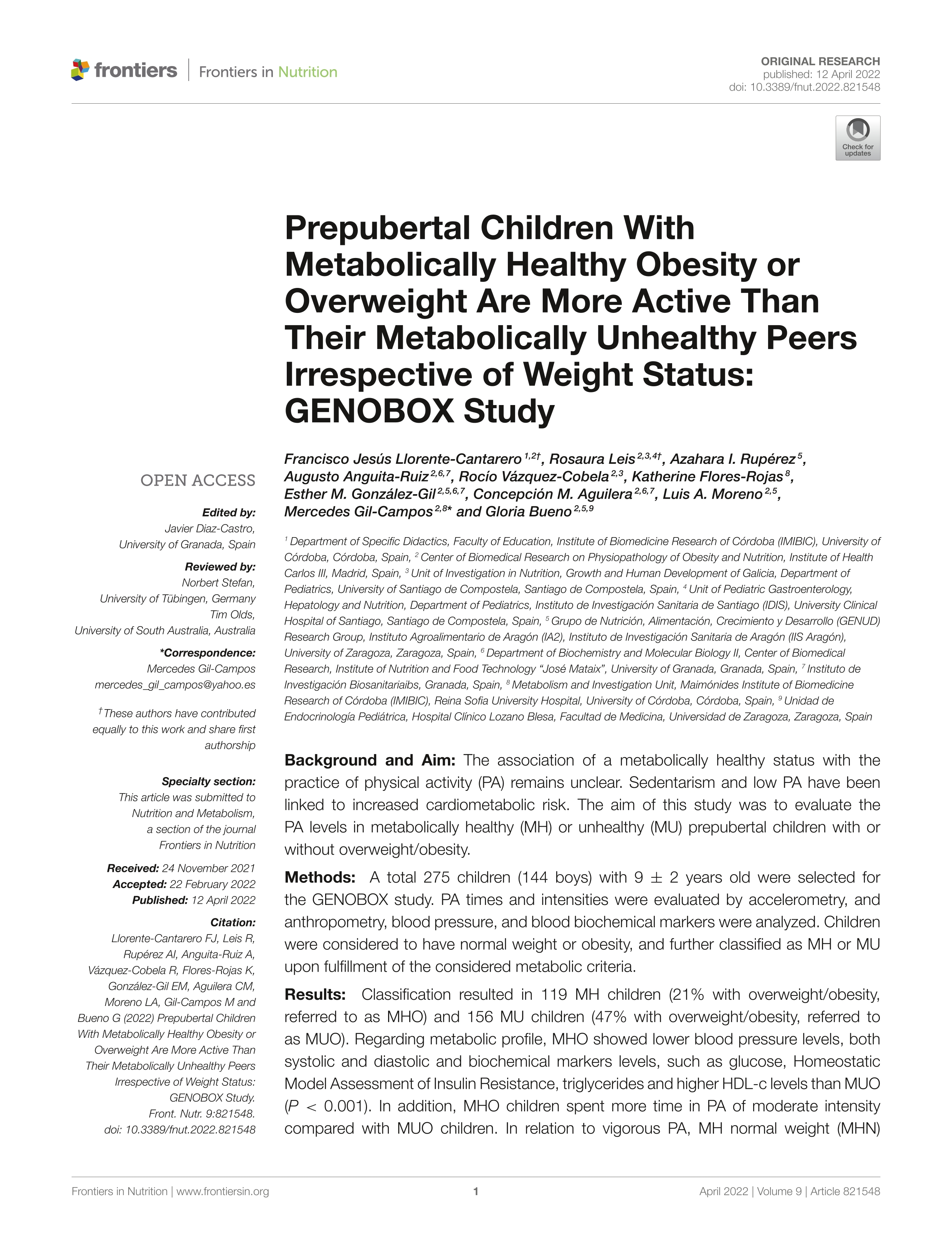
Resumen: Background and Aim: The association of a metabolically healthy status with the practice of physical activity (PA) remains unclear. Sedentarism and low PA have been linked to increased cardiometabolic risk. The aim of this study was to evaluate the PA levels in metabolically healthy (MH) or unhealthy (MU) prepubertal children with or without overweight/obesity. Methods: A total 275 children (144 boys) with 9 ± 2 years old were selected for the GENOBOX study. PA times and intensities were evaluated by accelerometry, and anthropometry, blood pressure, and blood biochemical markers were analyzed. Children were considered to have normal weight or obesity, and further classified as MH or MU upon fulfillment of the considered metabolic criteria. Results: Classification resulted in 119 MH children (21% with overweight/obesity, referred to as MHO) and 156 MU children (47% with overweight/obesity, referred to as MUO). Regarding metabolic profile, MHO showed lower blood pressure levels, both systolic and diastolic and biochemical markers levels, such as glucose, Homeostatic Model Assessment of Insulin Resistance, triglycerides and higher HDL-c levels than MUO (P < 0.001). In addition, MHO children spent more time in PA of moderate intensity compared with MUO children. In relation to vigorous PA, MH normal weight (MHN) children showed higher levels than MUO children. Considering sex, boys spent more time engaged in moderate, vigorous, and moderate–vigorous (MV) PA than girls, and the number of boys in the MH group was also higher. Conclusion: Prepubertal MHO children are less sedentary, more active, and have better metabolic profiles than their MUO peers. However, all children, especially girls, should increase their PA engagement, both in terms of time and intensity because PA appears to be beneficial for metabolic health status itself. Copyright © 2022 Llorente-Cantarero, Leis, Rupérez, Anguita-Ruiz, Vázquez-Cobela, Flores-Rojas, González-Gil, Aguilera, Moreno, Gil-Campos and Bueno.
Idioma: Inglés
DOI: 10.3389/fnut.2022.821548
Año: 2022
Publicado en: Frontiers in Nutrition 9 (2022), 821542 [9 pp]
ISSN: 2296-861X
Factor impacto JCR: 5.0 (2022)
Categ. JCR: NUTRITION & DIETETICS rank: 28 / 87 = 0.322 (2022) - Q2 - T1
Factor impacto CITESCORE: 3.5 - Agricultural and Biological Sciences (Q2) - Nursing (Q2) - Medicine (Q2)
Factor impacto SCIMAGO: 0.875 - Food Science (Q1) - Nutrition and Dietetics (Q2) - Endocrinology, Diabetes and Metabolism (Q2)
Financiación: info:eu-repo/grantAgreement/ES/ISCIII-FEDER/PI051968
Financiación: info:eu-repo/grantAgreement/ES/ISCIII-FEDER/PI11-02042
Financiación: info:eu-repo/grantAgreement/ES/ISCIII-FEDER/PI11-02059
Financiación: info:eu-repo/grantAgreement/ES/ISCIII-FEDER/PI16-00871
Financiación: info:eu-repo/grantAgreement/ES/ISCIII-FEDER/PI16-01205
Financiación: info:eu-repo/grantAgreement/ES/ISCIII-FEDER/PI16-01301
Financiación: info:eu-repo/grantAgreement/ES/ISCIII/i-PFIS-IFI17-00048
Financiación: info:eu-repo/grantAgreement/ES/MEC/FPU16-03653
Tipo y forma: Artículo (Versión definitiva)
Área (Departamento): Área Pediatría (Dpto. Microb.Ped.Radio.Sal.Pú.)
 Debe reconocer adecuadamente la autoría, proporcionar un enlace a la licencia e indicar si se han realizado cambios. Puede hacerlo de cualquier manera razonable, pero no de una manera que sugiera que tiene el apoyo del licenciador o lo recibe por el uso que hace.
Exportado de SIDERAL (2024-03-18-14:47:26)
Visitas y descargas
Idioma: Inglés
DOI: 10.3389/fnut.2022.821548
Año: 2022
Publicado en: Frontiers in Nutrition 9 (2022), 821542 [9 pp]
ISSN: 2296-861X
Factor impacto JCR: 5.0 (2022)
Categ. JCR: NUTRITION & DIETETICS rank: 28 / 87 = 0.322 (2022) - Q2 - T1
Factor impacto CITESCORE: 3.5 - Agricultural and Biological Sciences (Q2) - Nursing (Q2) - Medicine (Q2)
Factor impacto SCIMAGO: 0.875 - Food Science (Q1) - Nutrition and Dietetics (Q2) - Endocrinology, Diabetes and Metabolism (Q2)
Financiación: info:eu-repo/grantAgreement/ES/ISCIII-FEDER/PI051968
Financiación: info:eu-repo/grantAgreement/ES/ISCIII-FEDER/PI11-02042
Financiación: info:eu-repo/grantAgreement/ES/ISCIII-FEDER/PI11-02059
Financiación: info:eu-repo/grantAgreement/ES/ISCIII-FEDER/PI16-00871
Financiación: info:eu-repo/grantAgreement/ES/ISCIII-FEDER/PI16-01205
Financiación: info:eu-repo/grantAgreement/ES/ISCIII-FEDER/PI16-01301
Financiación: info:eu-repo/grantAgreement/ES/ISCIII/i-PFIS-IFI17-00048
Financiación: info:eu-repo/grantAgreement/ES/MEC/FPU16-03653
Tipo y forma: Artículo (Versión definitiva)
Área (Departamento): Área Pediatría (Dpto. Microb.Ped.Radio.Sal.Pú.)
Debe reconocer adecuadamente la autoría, proporcionar un enlace a la licencia e indicar si se han realizado cambios. Puede hacerlo de cualquier manera razonable, pero no de una manera que sugiera que tiene el apoyo del licenciador o lo recibe por el uso que hace. Exportado de SIDERAL (2024-03-18-14:47:26)
Enlace permanente:
Visitas y descargas
Este artículo se encuentra en las siguientes colecciones:
Artículos > Artículos por área > Pediatría
Registro creado el 2022-07-15, última modificación el 2024-03-19