Elucidating the mechanisms of action of antibiotic-like ionic gold and biogenic gold nanoparticles against bacteria
Paesa, Monica (Universidad de Zaragoza) ; Remirez de Ganuza, Cristina (Universidad de Zaragoza) ; Alejo, Teresa ; Yus, Cristina (Universidad de Zaragoza) ; Irusta, Silvia (Universidad de Zaragoza) ; Arruebo, Manuel (Universidad de Zaragoza) ; Sebastian, Víctor (Universidad de Zaragoza) ; Mendoza, Gracia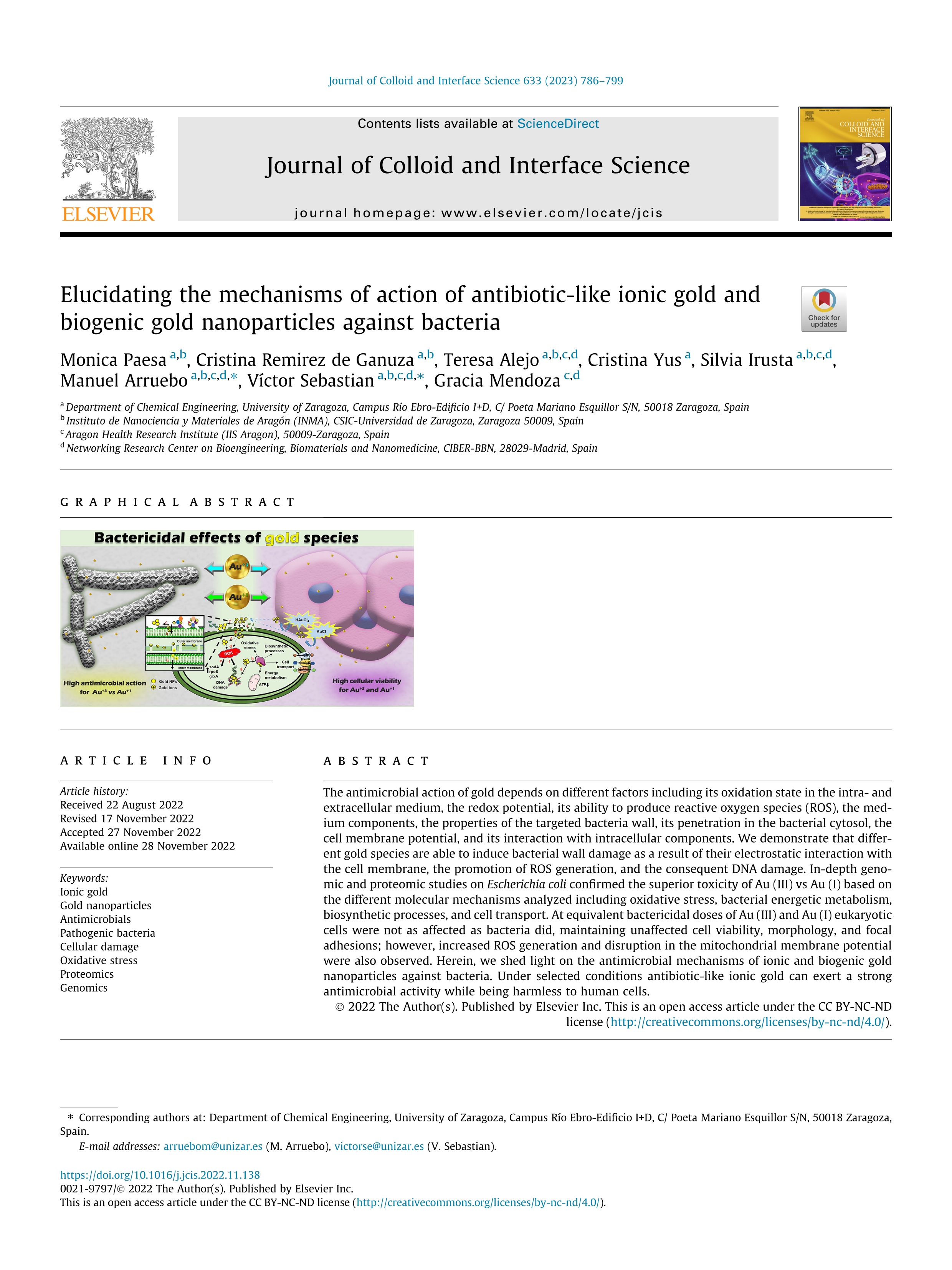
Resumen: The antimicrobial action of gold depends on different factors including its oxidation state in the intra- and extracellular medium, the redox potential, its ability to produce reactive oxygen species (ROS), the medium components, the properties of the targeted bacteria wall, its penetration in the bacterial cytosol, the cell membrane potential, and its interaction with intracellular components. We demonstrate that different gold species are able to induce bacterial wall damage as a result of their electrostatic interaction with the cell membrane, the promotion of ROS generation, and the consequent DNA damage. In-depth genomic and proteomic studies on Escherichia coli confirmed the superior toxicity of Au (III) vs Au (I) based on the different molecular mechanisms analyzed including oxidative stress, bacterial energetic metabolism, biosynthetic processes, and cell transport. At equivalent bactericidal doses of Au (III) and Au (I) eukaryotic cells were not as affected as bacteria did, maintaining unaffected cell viability, morphology, and focal adhesions; however, increased ROS generation and disruption in the mitochondrial membrane potential were also observed. Herein, we shed light on the antimicrobial mechanisms of ionic and biogenic gold nanoparticles against bacteria. Under selected conditions antibiotic-like ionic gold can exert a strong antimicrobial activity while being harmless to human cells.
Idioma: Inglés
DOI: 10.1016/j.jcis.2022.11.138
Año: 2023
Publicado en: Journal of Colloid and Interface Science 633 (2023), 786-799
ISSN: 0021-9797
Factor impacto JCR: 9.4 (2023)
Categ. JCR: CHEMISTRY, PHYSICAL rank: 32 / 178 = 0.18 (2023) - Q1 - T1
Factor impacto CITESCORE: 16.1 - Biomaterials (Q1) - Electronic, Optical and Magnetic Materials (Q1) - Colloid and Surface Chemistry (Q1) - Surfaces, Coatings and Films (Q1)
Factor impacto SCIMAGO: 1.76 - Biomaterials (Q1) - Surfaces, Coatings and Films (Q1) - Colloid and Surface Chemistry (Q1) - Electronic, Optical and Magnetic Materials (Q1)
Financiación: info:eu-repo/grantAgreement/ES/ISCIII/MS19-00092
Financiación: info:eu-repo/grantAgreement/ES/MICINN/CTQ2017-84473-R
Financiación: info:eu-repo/grantAgreement/ES/MICINN/PID2020-113987RB-I00
Financiación: info:eu-repo/grantAgreement/ES/MICINN/PID2021-127847OB-I00
Tipo y forma: Artículo (Versión definitiva)
Área (Departamento): Área Ingeniería Química (Dpto. Ing.Quím.Tecnol.Med.Amb.)
Área (Departamento): Área Tecnologi. Medio Ambiente (Dpto. Ing.Quím.Tecnol.Med.Amb.)
 Debe reconocer adecuadamente la autoría, proporcionar un enlace a la licencia e indicar si se han realizado cambios. Puede hacerlo de cualquier manera razonable, pero no de una manera que sugiera que tiene el apoyo del licenciador o lo recibe por el uso que hace. No puede utilizar el material para una finalidad comercial. Si remezcla, transforma o crea a partir del material, no puede difundir el material modificado.
Exportado de SIDERAL (2024-11-22-11:58:58)
Visitas y descargas
Idioma: Inglés
DOI: 10.1016/j.jcis.2022.11.138
Año: 2023
Publicado en: Journal of Colloid and Interface Science 633 (2023), 786-799
ISSN: 0021-9797
Factor impacto JCR: 9.4 (2023)
Categ. JCR: CHEMISTRY, PHYSICAL rank: 32 / 178 = 0.18 (2023) - Q1 - T1
Factor impacto CITESCORE: 16.1 - Biomaterials (Q1) - Electronic, Optical and Magnetic Materials (Q1) - Colloid and Surface Chemistry (Q1) - Surfaces, Coatings and Films (Q1)
Factor impacto SCIMAGO: 1.76 - Biomaterials (Q1) - Surfaces, Coatings and Films (Q1) - Colloid and Surface Chemistry (Q1) - Electronic, Optical and Magnetic Materials (Q1)
Financiación: info:eu-repo/grantAgreement/ES/ISCIII/MS19-00092
Financiación: info:eu-repo/grantAgreement/ES/MICINN/CTQ2017-84473-R
Financiación: info:eu-repo/grantAgreement/ES/MICINN/PID2020-113987RB-I00
Financiación: info:eu-repo/grantAgreement/ES/MICINN/PID2021-127847OB-I00
Tipo y forma: Artículo (Versión definitiva)
Área (Departamento): Área Ingeniería Química (Dpto. Ing.Quím.Tecnol.Med.Amb.)
Área (Departamento): Área Tecnologi. Medio Ambiente (Dpto. Ing.Quím.Tecnol.Med.Amb.)
Debe reconocer adecuadamente la autoría, proporcionar un enlace a la licencia e indicar si se han realizado cambios. Puede hacerlo de cualquier manera razonable, pero no de una manera que sugiera que tiene el apoyo del licenciador o lo recibe por el uso que hace. No puede utilizar el material para una finalidad comercial. Si remezcla, transforma o crea a partir del material, no puede difundir el material modificado.Exportado de SIDERAL (2024-11-22-11:58:58)
Enlace permanente:
Visitas y descargas
Este artículo se encuentra en las siguientes colecciones:
Artículos > Artículos por área > Tecnologías del Medio Ambiente
Artículos > Artículos por área > Ingeniería Química
Registro creado el 2023-02-24, última modificación el 2024-11-25