Effects of eHealth interventions on stress reduction and mental health promotion in healthcare professionals: a systematic review
López-Del-Hoyo, Yolanda (Universidad de Zaragoza) ; Fernández-Martínez, Selene ; Pérez-Aranda, Adrián ; Barceló-Soler, Alberto (Universidad de Zaragoza) ; Bani, Marco ; Russo, Selena ; Urcola-Pardo, Fernando (Universidad de Zaragoza) ; Strepparava, Maria Grazia ; García-Campayo, Javier (Universidad de Zaragoza)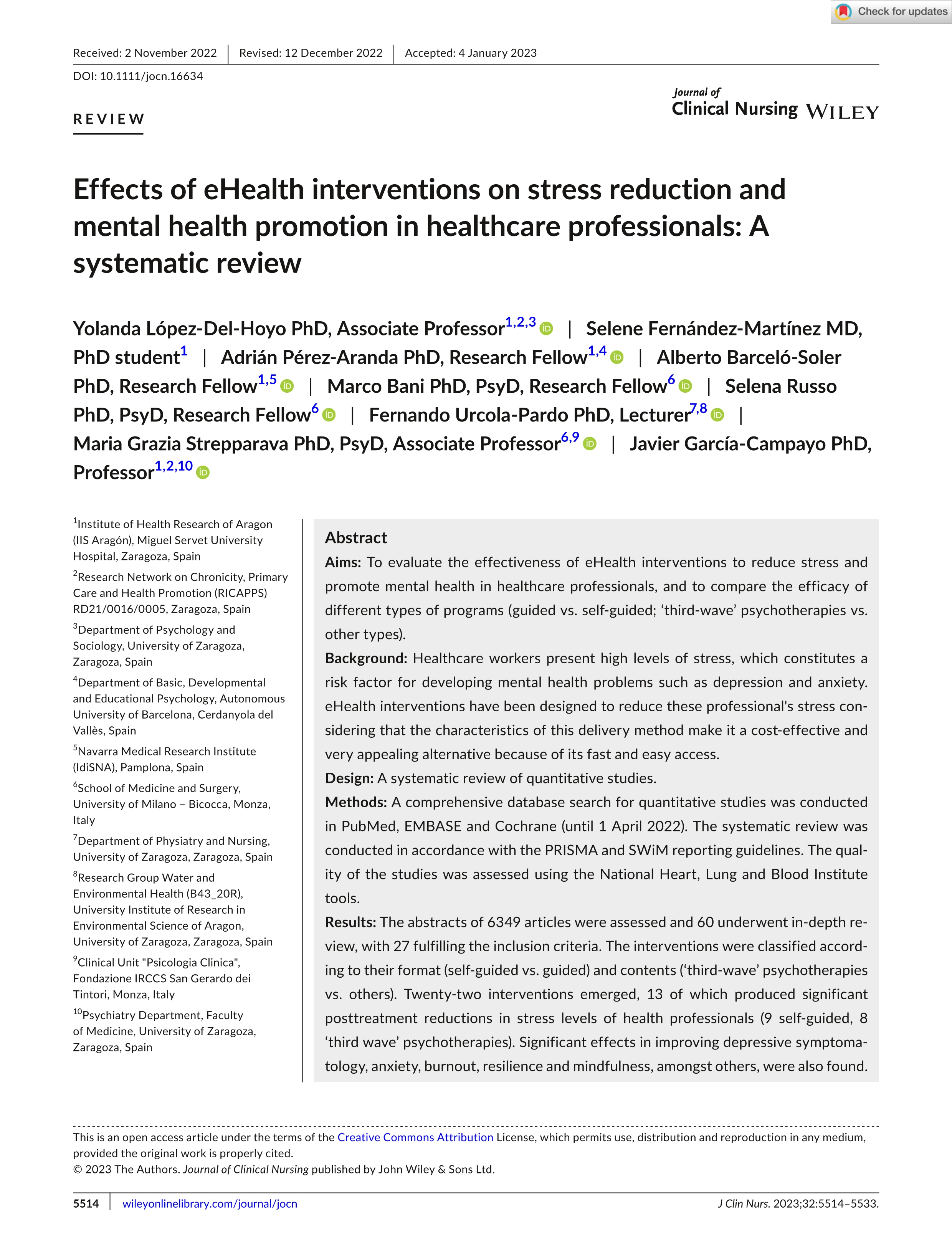
Resumen: Aims: To evaluate the effectiveness of eHealth interventions to reduce stress and promote mental health in healthcare professionals, and to compare the efficacy of different types of programs (guided vs. self-guided; ‘third-wave’ psychotherapies vs. other types). Background: Healthcare workers present high levels of stress, which constitutes a risk factor for developing mental health problems such as depression and anxiety. eHealth interventions have been designed to reduce these professional's stress considering that the characteristics of this delivery method make it a cost-effective and very appealing alternative because of its fast and easy access. Design: A systematic review of quantitative studies. Methods: A comprehensive database search for quantitative studies was conducted in PubMed, EMBASE and Cochrane (until 1 April 2022). The systematic review was conducted in accordance with the PRISMA and SWiM reporting guidelines. The quality of the studies was assessed using the National Heart, Lung and Blood Institute tools. Results: The abstracts of 6349 articles were assessed and 60 underwent in-depth review, with 27 fulfilling the inclusion criteria. The interventions were classified according to their format (self-guided vs. guided) and contents (‘third-wave’ psychotherapies vs. others). Twenty-two interventions emerged, 13 of which produced significant posttreatment reductions in stress levels of health professionals (9 self-guided, 8 ‘third wave’ psychotherapies). Significant effects in improving depressive symptomatology, anxiety, burnout, resilience and mindfulness, amongst others, were also found. Conclusion: The evidence gathered in this review highlights the heterogeneity of the eHealth interventions that have been studied; self-guided and ‘third-wave’ psychotherapy programs are the most common, often with promising results, although the methodological shortcomings of most studies hinder the extraction of sound conclusions.
Idioma: Inglés
DOI: 10.1111/jocn.16634
Año: 2023
Publicado en: JOURNAL OF CLINICAL NURSING 32, 17-18 (2023), 5514-5533
ISSN: 0962-1067
Factor impacto JCR: 3.2 (2023)
Categ. JCR: NURSING rank: 14 / 193 = 0.073 (2023) - Q1 - T1
Categ. JCR: NURSING rank: 14 / 193 = 0.073 (2023) - Q1 - T1
Factor impacto CITESCORE: 6.4 - Nursing (all) (Q1)
Factor impacto SCIMAGO: 1.235 - Nursing (miscellaneous) (Q1) - Medicine (miscellaneous) (Q1)
Financiación: info:eu-repo/grantAgreement/ES/DGA-FEDER/B43-20R
Financiación: info:eu-repo/grantAgreement/ES/ISCIII/CD20-00181
Financiación: info:eu-repo/grantAgreement/ES/ISCIII-RICAPPS/RD21-0016-0005
Tipo y forma: Review (Published version)
Área (Departamento): Área Enfermería (Dpto. Fisiatría y Enfermería)
Área (Departamento): Área Psicología Básica (Dpto. Psicología y Sociología)
Área (Departamento): Area Psiquiatría (Dpto. Medicina, Psiqu. y Derm.)
Área (Departamento): Área Psicolog.Evolut.Educac (Dpto. Psicología y Sociología)
Exportado de SIDERAL (2025-11-13-15:00:45)
Visitas y descargas
Idioma: Inglés
DOI: 10.1111/jocn.16634
Año: 2023
Publicado en: JOURNAL OF CLINICAL NURSING 32, 17-18 (2023), 5514-5533
ISSN: 0962-1067
Factor impacto JCR: 3.2 (2023)
Categ. JCR: NURSING rank: 14 / 193 = 0.073 (2023) - Q1 - T1
Categ. JCR: NURSING rank: 14 / 193 = 0.073 (2023) - Q1 - T1
Factor impacto CITESCORE: 6.4 - Nursing (all) (Q1)
Factor impacto SCIMAGO: 1.235 - Nursing (miscellaneous) (Q1) - Medicine (miscellaneous) (Q1)
Financiación: info:eu-repo/grantAgreement/ES/DGA-FEDER/B43-20R
Financiación: info:eu-repo/grantAgreement/ES/ISCIII/CD20-00181
Financiación: info:eu-repo/grantAgreement/ES/ISCIII-RICAPPS/RD21-0016-0005
Tipo y forma: Review (Published version)
Área (Departamento): Área Enfermería (Dpto. Fisiatría y Enfermería)
Área (Departamento): Área Psicología Básica (Dpto. Psicología y Sociología)
Área (Departamento): Area Psiquiatría (Dpto. Medicina, Psiqu. y Derm.)
Área (Departamento): Área Psicolog.Evolut.Educac (Dpto. Psicología y Sociología)
Exportado de SIDERAL (2025-11-13-15:00:45)
Permalink:
Visitas y descargas
Este artículo se encuentra en las siguientes colecciones:
articulos > articulos-por-area > psicologia_evolutiva_y_de_la_educacion
articulos > articulos-por-area > psicologia_basica
articulos > articulos-por-area > psiquiatria
articulos > articulos-por-area > enfermeria
Notice créée le 2023-04-20, modifiée le 2025-11-13