Cognitive stimulation and psychosocial results in older adults: A systematic review and meta-analysis
Gómez-Soria, Isabel (Universidad de Zaragoza) ; Iguacel, Isabel (Universidad de Zaragoza) ; Cuenca-Zaldívar, Juan Nicolás ; Aguilar-Latorre, Alejandra (Universidad de Zaragoza) ; Peralta-Marrupe, Patricia (Universidad de Zaragoza) ; Latorre, Eva (Universidad de Zaragoza) ; Calatayud, Estela (Universidad de Zaragoza)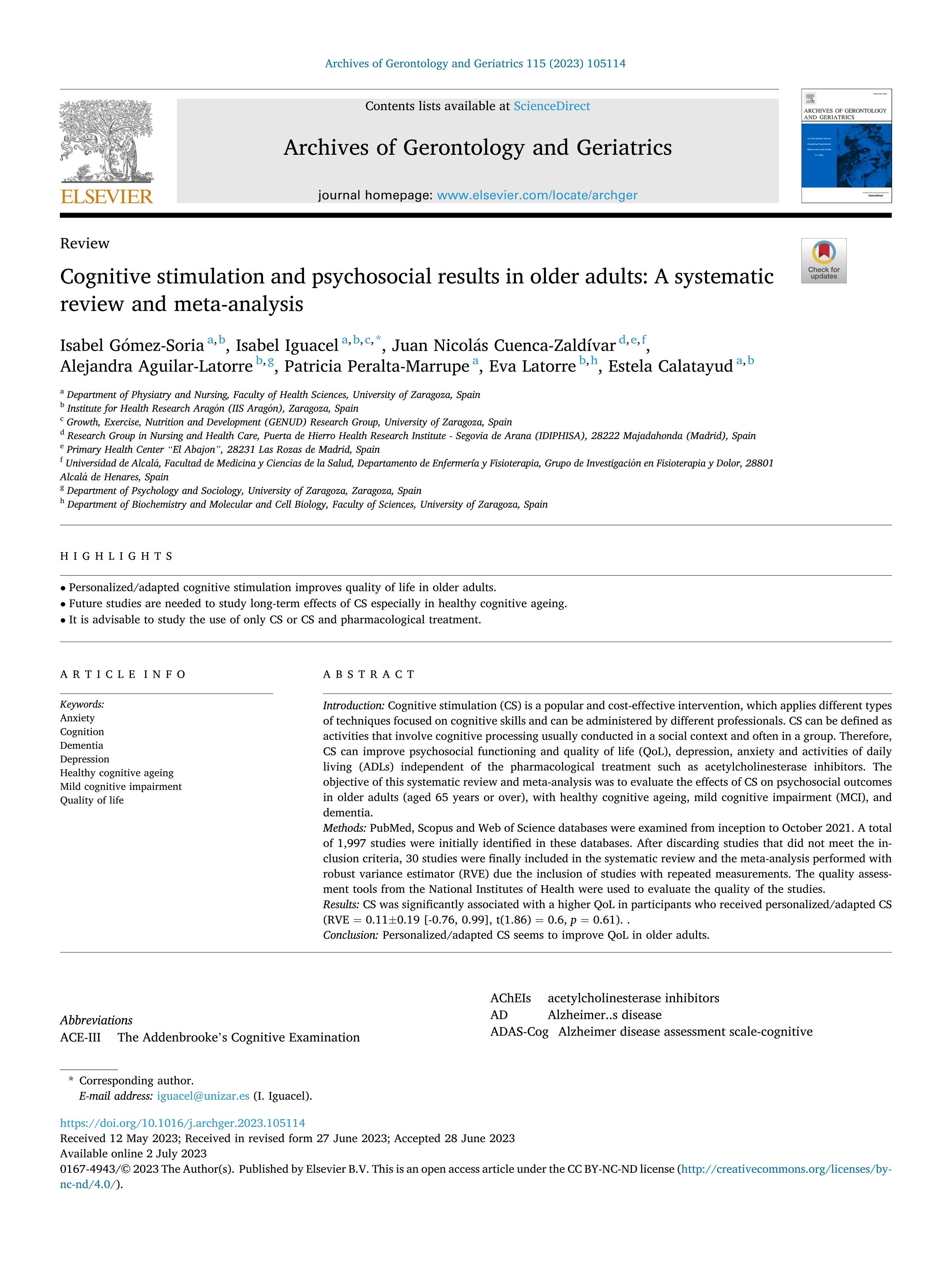
Resumen: Introduction
Cognitive stimulation (CS) is a popular and cost-effective intervention, which applies different types of techniques focused on cognitive skills and can be administered by different professionals. CS can be defined as activities that involve cognitive processing usually conducted in a social context and often in a group. Therefore, CS can improve psychosocial functioning and quality of life (QoL), depression, anxiety and activities of daily living (ADLs) independent of the pharmacological treatment such as acetylcholinesterase inhibitors. The objective of this systematic review and meta-analysis was to evaluate the effects of CS on psychosocial outcomes in older adults (aged 65 years or over), with healthy cognitive ageing, mild cognitive impairment (MCI), and dementia.
Methods
PubMed, Scopus and Web of Science databases were examined from inception to October 2021. A total of 1,997 studies were initially identified in these databases. After discarding studies that did not meet the inclusion criteria, 30 studies were finally included in the systematic review and the meta-analysis performed with robust variance estimator (RVE) due the inclusion of studies with repeated measurements. The quality assessment tools from the National Institutes of Health were used to evaluate the quality of the studies.
Results
CS was significantly associated with a higher QoL in participants who received personalized/adapted CS (RVE = 0.11±0.19 [-0.76, 0.99], t(1.86) = 0.6, p = 0.61). .
Conclusion
Personalized/adapted CS seems to improve QoL in older adults.
Idioma: Inglés
DOI: 10.1016/j.archger.2023.105114
Año: 2023
Publicado en: ARCHIVES OF GERONTOLOGY AND GERIATRICS 115 (2023), 105114 [18 pp.]
ISSN: 0167-4943
Factor impacto JCR: 3.5 (2023)
Categ. JCR: GERIATRICS & GERONTOLOGY rank: 29 / 74 = 0.392 (2023) - Q2 - T2
Factor impacto CITESCORE: 7.3 - Geriatrics and Gerontology (Q1) - Gerontology (Q1) - Health (social science) (Q1) - Aging (Q2)
Factor impacto SCIMAGO: 1.054 - Gerontology (Q1) - Health (social science) (Q1) - Aging (Q2) - Geriatrics and Gerontology (Q2)
Tipo y forma: Article (Published version)
Área (Departamento): Área Enfermería (Dpto. Fisiatría y Enfermería)
Área (Departamento): Área Fisioterapia (Dpto. Fisiatría y Enfermería)
Área (Departamento): Área Psicolog.Evolut.Educac (Dpto. Psicología y Sociología)
Área (Departamento): Área Biología Celular (Dpto. Bioq.Biolog.Mol. Celular)
Exportado de SIDERAL (2024-11-22-12:10:32)
Visitas y descargas
Cognitive stimulation (CS) is a popular and cost-effective intervention, which applies different types of techniques focused on cognitive skills and can be administered by different professionals. CS can be defined as activities that involve cognitive processing usually conducted in a social context and often in a group. Therefore, CS can improve psychosocial functioning and quality of life (QoL), depression, anxiety and activities of daily living (ADLs) independent of the pharmacological treatment such as acetylcholinesterase inhibitors. The objective of this systematic review and meta-analysis was to evaluate the effects of CS on psychosocial outcomes in older adults (aged 65 years or over), with healthy cognitive ageing, mild cognitive impairment (MCI), and dementia.
Methods
PubMed, Scopus and Web of Science databases were examined from inception to October 2021. A total of 1,997 studies were initially identified in these databases. After discarding studies that did not meet the inclusion criteria, 30 studies were finally included in the systematic review and the meta-analysis performed with robust variance estimator (RVE) due the inclusion of studies with repeated measurements. The quality assessment tools from the National Institutes of Health were used to evaluate the quality of the studies.
Results
CS was significantly associated with a higher QoL in participants who received personalized/adapted CS (RVE = 0.11±0.19 [-0.76, 0.99], t(1.86) = 0.6, p = 0.61). .
Conclusion
Personalized/adapted CS seems to improve QoL in older adults.
Idioma: Inglés
DOI: 10.1016/j.archger.2023.105114
Año: 2023
Publicado en: ARCHIVES OF GERONTOLOGY AND GERIATRICS 115 (2023), 105114 [18 pp.]
ISSN: 0167-4943
Factor impacto JCR: 3.5 (2023)
Categ. JCR: GERIATRICS & GERONTOLOGY rank: 29 / 74 = 0.392 (2023) - Q2 - T2
Factor impacto CITESCORE: 7.3 - Geriatrics and Gerontology (Q1) - Gerontology (Q1) - Health (social science) (Q1) - Aging (Q2)
Factor impacto SCIMAGO: 1.054 - Gerontology (Q1) - Health (social science) (Q1) - Aging (Q2) - Geriatrics and Gerontology (Q2)
Tipo y forma: Article (Published version)
Área (Departamento): Área Enfermería (Dpto. Fisiatría y Enfermería)
Área (Departamento): Área Fisioterapia (Dpto. Fisiatría y Enfermería)
Área (Departamento): Área Psicolog.Evolut.Educac (Dpto. Psicología y Sociología)
Área (Departamento): Área Biología Celular (Dpto. Bioq.Biolog.Mol. Celular)
Exportado de SIDERAL (2024-11-22-12:10:32)
Permalink:
Visitas y descargas
Este artículo se encuentra en las siguientes colecciones:
articulos > articulos-por-area > psicologia_evolutiva_y_de_la_educacion
articulos > articulos-por-area > biologia_celular
articulos > articulos-por-area > fisioterapia
articulos > articulos-por-area > enfermeria
Notice créée le 2023-09-11, modifiée le 2024-11-25