Cardiometabolic risk profile among children with migrant parents and role of parental education: the IDEFICS/I.Family cohort
Lindblad, Anna ; Samkange-Zeeb, Florence ; de Henauw, Stefaan ; Solea, Antonia ; Veidebaum, Toomas ; Lauria, Fabio ; Moreno, Luis A. (Universidad de Zaragoza) ; Iguacel, Isabel (Universidad de Zaragoza) ; Molnár, Dénes ; Ahrens, Wolfgang ; Winkler, Volker ; Lissner, Lauren ; Mehlig, Kirsten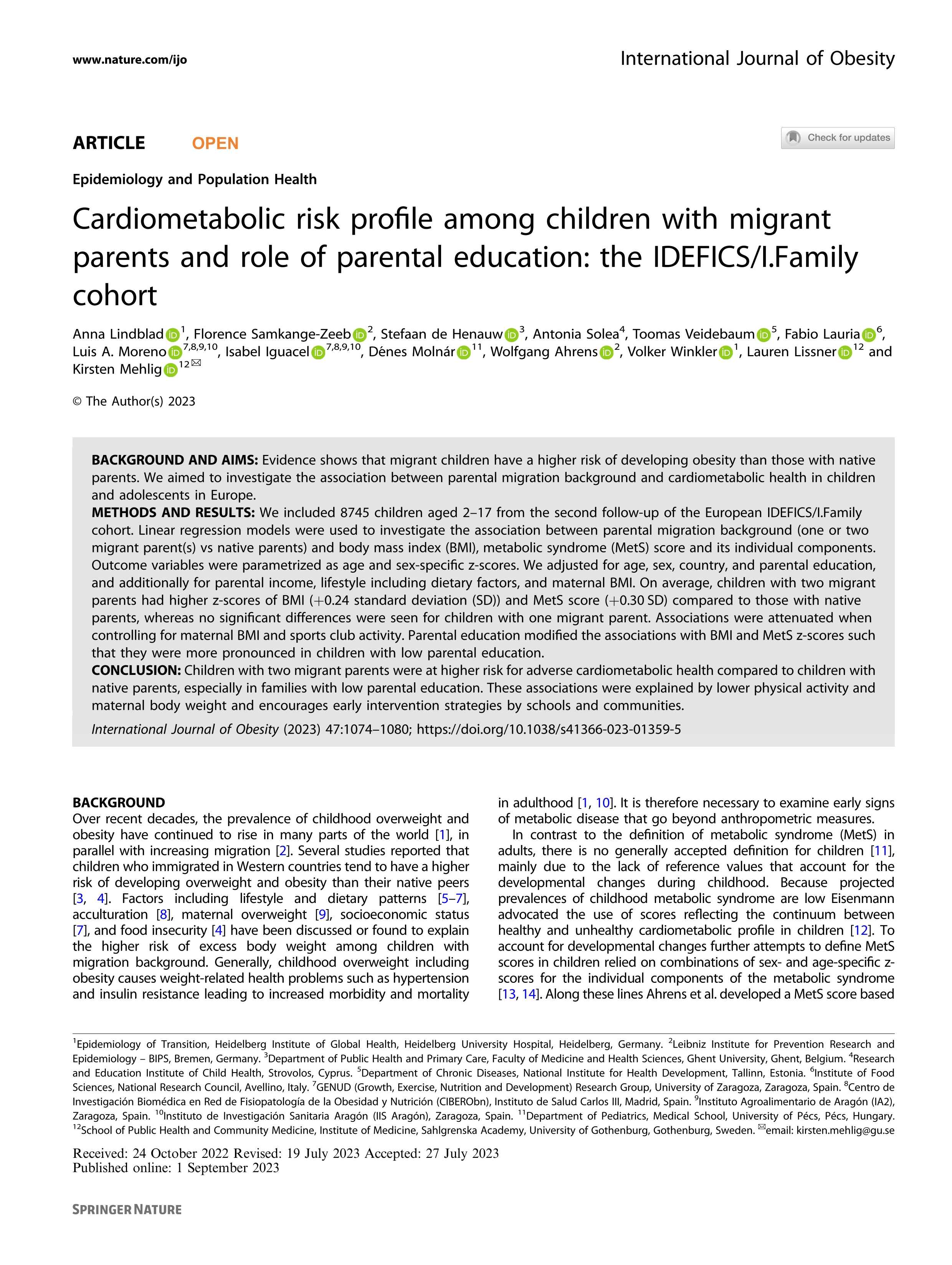


Resumen: Background and aims
Evidence shows that migrant children have a higher risk of developing obesity than those with native parents. We aimed to investigate the association between parental migration background and cardiometabolic health in children and adolescents in Europe.
Methods and results
We included 8745 children aged 2–17 from the second follow-up of the European IDEFICS/I.Family cohort. Linear regression models were used to investigate the association between parental migration background (one or two migrant parent(s) vs native parents) and body mass index (BMI), metabolic syndrome (MetS) score and its individual components. Outcome variables were parametrized as age and sex-specific z-scores. We adjusted for age, sex, country, and parental education, and additionally for parental income, lifestyle including dietary factors, and maternal BMI. On average, children with two migrant parents had higher z-scores of BMI (+0.24 standard deviation (SD)) and MetS score (+0.30 SD) compared to those with native parents, whereas no significant differences were seen for children with one migrant parent. Associations were attenuated when controlling for maternal BMI and sports club activity. Parental education modified the associations with BMI and MetS z-scores such that they were more pronounced in children with low parental education.
Conclusion
Children with two migrant parents were at higher risk for adverse cardiometabolic health compared to children with native parents, especially in families with low parental education. These associations were explained by lower physical activity and maternal body weight and encourages early intervention strategies by schools and communities.
Idioma: Inglés
DOI: 10.1038/s41366-023-01359-5
Año: 2023
Publicado en: INTERNATIONAL JOURNAL OF OBESITY 47, 11 (2023), 1074-1080
ISSN: 0307-0565
Factor impacto JCR: 4.2 (2023)
Categ. JCR: NUTRITION & DIETETICS rank: 27 / 114 = 0.237 (2023) - Q1 - T1
Categ. JCR: ENDOCRINOLOGY & METABOLISM rank: 40 / 186 = 0.215 (2023) - Q1 - T1
Factor impacto CITESCORE: 10.0 - Endocrinology, Diabetes and Metabolism (Q1) - Nutrition and Dietetics (Q1) - Medicine (miscellaneous) (Q1)
Factor impacto SCIMAGO: 1.504 - Endocrinology, Diabetes and Metabolism (Q1) - Nutrition and Dietetics (Q1) - Medicine (miscellaneous) (Q1)
Financiación: info:eu-repo/grantAgreement/EUR/FP6/FOOD-016181
Financiación: info:eu-repo/grantAgreement/EC/FP7/266044/EU/Determinants of eating behaviour in European children, adolescents and their parents/I.FAMILY
Tipo y forma: Article (Published version)
Área (Departamento): Área Enfermería (Dpto. Fisiatría y Enfermería)
Exportado de SIDERAL (2024-11-22-12:04:16)
Visitas y descargas
Evidence shows that migrant children have a higher risk of developing obesity than those with native parents. We aimed to investigate the association between parental migration background and cardiometabolic health in children and adolescents in Europe.
Methods and results
We included 8745 children aged 2–17 from the second follow-up of the European IDEFICS/I.Family cohort. Linear regression models were used to investigate the association between parental migration background (one or two migrant parent(s) vs native parents) and body mass index (BMI), metabolic syndrome (MetS) score and its individual components. Outcome variables were parametrized as age and sex-specific z-scores. We adjusted for age, sex, country, and parental education, and additionally for parental income, lifestyle including dietary factors, and maternal BMI. On average, children with two migrant parents had higher z-scores of BMI (+0.24 standard deviation (SD)) and MetS score (+0.30 SD) compared to those with native parents, whereas no significant differences were seen for children with one migrant parent. Associations were attenuated when controlling for maternal BMI and sports club activity. Parental education modified the associations with BMI and MetS z-scores such that they were more pronounced in children with low parental education.
Conclusion
Children with two migrant parents were at higher risk for adverse cardiometabolic health compared to children with native parents, especially in families with low parental education. These associations were explained by lower physical activity and maternal body weight and encourages early intervention strategies by schools and communities.
Idioma: Inglés
DOI: 10.1038/s41366-023-01359-5
Año: 2023
Publicado en: INTERNATIONAL JOURNAL OF OBESITY 47, 11 (2023), 1074-1080
ISSN: 0307-0565
Factor impacto JCR: 4.2 (2023)
Categ. JCR: NUTRITION & DIETETICS rank: 27 / 114 = 0.237 (2023) - Q1 - T1
Categ. JCR: ENDOCRINOLOGY & METABOLISM rank: 40 / 186 = 0.215 (2023) - Q1 - T1
Factor impacto CITESCORE: 10.0 - Endocrinology, Diabetes and Metabolism (Q1) - Nutrition and Dietetics (Q1) - Medicine (miscellaneous) (Q1)
Factor impacto SCIMAGO: 1.504 - Endocrinology, Diabetes and Metabolism (Q1) - Nutrition and Dietetics (Q1) - Medicine (miscellaneous) (Q1)
Financiación: info:eu-repo/grantAgreement/EUR/FP6/FOOD-016181
Financiación: info:eu-repo/grantAgreement/EC/FP7/266044/EU/Determinants of eating behaviour in European children, adolescents and their parents/I.FAMILY
Tipo y forma: Article (Published version)
Área (Departamento): Área Enfermería (Dpto. Fisiatría y Enfermería)
Exportado de SIDERAL (2024-11-22-12:04:16)
Permalink:
Visitas y descargas
Este artículo se encuentra en las siguientes colecciones:
articulos > articulos-por-area > enfermeria
Notice créée le 2023-11-16, modifiée le 2024-11-25