miR482f and miR482c-5p from edible plant-derived foods inhibit the expression of pro-inflammatory genes in human THP-1 macrophages
Díez-Sainz, Ester ; Lorente-Cebrián, Silvia (Universidad de Zaragoza) ; Aranaz, Paula ; Amri, Ez-Zoubir ; Riezu-Boj, José I. ; Milagro, Fermín I.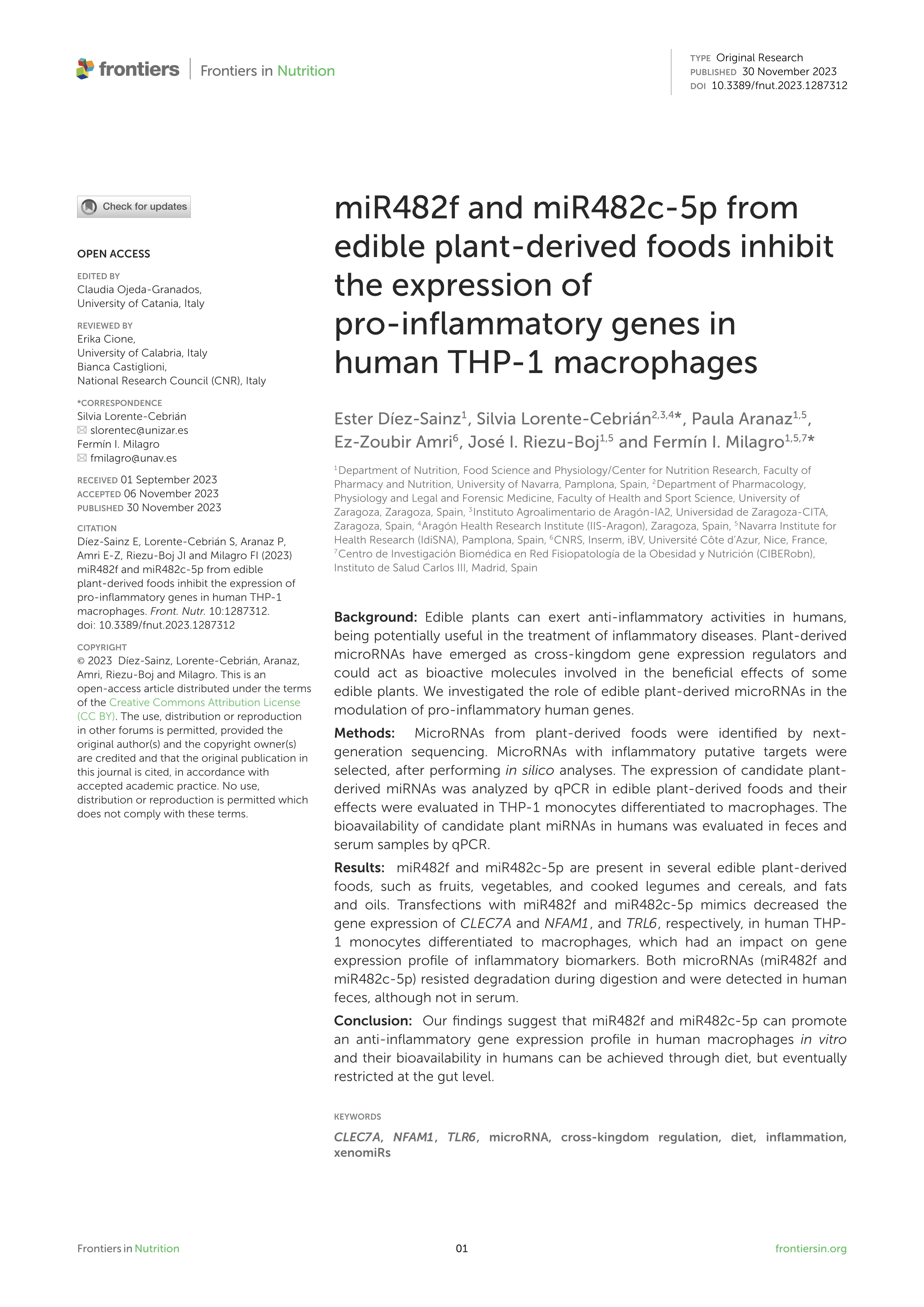
Resumen: Edible plants can exert anti-inflammatory activities in humans, being potentially useful in the treatment of inflammatory diseases. Plant-derived microRNAs have emerged as cross-kingdom gene expression regulators and could act as bioactive molecules involved in the beneficial effects of some edible plants. We investigated the role of edible plant-derived microRNAs in the modulation of pro-inflammatory human genes.MethodsMicroRNAs from plant-derived foods were identified by next-generation sequencing. MicroRNAs with inflammatory putative targets were selected, after performing in silico analyses. The expression of candidate plant-derived miRNAs was analyzed by qPCR in edible plant-derived foods and their effects were evaluated in THP-1 monocytes differentiated to macrophages. The bioavailability of candidate plant miRNAs in humans was evaluated in feces and serum samples by qPCR.ResultsmiR482f and miR482c-5p are present in several edible plant-derived foods, such as fruits, vegetables, and cooked legumes and cereals, and fats and oils. Transfections with miR482f and miR482c-5p mimics decreased the gene expression of CLEC7A and NFAM1, and TRL6, respectively, in human THP-1 monocytes differentiated to macrophages, which had an impact on gene expression profile of inflammatory biomarkers. Both microRNAs (miR482f and miR482c-5p) resisted degradation during digestion and were detected in human feces, although not in serum.ConclusionOur findings suggest that miR482f and miR482c-5p can promote an anti-inflammatory gene expression profile in human macrophages in vitro and their bioavailability in humans can be achieved through diet, but eventually restricted at the gut level.
Idioma: Inglés
DOI: 10.3389/fnut.2023.1287312
Año: 2023
Publicado en: Frontiers in Nutrition 10 (2023), 1287312 [15 pp.]
ISSN: 2296-861X
Factor impacto JCR: 4.0 (2023)
Categ. JCR: NUTRITION & DIETETICS rank: 31 / 114 = 0.272 (2023) - Q2 - T1
Factor impacto CITESCORE: 5.2 - Endocrinology, Diabetes and Metabolism (Q2) - Food Science (Q2) - Nutrition and Dietetics (Q2)
Factor impacto SCIMAGO: 0.828 - Food Science (Q1) - Nutrition and Dietetics (Q2) - Endocrinology, Diabetes and Metabolism (Q2)
Financiación: info:eu-repo/grantAgreement/ES/ISCIII/CB12-03-30002
Financiación: info:eu-repo/grantAgreement/ES/MINECO-FEDER/BFU2015-65937-R
Financiación: info:eu-repo/grantAgreement/ES/MINECO/PID2022-141766OB-I00
Financiación: info:eu-repo/grantAgreement/ES/MINECO/RTI2018-102205-B-I00
Tipo y forma: Article (Published version)
Área (Departamento): Área Fisiología (Dpto. Farmac.Fisiol.y Med.L.F.)
 You must give appropriate credit, provide a link to the license, and indicate if changes were made. You may do so in any reasonable manner, but not in any way that suggests the licensor endorses you or your use.
Exportado de SIDERAL (2024-11-22-11:59:45)
Visitas y descargas
Idioma: Inglés
DOI: 10.3389/fnut.2023.1287312
Año: 2023
Publicado en: Frontiers in Nutrition 10 (2023), 1287312 [15 pp.]
ISSN: 2296-861X
Factor impacto JCR: 4.0 (2023)
Categ. JCR: NUTRITION & DIETETICS rank: 31 / 114 = 0.272 (2023) - Q2 - T1
Factor impacto CITESCORE: 5.2 - Endocrinology, Diabetes and Metabolism (Q2) - Food Science (Q2) - Nutrition and Dietetics (Q2)
Factor impacto SCIMAGO: 0.828 - Food Science (Q1) - Nutrition and Dietetics (Q2) - Endocrinology, Diabetes and Metabolism (Q2)
Financiación: info:eu-repo/grantAgreement/ES/ISCIII/CB12-03-30002
Financiación: info:eu-repo/grantAgreement/ES/MINECO-FEDER/BFU2015-65937-R
Financiación: info:eu-repo/grantAgreement/ES/MINECO/PID2022-141766OB-I00
Financiación: info:eu-repo/grantAgreement/ES/MINECO/RTI2018-102205-B-I00
Tipo y forma: Article (Published version)
Área (Departamento): Área Fisiología (Dpto. Farmac.Fisiol.y Med.L.F.)
You must give appropriate credit, provide a link to the license, and indicate if changes were made. You may do so in any reasonable manner, but not in any way that suggests the licensor endorses you or your use. Exportado de SIDERAL (2024-11-22-11:59:45)
Permalink:
Visitas y descargas
Este artículo se encuentra en las siguientes colecciones:
Articles > Artículos por área > Fisiología
Record created 2024-01-18, last modified 2024-11-25