Assessment of the performance of numerical modeling in reproducing a replenishment of sediments in a water-worked channel
Juez, Carmelo ; Battisacco, Elena ; Schleiss, Anton ; Franca, Mário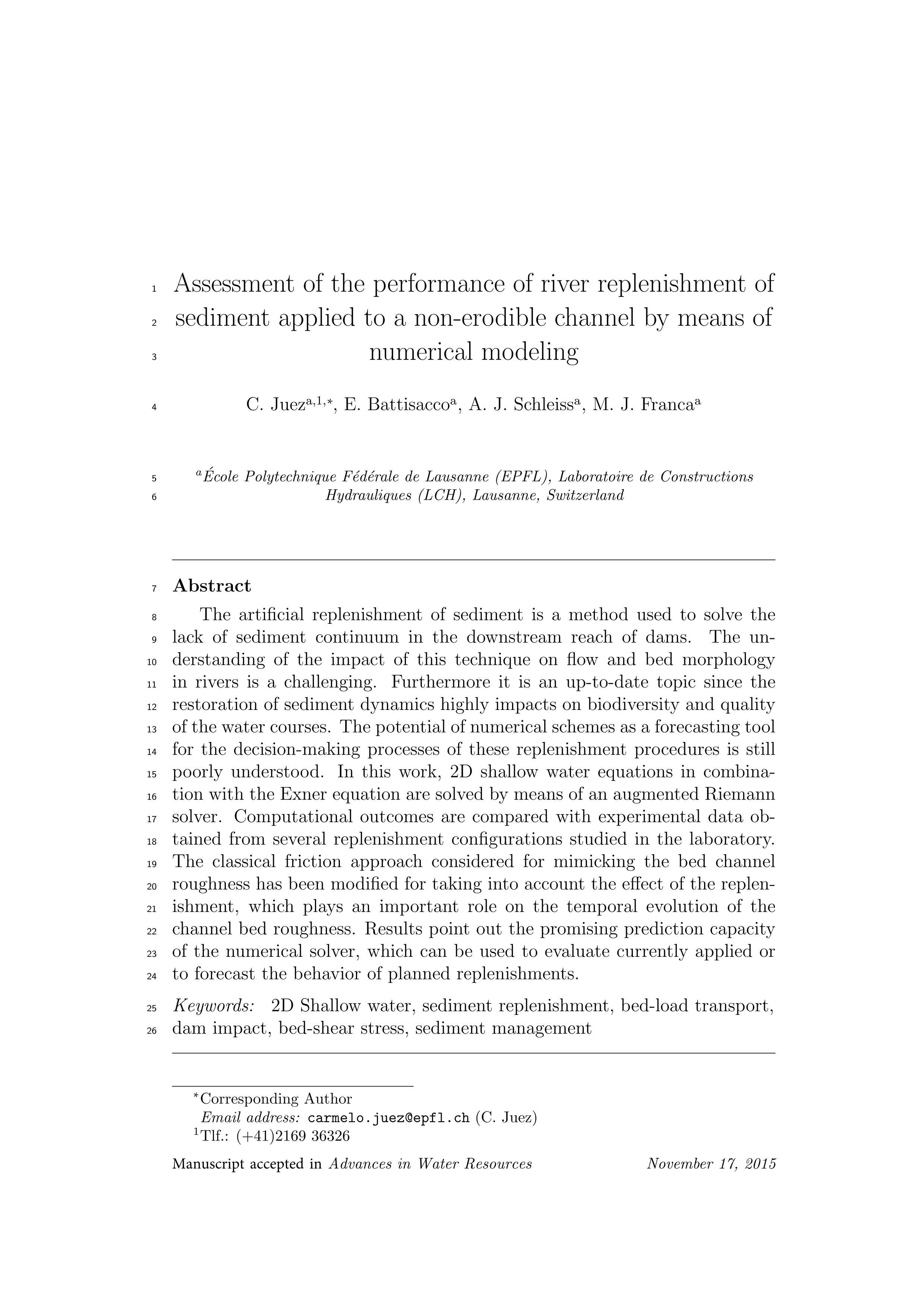

Resumen: The artificial replenishment of sediment is used as a method to re-establish sediment continuity downstream of a dam. However, the impact of this technique on the hydraulics conditions, and resulting bed morphology, is yet to be understood. Several numerical tools have been developed during last years for modeling sediment transport and morphology evolution which can be used for this application. These models range from 1D to 3D approaches: the first being over simplistic for the simulation of such a complex geometry; the latter requires often a prohibitive computational effort. However, 2D models are computationally efficient and in these cases may already provide sufficiently accurate predictions of the morphology evolution caused by the sediment replenishment in a river. Here, the 2D shallow water equations in combination with the Exner equation are solved by means of a weak-coupled strategy. The classical friction approach considered for reproducing the bed channel roughness has been modified to take into account the morphological effect of replenishment which provokes a channel bed fining. Computational outcomes are compared with four sets of experimental data obtained from several replenishment configurations studied in the laboratory. The experiments differ in terms of placement volume and configuration. A set of analysis parameters is proposed for the experimental-numerical comparison, with particular attention to the spreading, covered surface and travel distance of placed replenishment grains. The numerical tool is reliable in reproducing the overall tendency shown by the experimental data. The effect of fining roughness is better reproduced with the approach herein proposed. However, it is also highlighted that the sediment clusters found in the experiment are not well numerically reproduced in the regions of the channel with a limited number of sediment grains.
Idioma: Inglés
DOI: 10.1016/j.advwatres.2016.03.010
Año: 2016
Publicado en: Advances in Water Resources 92 (2016), 10-22
ISSN: 0309-1708
Factor impacto JCR: 3.221 (2016)
Categ. JCR: WATER RESOURCES rank: 7 / 87 = 0.08 (2016) - Q1 - T1
Factor impacto SCIMAGO: 2.202 - Water Science and Technology (Q1)
Financiación: info:eu-repo/grantAgreement/EC/FP7/607394/EU/Sediment transport in fluvial, estuarine and coastal environment/SEDITRANS
Tipo y forma: Article (PostPrint)
Exportado de SIDERAL (2024-01-25-15:07:24)
Visitas y descargas
Idioma: Inglés
DOI: 10.1016/j.advwatres.2016.03.010
Año: 2016
Publicado en: Advances in Water Resources 92 (2016), 10-22
ISSN: 0309-1708
Factor impacto JCR: 3.221 (2016)
Categ. JCR: WATER RESOURCES rank: 7 / 87 = 0.08 (2016) - Q1 - T1
Factor impacto SCIMAGO: 2.202 - Water Science and Technology (Q1)
Financiación: info:eu-repo/grantAgreement/EC/FP7/607394/EU/Sediment transport in fluvial, estuarine and coastal environment/SEDITRANS
Tipo y forma: Article (PostPrint)
Exportado de SIDERAL (2024-01-25-15:07:24)
Permalink:
Visitas y descargas
Este artículo se encuentra en las siguientes colecciones:
articulos
Notice créée le 2024-01-25, modifiée le 2024-01-25