In vitro cell-transforming potential of secondary polyethylene terephthalate and polylactic acid nanoplastics
Domenech, Josefa ; Villacorta, Aliro ; Ferrer, Juan Francisco ; Llorens-Chiralt, Raquel ; Marcos, Ricard ; Hernández, Alba ; Catalán, Julia (Universidad de Zaragoza)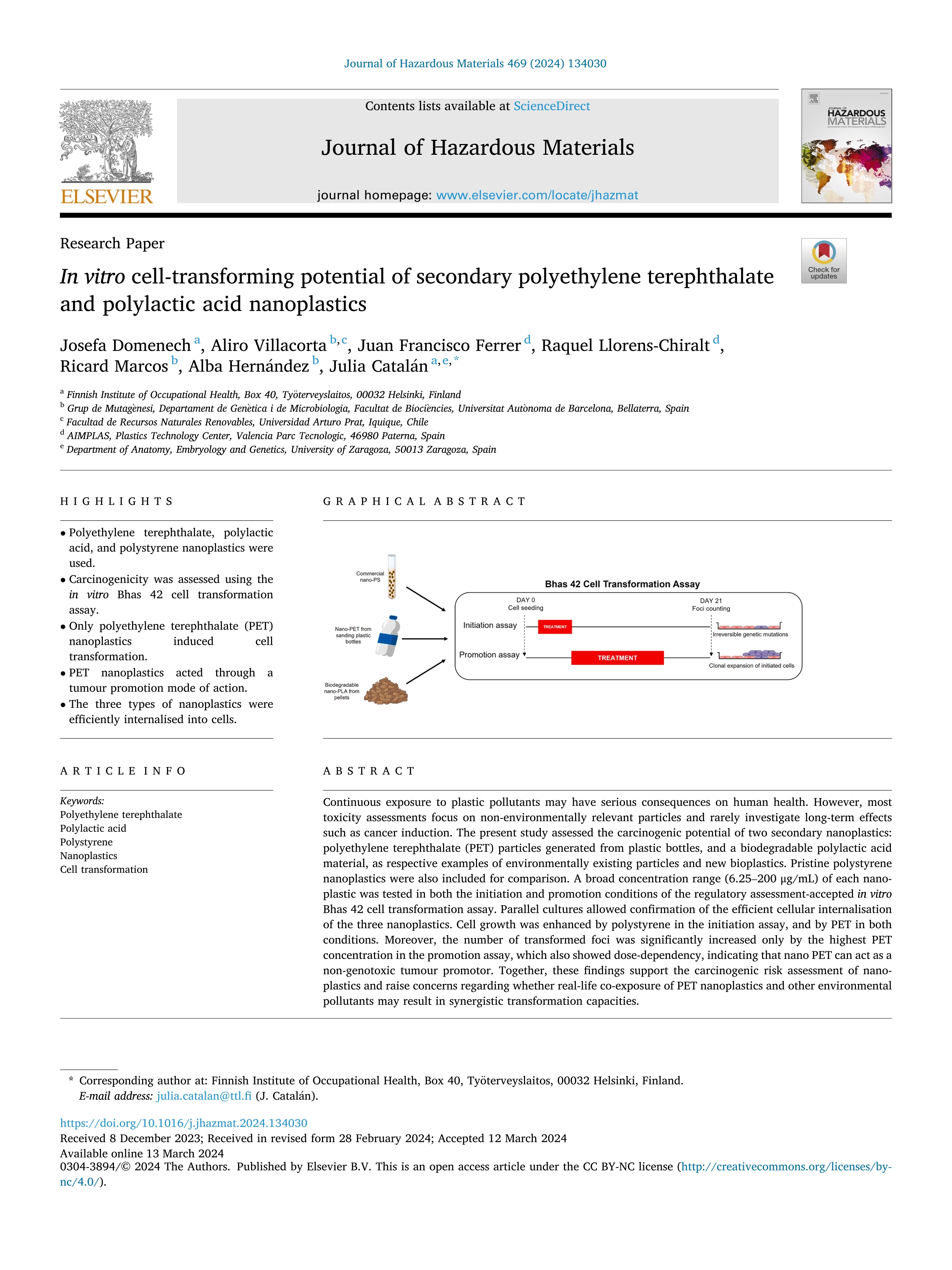

Resumen: Continuous exposure to plastic pollutants may have serious consequences on human health. However, most toxicity assessments focus on non-environmentally relevant particles and rarely investigate long-term effects such as cancer induction. The present study assessed the carcinogenic potential of two secondary nanoplastics: polyethylene terephthalate (PET) particles generated from plastic bottles, and a biodegradable polylactic acid material, as respective examples of environmentally existing particles and new bioplastics. Pristine polystyrene nanoplastics were also included for comparison. A broad concentration range (6.25–200 μg/mL) of each nanoplastic was tested in both the initiation and promotion conditions of the regulatory assessment-accepted in vitro Bhas 42 cell transformation assay. Parallel cultures allowed confirmation of the efficient cellular internalisation of the three nanoplastics. Cell growth was enhanced by polystyrene in the initiation assay, and by PET in both conditions. Moreover, the number of transformed foci was significantly increased only by the highest PET concentration in the promotion assay, which also showed dose-dependency, indicating that nano PET can act as a non-genotoxic tumour promotor. Together, these findings support the carcinogenic risk assessment of nanoplastics and raise concerns regarding whether real-life co-exposure of PET nanoplastics and other environmental pollutants may result in synergistic transformation capacities.
Idioma: Inglés
DOI: 10.1016/j.jhazmat.2024.134030
Año: 2024
Publicado en: Journal of Hazardous Materials 469 (2024), 134030 [14 pp.]
ISSN: 0304-3894
Factor impacto JCR: 11.3 (2024)
Categ. JCR: ENVIRONMENTAL SCIENCES rank: 19 / 376 = 0.051 (2024) - Q1 - T1
Categ. JCR: ENGINEERING, ENVIRONMENTAL rank: 5 / 83 = 0.06 (2024) - Q1 - T1
Factor impacto CITESCORE: 24.6 - Pollution (Q1) - Environmental Chemistry (Q1) - Environmental Engineering (Q1) - Waste Management and Disposal (Q1) - Health, Toxicology and Mutagenesis (Q1)
Factor impacto SCIMAGO: 3.078 - Environmental Chemistry (Q1) - Environmental Engineering (Q1) - Waste Management and Disposal (Q1) - Pollution (Q1) - Health, Toxicology and Mutagenesis (Q1)
Financiación: info:eu-repo/grantAgreement/EC/H2020/965196/EU/Innovative tools to study the impact and mode of action of micro and nanoplastics on human health: towards a knowledge base for risk assessment/PLASTICHEAL
Financiación: info:eu-repo/grantAgreement/ES/MICINN/PID2020-116789-RB-C43
Tipo y forma: Article (Published version)
Área (Departamento): Área Genética (Dpto. Anatom.,Embri.Genét.Ani.)
Exportado de SIDERAL (2026-02-17-20:22:57)
Visitas y descargas
Idioma: Inglés
DOI: 10.1016/j.jhazmat.2024.134030
Año: 2024
Publicado en: Journal of Hazardous Materials 469 (2024), 134030 [14 pp.]
ISSN: 0304-3894
Factor impacto JCR: 11.3 (2024)
Categ. JCR: ENVIRONMENTAL SCIENCES rank: 19 / 376 = 0.051 (2024) - Q1 - T1
Categ. JCR: ENGINEERING, ENVIRONMENTAL rank: 5 / 83 = 0.06 (2024) - Q1 - T1
Factor impacto CITESCORE: 24.6 - Pollution (Q1) - Environmental Chemistry (Q1) - Environmental Engineering (Q1) - Waste Management and Disposal (Q1) - Health, Toxicology and Mutagenesis (Q1)
Factor impacto SCIMAGO: 3.078 - Environmental Chemistry (Q1) - Environmental Engineering (Q1) - Waste Management and Disposal (Q1) - Pollution (Q1) - Health, Toxicology and Mutagenesis (Q1)
Financiación: info:eu-repo/grantAgreement/EC/H2020/965196/EU/Innovative tools to study the impact and mode of action of micro and nanoplastics on human health: towards a knowledge base for risk assessment/PLASTICHEAL
Financiación: info:eu-repo/grantAgreement/ES/MICINN/PID2020-116789-RB-C43
Tipo y forma: Article (Published version)
Área (Departamento): Área Genética (Dpto. Anatom.,Embri.Genét.Ani.)
Exportado de SIDERAL (2026-02-17-20:22:57)
Permalink:
Visitas y descargas
Este artículo se encuentra en las siguientes colecciones:
articulos > articulos-por-area > genetica
Notice créée le 2024-04-12, modifiée le 2026-02-17