Cost-Utility of Attachment-Based Compassion Therapy (ABCT) and Mindfulness-Based Stress Reduction (MBSR) in the Management of Depressive, Anxious, and Adjustment Disorders in Mental Health Settings: Economic Evaluation Alongside a Randomized Controlled Trial
D’Amico, Francesco ; Navarrete, Jaime ; Montero-Marín, Jesús ; Cardeñosa-Valera, Eugenia ; Navarro-Gil, Mayte (Universidad de Zaragoza) ; Pérez-Aranda, Adrián ; López-del-Hoyo, Yolanda (Universidad de Zaragoza) ; Collado-Navarro, Carlos ; García-Campayo, Javier (Universidad de Zaragoza) ; Luciano, Juan V.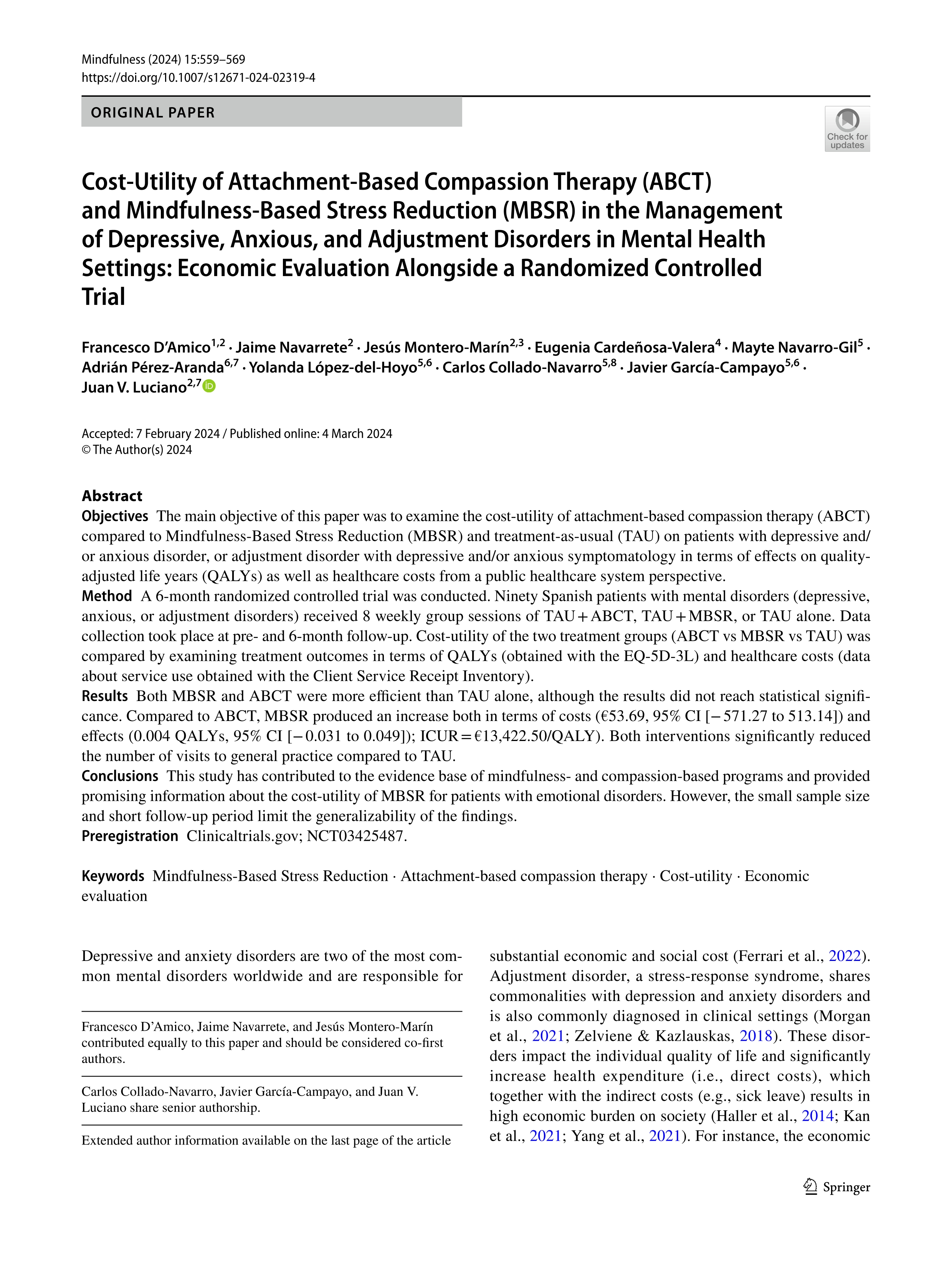
Resumen: Objectives: The main objective of this paper was to examine the cost-utility of attachment-based compassion therapy (ABCT) compared to Mindfulness-Based Stress Reduction (MBSR) and treatment-as-usual (TAU) on patients with depressive and/or anxious disorder, or adjustment disorder with depressive and/or anxious symptomatology in terms of effects on quality-adjusted life years (QALYs) as well as healthcare costs from a public healthcare system perspective.
Method: A 6-month randomized controlled trial was conducted. Ninety Spanish patients with mental disorders (depressive, anxious, or adjustment disorders) received 8 weekly group sessions of TAU + ABCT, TAU + MBSR, or TAU alone. Data collection took place at pre- and 6-month follow-up. Cost-utility of the two treatment groups (ABCT vs MBSR vs TAU) was compared by examining treatment outcomes in terms of QALYs (obtained with the EQ-5D-3L) and healthcare costs (data about service use obtained with the Client Service Receipt Inventory).
Results: Both MBSR and ABCT were more efficient than TAU alone, although the results did not reach statistical significance. Compared to ABCT, MBSR produced an increase both in terms of costs (€53.69, 95% CI [− 571.27 to 513.14]) and effects (0.004 QALYs, 95% CI [− 0.031 to 0.049]); ICUR = €13,422.50/QALY). Both interventions significantly reduced the number of visits to general practice compared to TAU.
Conclusions: This study has contributed to the evidence base of mindfulness- and compassion-based programs and provided promising information about the cost-utility of MBSR for patients with emotional disorders. However, the small sample size and short follow-up period limit the generalizability of the findings.
Preregistration Clinicaltrials.gov; NCT03425487
Idioma: Inglés
DOI: 10.1007/s12671-024-02319-4
Año: 2024
Publicado en: Mindfulness 15, 3 (2024), 11 pp.
ISSN: 1868-8527
Factor impacto JCR: 3.5 (2024)
Categ. JCR: PSYCHOLOGY, CLINICAL rank: 30 / 185 = 0.162 (2024) - Q1 - T1
Categ. JCR: PSYCHIATRY rank: 71 / 288 = 0.247 (2024) - Q1 - T1
Factor impacto CITESCORE: 6.9 - Developmental and Educational Psychology (Q1) - Social Psychology (Q1) - Experimental and Cognitive Psychology (Q1) - Health (social science) (Q1) - Applied Psychology (Q1)
Factor impacto SCIMAGO: 1.82 - Applied Psychology (Q1) - Developmental and Educational Psychology (Q1) - Social Psychology (Q1) - Health (social science) (Q1) - Experimental and Cognitive Psychology (Q1)
Financiación: info:eu-repo/grantAgreement/ES/ISCIII/CIBERESP/CB22-02-00052
Financiación: info:eu-repo/grantAgreement/ES/ISCIII/CP21-00080
Financiación: info:eu-repo/grantAgreement/ES/ISCIII-RICAPPS/RD21-0016-0005
Tipo y forma: Article (Published version)
Área (Departamento): Área Psicología Básica (Dpto. Psicología y Sociología)
Área (Departamento): Area Psiquiatría (Dpto. Medicina, Psiqu. y Derm.)
Área (Departamento): Área Psicolog.Evolut.Educac (Dpto. Psicología y Sociología)
 You must give appropriate credit, provide a link to the license, and indicate if changes were made. You may do so in any reasonable manner, but not in any way that suggests the licensor endorses you or your use.
Exportado de SIDERAL (2026-02-17-20:25:36)
Visitas y descargas
Method: A 6-month randomized controlled trial was conducted. Ninety Spanish patients with mental disorders (depressive, anxious, or adjustment disorders) received 8 weekly group sessions of TAU + ABCT, TAU + MBSR, or TAU alone. Data collection took place at pre- and 6-month follow-up. Cost-utility of the two treatment groups (ABCT vs MBSR vs TAU) was compared by examining treatment outcomes in terms of QALYs (obtained with the EQ-5D-3L) and healthcare costs (data about service use obtained with the Client Service Receipt Inventory).
Results: Both MBSR and ABCT were more efficient than TAU alone, although the results did not reach statistical significance. Compared to ABCT, MBSR produced an increase both in terms of costs (€53.69, 95% CI [− 571.27 to 513.14]) and effects (0.004 QALYs, 95% CI [− 0.031 to 0.049]); ICUR = €13,422.50/QALY). Both interventions significantly reduced the number of visits to general practice compared to TAU.
Conclusions: This study has contributed to the evidence base of mindfulness- and compassion-based programs and provided promising information about the cost-utility of MBSR for patients with emotional disorders. However, the small sample size and short follow-up period limit the generalizability of the findings.
Preregistration Clinicaltrials.gov; NCT03425487
Idioma: Inglés
DOI: 10.1007/s12671-024-02319-4
Año: 2024
Publicado en: Mindfulness 15, 3 (2024), 11 pp.
ISSN: 1868-8527
Factor impacto JCR: 3.5 (2024)
Categ. JCR: PSYCHOLOGY, CLINICAL rank: 30 / 185 = 0.162 (2024) - Q1 - T1
Categ. JCR: PSYCHIATRY rank: 71 / 288 = 0.247 (2024) - Q1 - T1
Factor impacto CITESCORE: 6.9 - Developmental and Educational Psychology (Q1) - Social Psychology (Q1) - Experimental and Cognitive Psychology (Q1) - Health (social science) (Q1) - Applied Psychology (Q1)
Factor impacto SCIMAGO: 1.82 - Applied Psychology (Q1) - Developmental and Educational Psychology (Q1) - Social Psychology (Q1) - Health (social science) (Q1) - Experimental and Cognitive Psychology (Q1)
Financiación: info:eu-repo/grantAgreement/ES/ISCIII/CIBERESP/CB22-02-00052
Financiación: info:eu-repo/grantAgreement/ES/ISCIII/CP21-00080
Financiación: info:eu-repo/grantAgreement/ES/ISCIII-RICAPPS/RD21-0016-0005
Tipo y forma: Article (Published version)
Área (Departamento): Área Psicología Básica (Dpto. Psicología y Sociología)
Área (Departamento): Area Psiquiatría (Dpto. Medicina, Psiqu. y Derm.)
Área (Departamento): Área Psicolog.Evolut.Educac (Dpto. Psicología y Sociología)
You must give appropriate credit, provide a link to the license, and indicate if changes were made. You may do so in any reasonable manner, but not in any way that suggests the licensor endorses you or your use. Exportado de SIDERAL (2026-02-17-20:25:36)
Permalink:
Visitas y descargas
Este artículo se encuentra en las siguientes colecciones:
Articles > Artículos por área > Psicología Evolutiva y de la Educación
Articles > Artículos por área > Psicología Básica
Articles > Artículos por área > Psiquiatría
Record created 2024-04-24, last modified 2026-02-17