Cost-Utility of Attachment-Based Compassion Therapy (ABCT) and Mindfulness-Based Stress Reduction (MBSR) in the Management of Depressive, Anxious, and Adjustment Disorders in Mental Health Settings: Economic Evaluation Alongside a Randomized Controlled Trial
D’Amico, Francesco ; Navarrete, Jaime ; Montero-Marín, Jesús ; Cardeñosa-Valera, Eugenia ; Navarro-Gil, Mayte (Universidad de Zaragoza) ; Pérez-Aranda, Adrián ; López-del-Hoyo, Yolanda (Universidad de Zaragoza) ; Collado-Navarro, Carlos ; García-Campayo, Javier (Universidad de Zaragoza) ; Luciano, Juan V.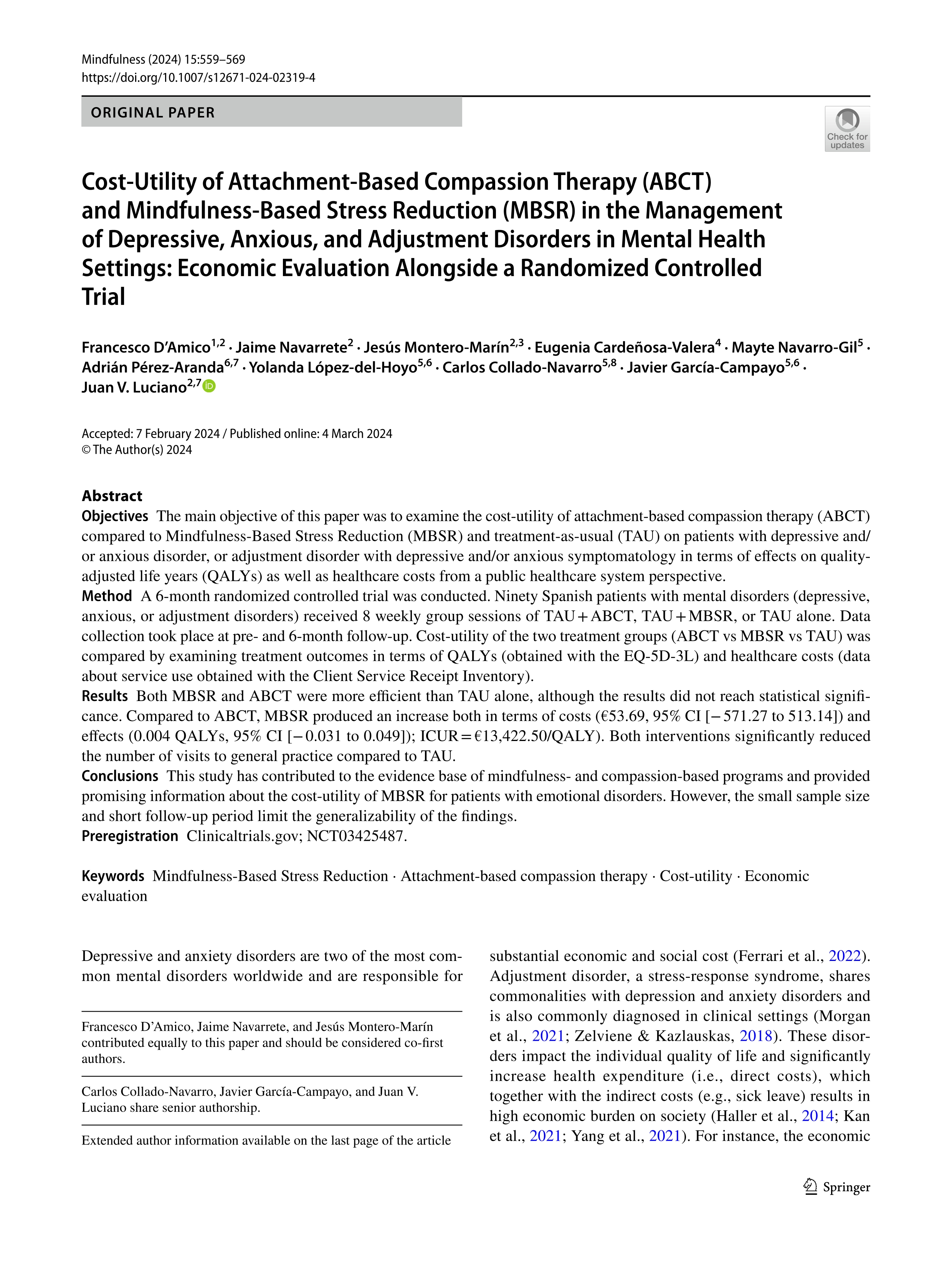
Resumen: Objectives: The main objective of this paper was to examine the cost-utility of attachment-based compassion therapy (ABCT) compared to Mindfulness-Based Stress Reduction (MBSR) and treatment-as-usual (TAU) on patients with depressive and/or anxious disorder, or adjustment disorder with depressive and/or anxious symptomatology in terms of effects on quality-adjusted life years (QALYs) as well as healthcare costs from a public healthcare system perspective.
Method: A 6-month randomized controlled trial was conducted. Ninety Spanish patients with mental disorders (depressive, anxious, or adjustment disorders) received 8 weekly group sessions of TAU + ABCT, TAU + MBSR, or TAU alone. Data collection took place at pre- and 6-month follow-up. Cost-utility of the two treatment groups (ABCT vs MBSR vs TAU) was compared by examining treatment outcomes in terms of QALYs (obtained with the EQ-5D-3L) and healthcare costs (data about service use obtained with the Client Service Receipt Inventory).
Results: Both MBSR and ABCT were more efficient than TAU alone, although the results did not reach statistical significance. Compared to ABCT, MBSR produced an increase both in terms of costs (€53.69, 95% CI [− 571.27 to 513.14]) and effects (0.004 QALYs, 95% CI [− 0.031 to 0.049]); ICUR = €13,422.50/QALY). Both interventions significantly reduced the number of visits to general practice compared to TAU.
Conclusions: This study has contributed to the evidence base of mindfulness- and compassion-based programs and provided promising information about the cost-utility of MBSR for patients with emotional disorders. However, the small sample size and short follow-up period limit the generalizability of the findings.
Preregistration Clinicaltrials.gov; NCT03425487
Idioma: Inglés
DOI: 10.1007/s12671-024-02319-4
Año: 2024
Publicado en: Mindfulness 15, 3 (2024), 11 pp.
ISSN: 1868-8527
Factor impacto JCR: 3.5 (2024)
Categ. JCR: PSYCHOLOGY, CLINICAL rank: 30 / 185 = 0.162 (2024) - Q1 - T1
Categ. JCR: PSYCHIATRY rank: 71 / 288 = 0.247 (2024) - Q1 - T1
Factor impacto CITESCORE: 6.9 - Developmental and Educational Psychology (Q1) - Social Psychology (Q1) - Experimental and Cognitive Psychology (Q1) - Health (social science) (Q1) - Applied Psychology (Q1)
Factor impacto SCIMAGO: 1.82 - Applied Psychology (Q1) - Developmental and Educational Psychology (Q1) - Social Psychology (Q1) - Health (social science) (Q1) - Experimental and Cognitive Psychology (Q1)
Financiación: info:eu-repo/grantAgreement/ES/ISCIII/CIBERESP/CB22-02-00052
Financiación: info:eu-repo/grantAgreement/ES/ISCIII/CP21-00080
Financiación: info:eu-repo/grantAgreement/ES/ISCIII-RICAPPS/RD21-0016-0005
Tipo y forma: Article (Published version)
Área (Departamento): Área Psicología Básica (Dpto. Psicología y Sociología)
Área (Departamento): Area Psiquiatría (Dpto. Medicina, Psiqu. y Derm.)
Área (Departamento): Área Psicolog.Evolut.Educac (Dpto. Psicología y Sociología)
Exportado de SIDERAL (2026-02-17-20:25:36)
Visitas y descargas
Method: A 6-month randomized controlled trial was conducted. Ninety Spanish patients with mental disorders (depressive, anxious, or adjustment disorders) received 8 weekly group sessions of TAU + ABCT, TAU + MBSR, or TAU alone. Data collection took place at pre- and 6-month follow-up. Cost-utility of the two treatment groups (ABCT vs MBSR vs TAU) was compared by examining treatment outcomes in terms of QALYs (obtained with the EQ-5D-3L) and healthcare costs (data about service use obtained with the Client Service Receipt Inventory).
Results: Both MBSR and ABCT were more efficient than TAU alone, although the results did not reach statistical significance. Compared to ABCT, MBSR produced an increase both in terms of costs (€53.69, 95% CI [− 571.27 to 513.14]) and effects (0.004 QALYs, 95% CI [− 0.031 to 0.049]); ICUR = €13,422.50/QALY). Both interventions significantly reduced the number of visits to general practice compared to TAU.
Conclusions: This study has contributed to the evidence base of mindfulness- and compassion-based programs and provided promising information about the cost-utility of MBSR for patients with emotional disorders. However, the small sample size and short follow-up period limit the generalizability of the findings.
Preregistration Clinicaltrials.gov; NCT03425487
Idioma: Inglés
DOI: 10.1007/s12671-024-02319-4
Año: 2024
Publicado en: Mindfulness 15, 3 (2024), 11 pp.
ISSN: 1868-8527
Factor impacto JCR: 3.5 (2024)
Categ. JCR: PSYCHOLOGY, CLINICAL rank: 30 / 185 = 0.162 (2024) - Q1 - T1
Categ. JCR: PSYCHIATRY rank: 71 / 288 = 0.247 (2024) - Q1 - T1
Factor impacto CITESCORE: 6.9 - Developmental and Educational Psychology (Q1) - Social Psychology (Q1) - Experimental and Cognitive Psychology (Q1) - Health (social science) (Q1) - Applied Psychology (Q1)
Factor impacto SCIMAGO: 1.82 - Applied Psychology (Q1) - Developmental and Educational Psychology (Q1) - Social Psychology (Q1) - Health (social science) (Q1) - Experimental and Cognitive Psychology (Q1)
Financiación: info:eu-repo/grantAgreement/ES/ISCIII/CIBERESP/CB22-02-00052
Financiación: info:eu-repo/grantAgreement/ES/ISCIII/CP21-00080
Financiación: info:eu-repo/grantAgreement/ES/ISCIII-RICAPPS/RD21-0016-0005
Tipo y forma: Article (Published version)
Área (Departamento): Área Psicología Básica (Dpto. Psicología y Sociología)
Área (Departamento): Area Psiquiatría (Dpto. Medicina, Psiqu. y Derm.)
Área (Departamento): Área Psicolog.Evolut.Educac (Dpto. Psicología y Sociología)
Exportado de SIDERAL (2026-02-17-20:25:36)
Permalink:
Visitas y descargas
Este artículo se encuentra en las siguientes colecciones:
articulos > articulos-por-area > psicologia_evolutiva_y_de_la_educacion
articulos > articulos-por-area > psicologia_basica
articulos > articulos-por-area > psiquiatria
Notice créée le 2024-04-24, modifiée le 2026-02-17