Homo- and Cross-Coupling of Phenylacetylenes and a-Hydroxyacetylenes Catalyzed by a Square-Planar Rhodium Monohydride
Heras, Laura A. de las ; Esteruelas, Miguel A. ; Oliván, Montserrat ; Oñate, Enrique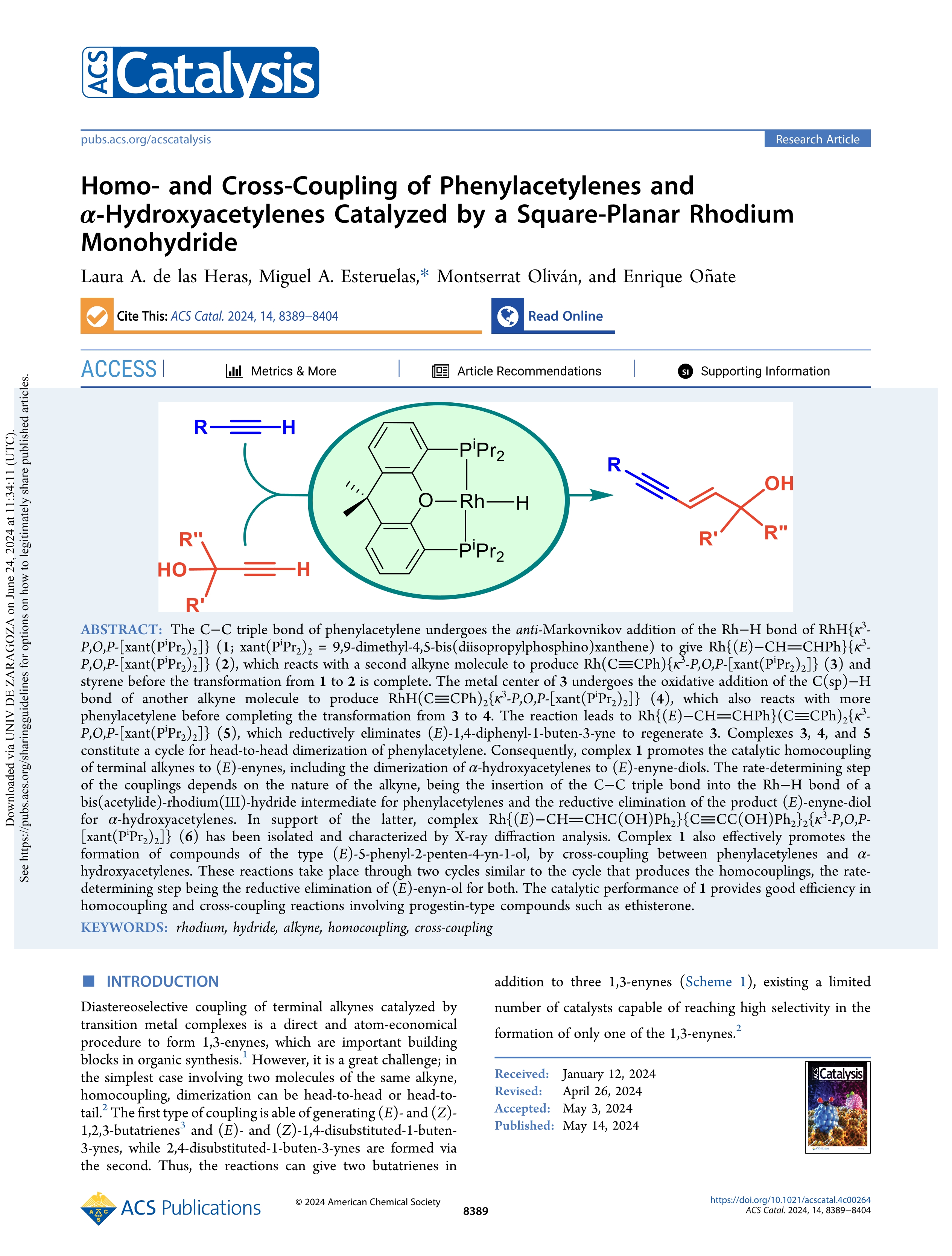
Resumen: The C–C triple bond of phenylacetylene undergoes the anti-Markovnikov addition of the Rh–H bond of RhH{κ3-P,O,P-[xant(PiPr2)2]} (1; xant(PiPr2)2 = 9,9-dimethyl-4,5-bis(diisopropylphosphino)xanthene) to give Rh{(E)–CH═CHPh}{κ3-P,O,P-[xant(PiPr2)2]} (2), which reacts with a second alkyne molecule to produce Rh(C≡CPh){κ3-P,O,P-[xant(PiPr2)2]} (3) and styrene before the transformation from 1 to 2 is complete. The metal center of 3 undergoes the oxidative addition of the C(sp)–H bond of another alkyne molecule to produce RhH(C≡CPh)2{κ3-P,O,P-[xant(PiPr2)2]} (4), which also reacts with more phenylacetylene before completing the transformation from 3 to 4. The reaction leads to Rh{(E)–CH═CHPh}(C≡CPh)2{κ3-P,O,P-[xant(PiPr2)2]} (5), which reductively eliminates (E)-1,4-diphenyl-1-buten-3-yne to regenerate 3. Complexes 3, 4, and 5 constitute a cycle for head-to-head dimerization of phenylacetylene. Consequently, complex 1 promotes the catalytic homocoupling of terminal alkynes to (E)-enynes, including the dimerization of α-hydroxyacetylenes to (E)-enyne-diols. The rate-determining step of the couplings depends on the nature of the alkyne, being the insertion of the C–C triple bond into the Rh–H bond of a bis(acetylide)-rhodium(III)-hydride intermediate for phenylacetylenes and the reductive elimination of the product (E)-enyne-diol for α-hydroxyacetylenes. In support of the latter, complex Rh{(E)–CH═CHC(OH)Ph2}{C≡CC(OH)Ph2}2{κ3-P,O,P-[xant(PiPr2)2]} (6) has been isolated and characterized by X-ray diffraction analysis. Complex 1 also effectively promotes the formation of compounds of the type (E)-5-phenyl-2-penten-4-yn-1-ol, by cross-coupling between phenylacetylenes and α-hydroxyacetylenes. These reactions take place through two cycles similar to the cycle that produces the homocouplings, the rate-determining step being the reductive elimination of (E)-enyn-ol for both. The catalytic performance of 1 provides good efficiency in homocoupling and cross-coupling reactions involving progestin-type compounds such as ethisterone.
Idioma: Inglés
DOI: 10.1021/acscatal.4c00264
Año: 2024
Publicado en: ACS CATALYSIS 14, 11 (2024), 8389-8404
ISSN: 2155-5435
Factor impacto JCR: 13.1 (2024)
Categ. JCR: CHEMISTRY, PHYSICAL rank: 21 / 185 = 0.114 (2024) - Q1 - T1
Factor impacto CITESCORE: 19.5 - Catalysis (Q1) - Chemistry (all) (Q1)
Factor impacto SCIMAGO: 3.782 - Chemistry (miscellaneous) (Q1) - Catalysis (Q1)
Financiación: info:eu-repo/grantAgreement/ES/DGA/E06-23R
Financiación: fo:eu-repo/grantAgreement/ES/DGA-FSE/LMP23-21
Financiación: info:eu-repo/grantAgreement/ES/MCIN/AEI/10.13039/501100011033
Financiación: info:eu-repo/grantAgreement/ES/MICINN/PID2020-115286GB-I00/AEI/10.13039/501100011033
Financiación: info:eu-repo/grantAgreement/ES/MICINN/RED2022-134287-T
Tipo y forma: Article (Published version)
 You must give appropriate credit, provide a link to the license, and indicate if changes were made. You may do so in any reasonable manner, but not in any way that suggests the licensor endorses you or your use.
Exportado de SIDERAL (2026-02-17-20:29:44)
Visitas y descargas
Idioma: Inglés
DOI: 10.1021/acscatal.4c00264
Año: 2024
Publicado en: ACS CATALYSIS 14, 11 (2024), 8389-8404
ISSN: 2155-5435
Factor impacto JCR: 13.1 (2024)
Categ. JCR: CHEMISTRY, PHYSICAL rank: 21 / 185 = 0.114 (2024) - Q1 - T1
Factor impacto CITESCORE: 19.5 - Catalysis (Q1) - Chemistry (all) (Q1)
Factor impacto SCIMAGO: 3.782 - Chemistry (miscellaneous) (Q1) - Catalysis (Q1)
Financiación: info:eu-repo/grantAgreement/ES/DGA/E06-23R
Financiación: fo:eu-repo/grantAgreement/ES/DGA-FSE/LMP23-21
Financiación: info:eu-repo/grantAgreement/ES/MCIN/AEI/10.13039/501100011033
Financiación: info:eu-repo/grantAgreement/ES/MICINN/PID2020-115286GB-I00/AEI/10.13039/501100011033
Financiación: info:eu-repo/grantAgreement/ES/MICINN/RED2022-134287-T
Tipo y forma: Article (Published version)
You must give appropriate credit, provide a link to the license, and indicate if changes were made. You may do so in any reasonable manner, but not in any way that suggests the licensor endorses you or your use. Exportado de SIDERAL (2026-02-17-20:29:44)
Permalink:
Visitas y descargas
Este artículo se encuentra en las siguientes colecciones:
Articles
Record created 2024-06-27, last modified 2026-02-17