Homo- and Cross-Coupling of Phenylacetylenes and a-Hydroxyacetylenes Catalyzed by a Square-Planar Rhodium Monohydride
Heras, Laura A. de las ; Esteruelas, Miguel A. ; Oliván, Montserrat ; Oñate, Enrique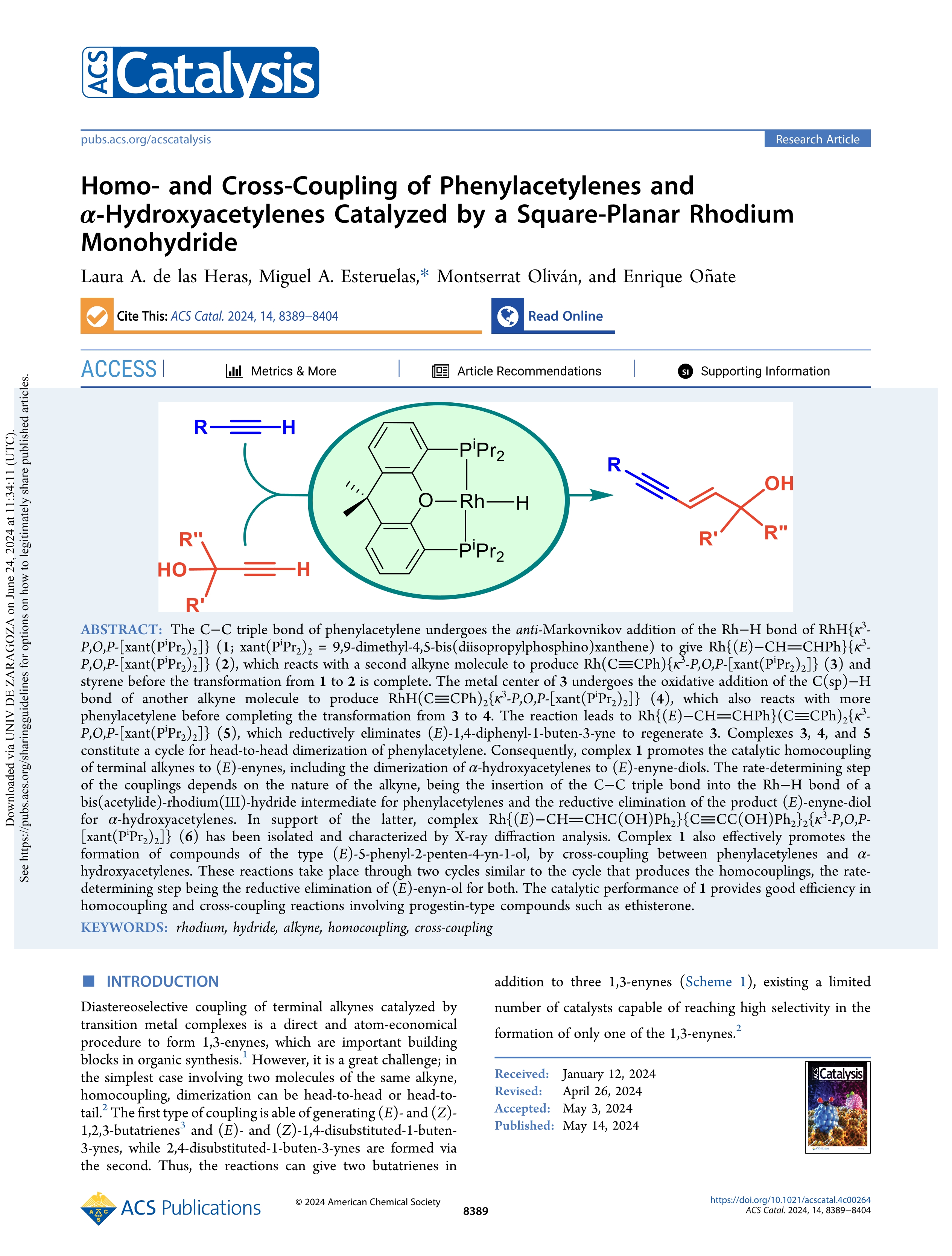
Resumen: The C–C triple bond of phenylacetylene undergoes the anti-Markovnikov addition of the Rh–H bond of RhH{κ3-P,O,P-[xant(PiPr2)2]} (1; xant(PiPr2)2 = 9,9-dimethyl-4,5-bis(diisopropylphosphino)xanthene) to give Rh{(E)–CH═CHPh}{κ3-P,O,P-[xant(PiPr2)2]} (2), which reacts with a second alkyne molecule to produce Rh(C≡CPh){κ3-P,O,P-[xant(PiPr2)2]} (3) and styrene before the transformation from 1 to 2 is complete. The metal center of 3 undergoes the oxidative addition of the C(sp)–H bond of another alkyne molecule to produce RhH(C≡CPh)2{κ3-P,O,P-[xant(PiPr2)2]} (4), which also reacts with more phenylacetylene before completing the transformation from 3 to 4. The reaction leads to Rh{(E)–CH═CHPh}(C≡CPh)2{κ3-P,O,P-[xant(PiPr2)2]} (5), which reductively eliminates (E)-1,4-diphenyl-1-buten-3-yne to regenerate 3. Complexes 3, 4, and 5 constitute a cycle for head-to-head dimerization of phenylacetylene. Consequently, complex 1 promotes the catalytic homocoupling of terminal alkynes to (E)-enynes, including the dimerization of α-hydroxyacetylenes to (E)-enyne-diols. The rate-determining step of the couplings depends on the nature of the alkyne, being the insertion of the C–C triple bond into the Rh–H bond of a bis(acetylide)-rhodium(III)-hydride intermediate for phenylacetylenes and the reductive elimination of the product (E)-enyne-diol for α-hydroxyacetylenes. In support of the latter, complex Rh{(E)–CH═CHC(OH)Ph2}{C≡CC(OH)Ph2}2{κ3-P,O,P-[xant(PiPr2)2]} (6) has been isolated and characterized by X-ray diffraction analysis. Complex 1 also effectively promotes the formation of compounds of the type (E)-5-phenyl-2-penten-4-yn-1-ol, by cross-coupling between phenylacetylenes and α-hydroxyacetylenes. These reactions take place through two cycles similar to the cycle that produces the homocouplings, the rate-determining step being the reductive elimination of (E)-enyn-ol for both. The catalytic performance of 1 provides good efficiency in homocoupling and cross-coupling reactions involving progestin-type compounds such as ethisterone.
Idioma: Inglés
DOI: 10.1021/acscatal.4c00264
Año: 2024
Publicado en: ACS CATALYSIS 14, 11 (2024), 8389-8404
ISSN: 2155-5435
Factor impacto JCR: 13.1 (2024)
Categ. JCR: CHEMISTRY, PHYSICAL rank: 21 / 185 = 0.114 (2024) - Q1 - T1
Factor impacto CITESCORE: 19.5 - Catalysis (Q1) - Chemistry (all) (Q1)
Factor impacto SCIMAGO: 3.782 - Chemistry (miscellaneous) (Q1) - Catalysis (Q1)
Financiación: info:eu-repo/grantAgreement/ES/DGA/E06-23R
Financiación: fo:eu-repo/grantAgreement/ES/DGA-FSE/LMP23-21
Financiación: info:eu-repo/grantAgreement/ES/MCIN/AEI/10.13039/501100011033
Financiación: info:eu-repo/grantAgreement/ES/MICINN/PID2020-115286GB-I00/AEI/10.13039/501100011033
Financiación: info:eu-repo/grantAgreement/ES/MICINN/RED2022-134287-T
Tipo y forma: Article (Published version)
Exportado de SIDERAL (2026-02-17-20:29:44)
Visitas y descargas
Idioma: Inglés
DOI: 10.1021/acscatal.4c00264
Año: 2024
Publicado en: ACS CATALYSIS 14, 11 (2024), 8389-8404
ISSN: 2155-5435
Factor impacto JCR: 13.1 (2024)
Categ. JCR: CHEMISTRY, PHYSICAL rank: 21 / 185 = 0.114 (2024) - Q1 - T1
Factor impacto CITESCORE: 19.5 - Catalysis (Q1) - Chemistry (all) (Q1)
Factor impacto SCIMAGO: 3.782 - Chemistry (miscellaneous) (Q1) - Catalysis (Q1)
Financiación: info:eu-repo/grantAgreement/ES/DGA/E06-23R
Financiación: fo:eu-repo/grantAgreement/ES/DGA-FSE/LMP23-21
Financiación: info:eu-repo/grantAgreement/ES/MCIN/AEI/10.13039/501100011033
Financiación: info:eu-repo/grantAgreement/ES/MICINN/PID2020-115286GB-I00/AEI/10.13039/501100011033
Financiación: info:eu-repo/grantAgreement/ES/MICINN/RED2022-134287-T
Tipo y forma: Article (Published version)
Exportado de SIDERAL (2026-02-17-20:29:44)
Permalink:
Visitas y descargas
Este artículo se encuentra en las siguientes colecciones:
articulos
Notice créée le 2024-06-27, modifiée le 2026-02-17