Recent advances on the chemistry of transition metal complexes with monoanionic bidentate silyl ligands
Batuecas, María (Universidad de Zaragoza) ; Goméz-España, Alejandra ; Fernández-Álvarez, Francisco J. (Universidad de Zaragoza)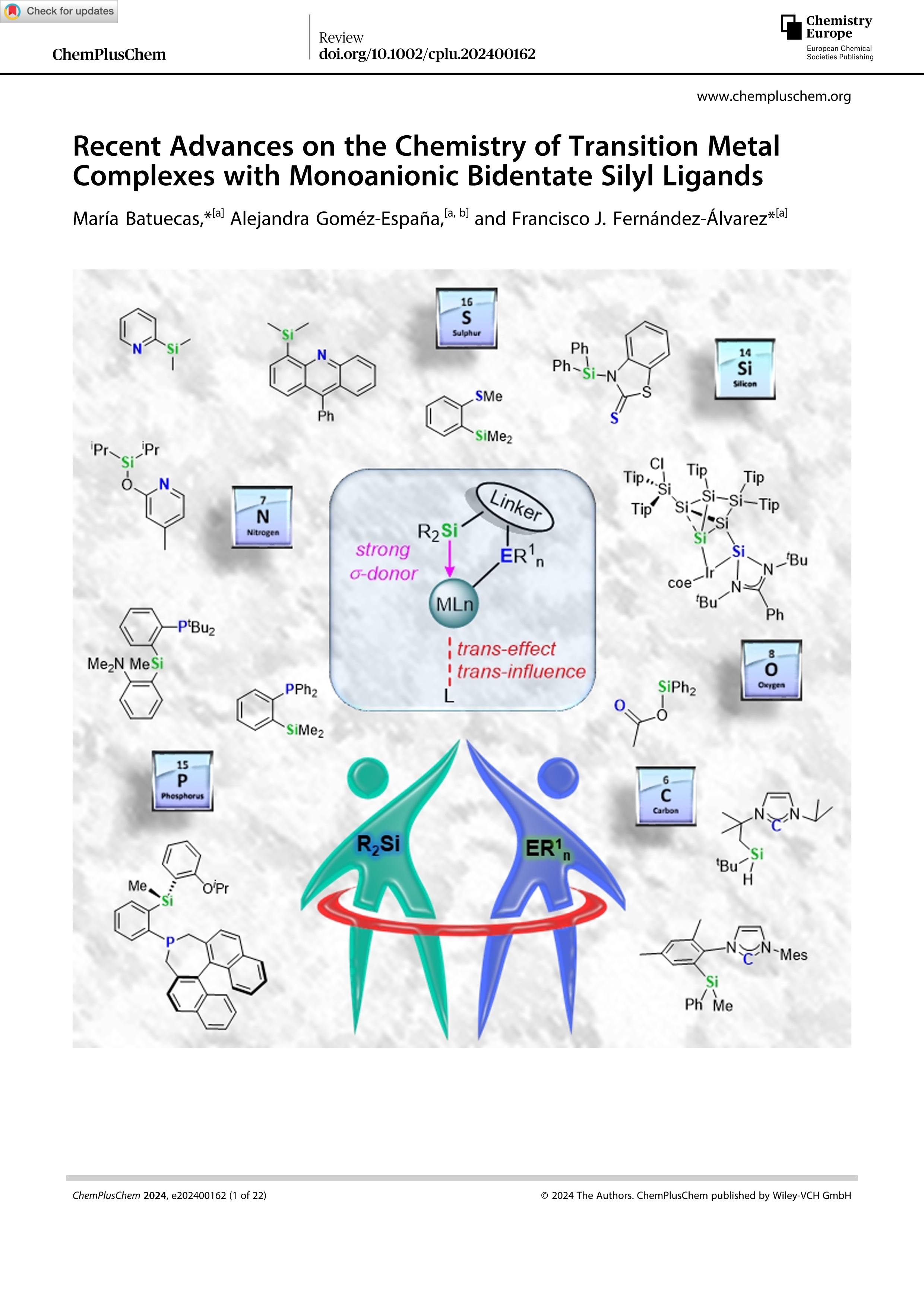

Resumen: The chemistry of transition-metal (TM) complexes with monoanionic bidentate (κ2-L,Si) silyl ligands has considerably grown in recent years. This work summarizes the advances in the chemistry of TM-(κ2-L,Si) complexes (L=N-heterocycle, phosphine, N-heterocyclic carbene, thioether, ester, silylether or tetrylene). The most common synthetic method has been the oxidative addition of the Si−H bond to the metal center assisted by the coordination of L. The metal silicon bond distances in TM-(κ2-L,Si) complexes are in the range of metal-silyl bond distances. TM-(κ2-L,Si) complexes have proven to be effective catalysts for hydrosilylation and/or hydrogenation of unsaturated molecules among other processes.
Idioma: Inglés
DOI: 10.1002/cplu.202400162
Año: 2024
Publicado en: ChemPlusChem 89, 9 (2024), e202400162 [22 pp.]
ISSN: 2192-6506
Factor impacto JCR: 2.8 (2024)
Categ. JCR: CHEMISTRY, MULTIDISCIPLINARY rank: 114 / 239 = 0.477 (2024) - Q2 - T2
Factor impacto CITESCORE: 4.4 - Chemistry (all) (Q2)
Factor impacto SCIMAGO: 0.73 - Chemistry (miscellaneous) (Q2)
Financiación: info:eu-repo/grantAgreement/ES/DGA/E42-23R
Financiación: info:eu-repo/grantAgreement/EC/H2020/101034288/EU/International Fellowship Programme for Talent Attraction to the Campus of International Excellence Campus Iberus/IberusExperience
Financiación: info:eu-repo/grantAgreement/ES/MICINN/PID2021-126212OB-I00
Tipo y forma: Revisión (Versión definitiva)
Área (Departamento): Área Química Inorgánica (Dpto. Química Inorgánica)
 Debe reconocer adecuadamente la autoría, proporcionar un enlace a la licencia e indicar si se han realizado cambios. Puede hacerlo de cualquier manera razonable, pero no de una manera que sugiera que tiene el apoyo del licenciador o lo recibe por el uso que hace. No puede utilizar el material para una finalidad comercial. Si remezcla, transforma o crea a partir del material, no puede difundir el material modificado.
Exportado de SIDERAL (2026-02-17-20:29:40)
Visitas y descargas
Idioma: Inglés
DOI: 10.1002/cplu.202400162
Año: 2024
Publicado en: ChemPlusChem 89, 9 (2024), e202400162 [22 pp.]
ISSN: 2192-6506
Factor impacto JCR: 2.8 (2024)
Categ. JCR: CHEMISTRY, MULTIDISCIPLINARY rank: 114 / 239 = 0.477 (2024) - Q2 - T2
Factor impacto CITESCORE: 4.4 - Chemistry (all) (Q2)
Factor impacto SCIMAGO: 0.73 - Chemistry (miscellaneous) (Q2)
Financiación: info:eu-repo/grantAgreement/ES/DGA/E42-23R
Financiación: info:eu-repo/grantAgreement/EC/H2020/101034288/EU/International Fellowship Programme for Talent Attraction to the Campus of International Excellence Campus Iberus/IberusExperience
Financiación: info:eu-repo/grantAgreement/ES/MICINN/PID2021-126212OB-I00
Tipo y forma: Revisión (Versión definitiva)
Área (Departamento): Área Química Inorgánica (Dpto. Química Inorgánica)
Debe reconocer adecuadamente la autoría, proporcionar un enlace a la licencia e indicar si se han realizado cambios. Puede hacerlo de cualquier manera razonable, pero no de una manera que sugiera que tiene el apoyo del licenciador o lo recibe por el uso que hace. No puede utilizar el material para una finalidad comercial. Si remezcla, transforma o crea a partir del material, no puede difundir el material modificado.Exportado de SIDERAL (2026-02-17-20:29:40)
Enlace permanente:
Visitas y descargas
Este artículo se encuentra en las siguientes colecciones:
Artículos > Artículos por área > Química Inorgánica
Registro creado el 2024-09-06, última modificación el 2026-02-17