Unveiling the kinetic versatility of aryl-alcohol oxidases with different electron acceptors
Serrano, Ana ; Cinca-Fernando, Paula (Universidad de Zaragoza) ; Carro, Juan ; Velázquez-Campoy, Adrián (Universidad de Zaragoza) ; Martínez-Júlvez, Marta (Universidad de Zaragoza) ; Martínez, Ángel T. ; Ferreira, Patricia (Universidad de Zaragoza)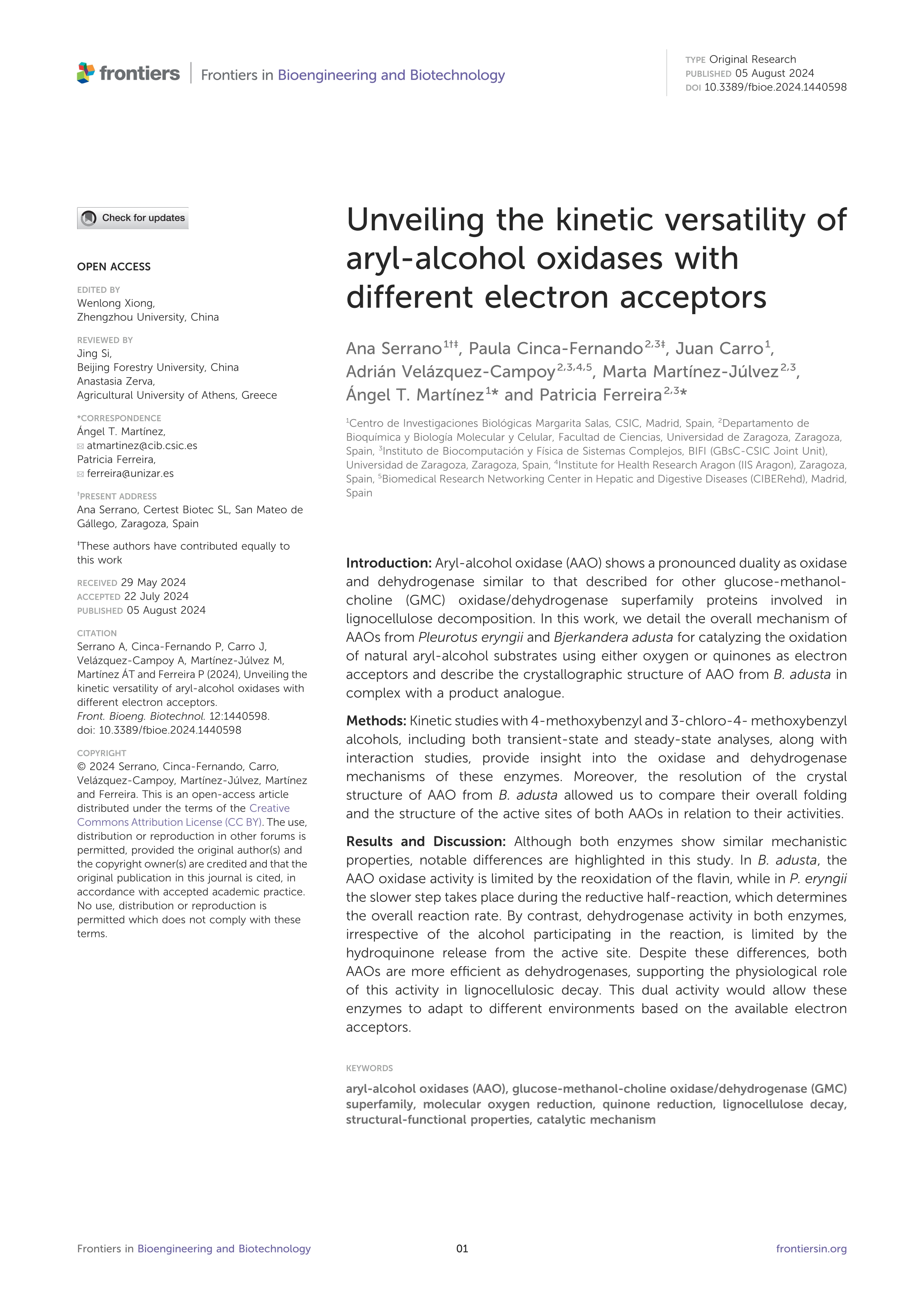
Resumen: Introduction: Aryl-alcohol oxidase (AAO) shows a pronounced duality as oxidase and dehydrogenase similar to that described for other glucose-methanol-choline (GMC) oxidase/dehydrogenase superfamily proteins involved in lignocellulose decomposition. In this work, we detail the overall mechanism of AAOs from Pleurotus eryngii and Bjerkandera adusta for catalyzing the oxidation of natural aryl-alcohol substrates using either oxygen or quinones as electron acceptors and describe the crystallographic structure of AAO from B. adusta in complex with a product analogue. Methods: Kinetic studies with 4-methoxybenzyl and 3-chloro-4- methoxybenzyl alcohols, including both transient-state and steady-state analyses, along with interaction studies, provide insight into the oxidase and dehydrogenase mechanisms of these enzymes. Moreover, the resolution of the crystal structure of AAO from B. adusta allowed us to compare their overall folding and the structure of the active sites of both AAOs in relation to their activities. Results and Discussion: Although both enzymes show similar mechanistic properties, notable differences are highlighted in this study. In B. adusta, the AAO oxidase activity is limited by the reoxidation of the flavin, while in P. eryngii the slower step takes place during the reductive half-reaction, which determines the overall reaction rate. By contrast, dehydrogenase activity in both enzymes, irrespective of the alcohol participating in the reaction, is limited by the hydroquinone release from the active site. Despite these differences, both AAOs are more efficient as dehydrogenases, supporting the physiological role of this activity in lignocellulosic decay. This dual activity would allow these enzymes to adapt to different environments based on the available electron acceptors.
Idioma: Inglés
DOI: 10.3389/fbioe.2024.1440598
Año: 2024
Publicado en: Frontiers in Bioengineering and Biotechnology 12 (2024), 1440598[15 pp.]
ISSN: 2296-4185
Factor impacto JCR: 4.8 (2024)
Categ. JCR: BIOTECHNOLOGY & APPLIED MICROBIOLOGY rank: 31 / 177 = 0.175 (2024) - Q1 - T1
Categ. JCR: ENGINEERING, BIOMEDICAL rank: 35 / 124 = 0.282 (2024) - Q2 - T1
Factor impacto CITESCORE: 8.8 - Biotechnology (Q1) - Histology (Q1) - Biomedical Engineering (Q1) - Bioengineering (Q2)
Factor impacto SCIMAGO: 0.974 - Biomedical Engineering (Q1) - Histology (Q1) - Biotechnology (Q1) - Bioengineering (Q2)
Financiación: info:eu-repo/grantAgreement/ES/MICINN/PID2022-136369NB-I00
Financiación: info:eu-repo/grantAgreement/EUR/MICINN/TED2021-130803B-I00
Tipo y forma: Article (Published version)
Área (Departamento): Área Bioquímica y Biolog.Mole. (Dpto. Bioq.Biolog.Mol. Celular)
Exportado de SIDERAL (2026-01-12-13:07:01)
Visitas y descargas
Idioma: Inglés
DOI: 10.3389/fbioe.2024.1440598
Año: 2024
Publicado en: Frontiers in Bioengineering and Biotechnology 12 (2024), 1440598[15 pp.]
ISSN: 2296-4185
Factor impacto JCR: 4.8 (2024)
Categ. JCR: BIOTECHNOLOGY & APPLIED MICROBIOLOGY rank: 31 / 177 = 0.175 (2024) - Q1 - T1
Categ. JCR: ENGINEERING, BIOMEDICAL rank: 35 / 124 = 0.282 (2024) - Q2 - T1
Factor impacto CITESCORE: 8.8 - Biotechnology (Q1) - Histology (Q1) - Biomedical Engineering (Q1) - Bioengineering (Q2)
Factor impacto SCIMAGO: 0.974 - Biomedical Engineering (Q1) - Histology (Q1) - Biotechnology (Q1) - Bioengineering (Q2)
Financiación: info:eu-repo/grantAgreement/ES/MICINN/PID2022-136369NB-I00
Financiación: info:eu-repo/grantAgreement/EUR/MICINN/TED2021-130803B-I00
Tipo y forma: Article (Published version)
Área (Departamento): Área Bioquímica y Biolog.Mole. (Dpto. Bioq.Biolog.Mol. Celular)
Exportado de SIDERAL (2026-01-12-13:07:01)
Permalink:
Visitas y descargas
Este artículo se encuentra en las siguientes colecciones:
articulos > articulos-por-area > bioquimica_y_biologia_molecular
Notice créée le 2024-09-06, modifiée le 2026-01-12