Nano-vault architecture mitigates stress in silicon-based anodes for lithium-ion batteries
Haro, M. (Universidad de Zaragoza) ; Kumar, P. ; Zhao, J.L. ; Koutsogiannis, P. ; Porkovich, A.J. ; Ziadi, Z. ; Bouloumis, T. ; Singh, V. ; Juarez-Perez, E.J. ; Toulkeridou, E. ; Nordlund, K. ; Djurabekova, F. ; Sowwan, M. ; Grammatikopoulos, P.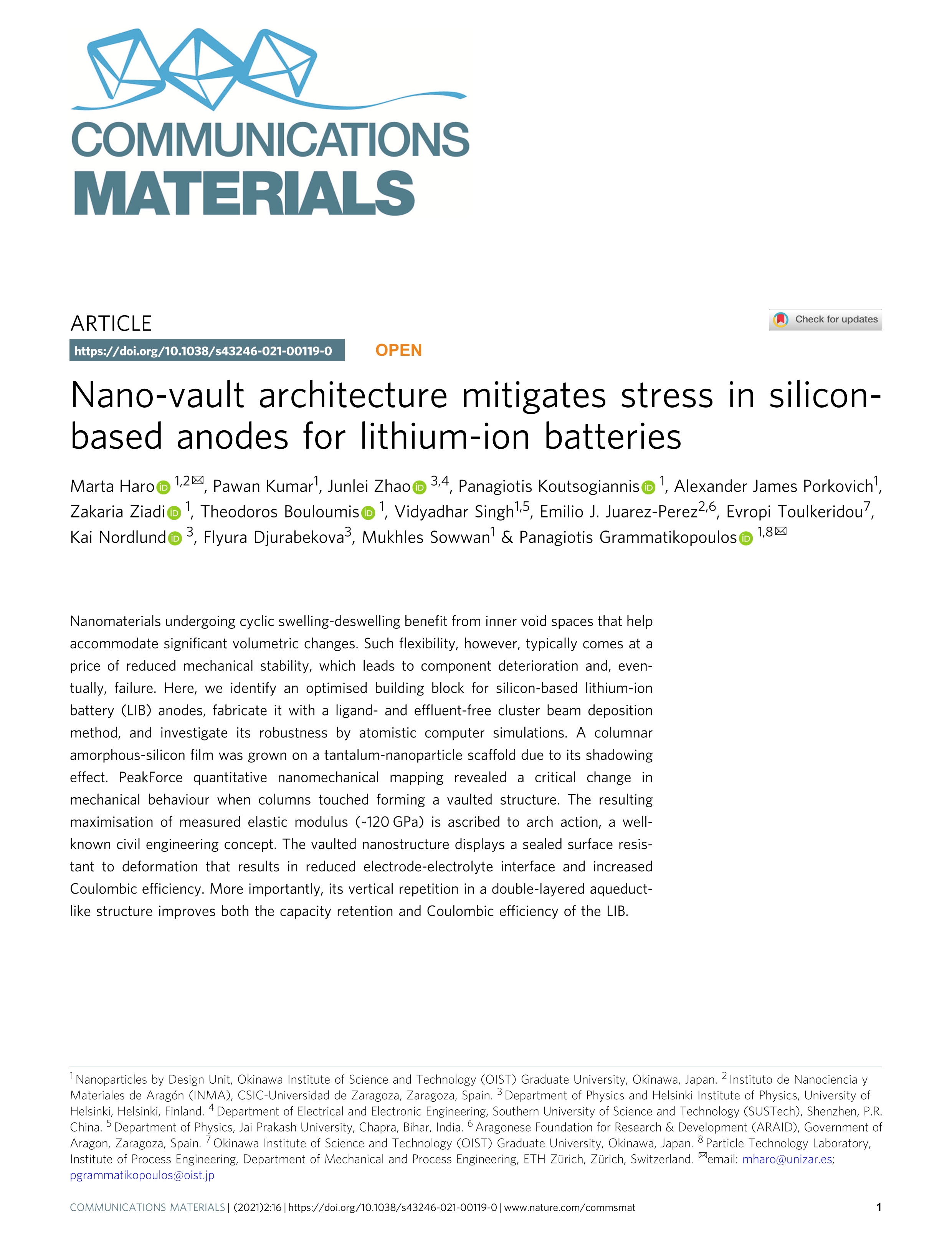
Resumen: Nanomaterials undergoing cyclic swelling-deswelling benefit from inner void spaces that help accommodate significant volumetric changes. Such flexibility, however, typically comes at a price of reduced mechanical stability, which leads to component deterioration and, eventually, failure. Here, we identify an optimised building block for silicon-based lithium-ion battery (LIB) anodes, fabricate it with a ligand- and effluent-free cluster beam deposition method, and investigate its robustness by atomistic computer simulations. A columnar amorphous-silicon film was grown on a tantalum-nanoparticle scaffold due to its shadowing effect. PeakForce quantitative nanomechanical mapping revealed a critical change in mechanical behaviour when columns touched forming a vaulted structure. The resulting maximisation of measured elastic modulus (similar to 120GPa) is ascribed to arch action, a well-known civil engineering concept. The vaulted nanostructure displays a sealed surface resistant to deformation that results in reduced electrode-electrolyte interface and increased Coulombic efficiency. More importantly, its vertical repetition in a double-layered aqueduct-like structure improves both the capacity retention and Coulombic efficiency of the LIB. Lithiation of anodes during cycling of lithium-ion batteries generates stresses that reduce operation lifetime. Here, a composite silicon-based anode with a nanoscale vaulted architecture shows high mechanical stability and electrochemical performance in a lithium-ion battery.
Idioma: Inglés
DOI: 10.1038/s43246-021-00119-0
Año: 2021
Publicado en: Communications materials 2, 1 (2021), 16 [10 pp]
ISSN: 2662-4443
Factor impacto CITESCORE: 4.0 - Materials Science (Q2) - Engineering (Q2)
Financiación: info:eu-repo/grantAgreement/ES/MICINN/PID2019-108247RA-I00
Financiación: info:eu-repo/grantAgreement/ES/MICINN/RYC-2018-025222-I
Tipo y forma: Artículo (Versión definitiva)
Área (Departamento): Área Química Física (Dpto. Química Física)
 Debe reconocer adecuadamente la autoría, proporcionar un enlace a la licencia e indicar si se han realizado cambios. Puede hacerlo de cualquier manera razonable, pero no de una manera que sugiera que tiene el apoyo del licenciador o lo recibe por el uso que hace.
Exportado de SIDERAL (2024-10-15-10:50:40)
Visitas y descargas
Idioma: Inglés
DOI: 10.1038/s43246-021-00119-0
Año: 2021
Publicado en: Communications materials 2, 1 (2021), 16 [10 pp]
ISSN: 2662-4443
Factor impacto CITESCORE: 4.0 - Materials Science (Q2) - Engineering (Q2)
Financiación: info:eu-repo/grantAgreement/ES/MICINN/PID2019-108247RA-I00
Financiación: info:eu-repo/grantAgreement/ES/MICINN/RYC-2018-025222-I
Tipo y forma: Artículo (Versión definitiva)
Área (Departamento): Área Química Física (Dpto. Química Física)
Debe reconocer adecuadamente la autoría, proporcionar un enlace a la licencia e indicar si se han realizado cambios. Puede hacerlo de cualquier manera razonable, pero no de una manera que sugiera que tiene el apoyo del licenciador o lo recibe por el uso que hace. Exportado de SIDERAL (2024-10-15-10:50:40)
Enlace permanente:
Visitas y descargas
Este artículo se encuentra en las siguientes colecciones:
Artículos > Artículos por área > Química Física
Registro creado el 2024-10-15, última modificación el 2024-10-15