Bayesian optimization for robust robotic grasping using a sensorized compliant hand
Lechuz-Sierra, Juan G. (Universidad de Zaragoza) ; Martín, Ana Elvira H. ; Sundaram, Ashok M. ; Martinez-Cantín, Rubén (Universidad de Zaragoza) ; Roa, Máximo A.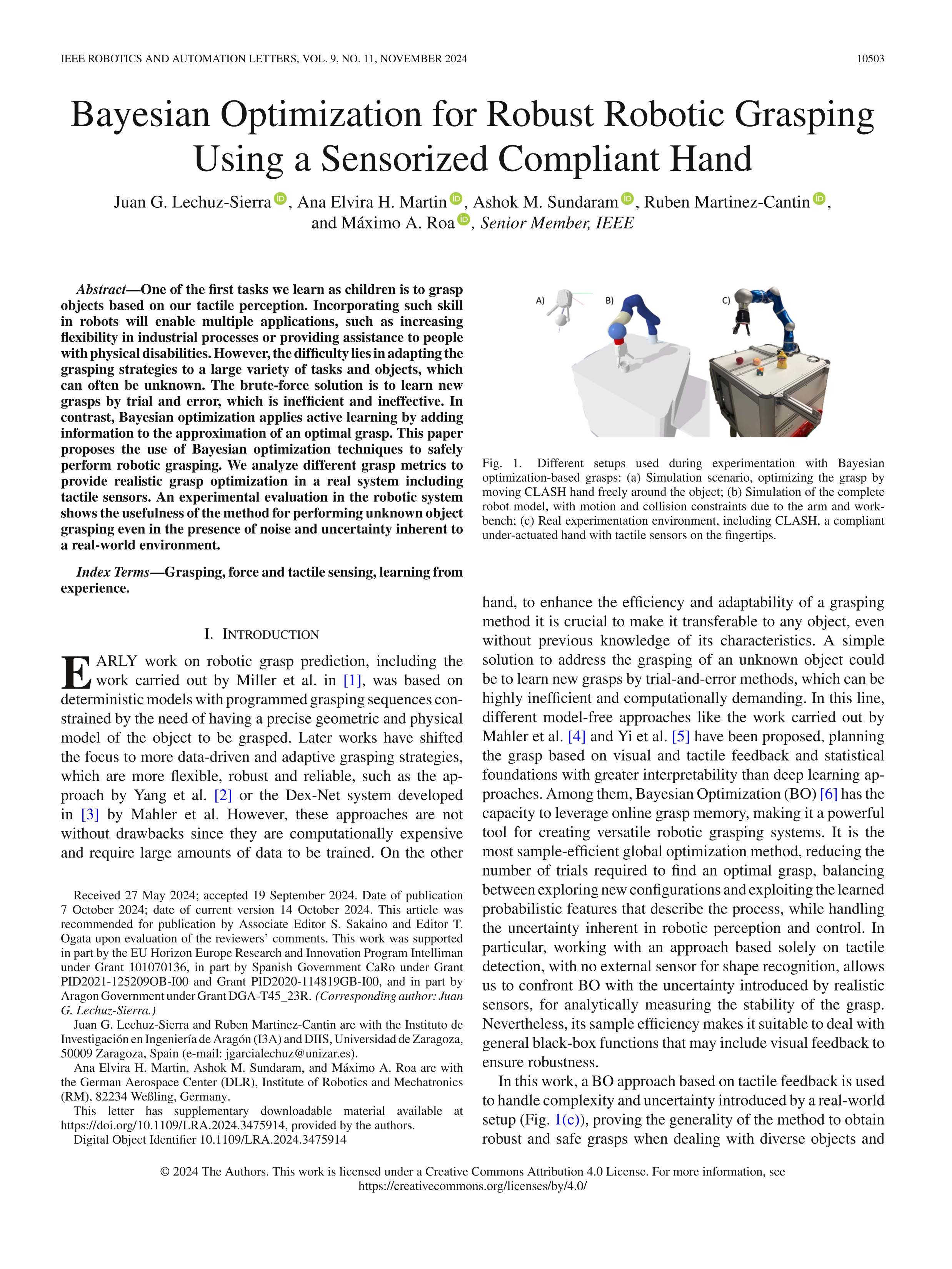
Resumen: One of the first tasks we learn as children is to grasp objects based on our tactile perception. Incorporating such skill in robots will enable multiple applications, such as increasing flexibility in industrial processes or providing assistance to people with physical disabilities. However, the difficulty lies in adapting the grasping strategies to a large variety of tasks and objects, which can often be unknown. The brute-force solution is to learn new grasps by trial and error, which is inefficient and ineffective. In contrast, Bayesian optimization applies active learning by adding information to the approximation of an optimal grasp. This paper proposes the use of Bayesian optimization techniques to safely perform robotic grasping. We analyze different grasp metrics to provide realistic grasp optimization in a real system including tactile sensors. An experimental evaluation in the robotic system shows the usefulness of the method for performing unknown object grasping even in the presence of noise and uncertainty inherent to a real-world environment.
Idioma: Inglés
DOI: 10.1109/LRA.2024.3475914
Año: 2024
Publicado en: IEEE Robotics and Automation Letters 9, 11 (2024), 10503-10510
ISSN: 2377-3766
Factor impacto JCR: 5.3 (2024)
Categ. JCR: ROBOTICS rank: 12 / 48 = 0.25 (2024) - Q1 - T1
Factor impacto CITESCORE: 10.3 - Mechanical Engineering (Q1) - Computer Science Applications (Q1) - Control and Systems Engineering (Q1) - Human-Computer Interaction (Q1) - Control and Optimization (Q1) - Biomedical Engineering (Q1) - Computer Vision and Pattern Recognition (Q1) - Artificial Intelligence (Q1)
Factor impacto SCIMAGO: 1.481 - Artificial Intelligence (Q1) - Biomedical Engineering (Q1) - Computer Science Applications (Q1) - Mechanical Engineering (Q1) - Control and Optimization (Q1) - Control and Systems Engineering (Q1) - Human-Computer Interaction (Q1) - Computer Vision and Pattern Recognition (Q1)
Financiación: info:eu-repo/grantAgreement/ES/AEI/PID2020-114819GB-I00
Financiación: info:eu-repo/grantAgreement/ES/DGA/T45-23R
Financiación: info:eu-repo/grantAgreement/EC/HORIZON EUROPE/101070136/EU/AI-Powered Manipulation System for Advanced Robotic Service, Manufacturing and Prosthetics/IntelliMan
Financiación: info:eu-repo/grantAgreement/ES/MICINN-AEI/PID2021-125209OB-I00
Tipo y forma: Article (Published version)
Área (Departamento): Área Ingen.Sistemas y Automát. (Dpto. Informát.Ingenie.Sistms.)
Exportado de SIDERAL (2026-02-17-20:28:39)
Visitas y descargas
Idioma: Inglés
DOI: 10.1109/LRA.2024.3475914
Año: 2024
Publicado en: IEEE Robotics and Automation Letters 9, 11 (2024), 10503-10510
ISSN: 2377-3766
Factor impacto JCR: 5.3 (2024)
Categ. JCR: ROBOTICS rank: 12 / 48 = 0.25 (2024) - Q1 - T1
Factor impacto CITESCORE: 10.3 - Mechanical Engineering (Q1) - Computer Science Applications (Q1) - Control and Systems Engineering (Q1) - Human-Computer Interaction (Q1) - Control and Optimization (Q1) - Biomedical Engineering (Q1) - Computer Vision and Pattern Recognition (Q1) - Artificial Intelligence (Q1)
Factor impacto SCIMAGO: 1.481 - Artificial Intelligence (Q1) - Biomedical Engineering (Q1) - Computer Science Applications (Q1) - Mechanical Engineering (Q1) - Control and Optimization (Q1) - Control and Systems Engineering (Q1) - Human-Computer Interaction (Q1) - Computer Vision and Pattern Recognition (Q1)
Financiación: info:eu-repo/grantAgreement/ES/AEI/PID2020-114819GB-I00
Financiación: info:eu-repo/grantAgreement/ES/DGA/T45-23R
Financiación: info:eu-repo/grantAgreement/EC/HORIZON EUROPE/101070136/EU/AI-Powered Manipulation System for Advanced Robotic Service, Manufacturing and Prosthetics/IntelliMan
Financiación: info:eu-repo/grantAgreement/ES/MICINN-AEI/PID2021-125209OB-I00
Tipo y forma: Article (Published version)
Área (Departamento): Área Ingen.Sistemas y Automát. (Dpto. Informát.Ingenie.Sistms.)
Exportado de SIDERAL (2026-02-17-20:28:39)
Permalink:
Visitas y descargas
Este artículo se encuentra en las siguientes colecciones:
articulos > articulos-por-area > ingenieria_de_sistemas_y_automatica
Notice créée le 2024-11-22, modifiée le 2026-02-17