Retrospective analysis to validate the CTS5 in patients from <i>El Álamo IV</i> registry and GEICAM adjuvant studies
Lopez-Tarruella, Sara ; Pollán, Marina ; Carrasco, Eva ; Andrés, Raquel (Universidad de Zaragoza) ; Martín, Miguel ; Servitja, Sonia ; Bermejo, Begoña ; Antón, Antonio (Universidad de Zaragoza) ; Guerrero-Zotano, Ángel ; Muñoz, Montserrat ; Fernández, Luis ; Martínez del Prado, Purificación ; Álvarez, Isabel ; Calvo, Lourdes ; Rodríguez-Lescure, Álvaro ; Marín, María ; Ruiz-Borrego, Manuel ; Herranz, Jesús ; Polonio, Óscar ; Adrover, Encarna ; Moreno, Diana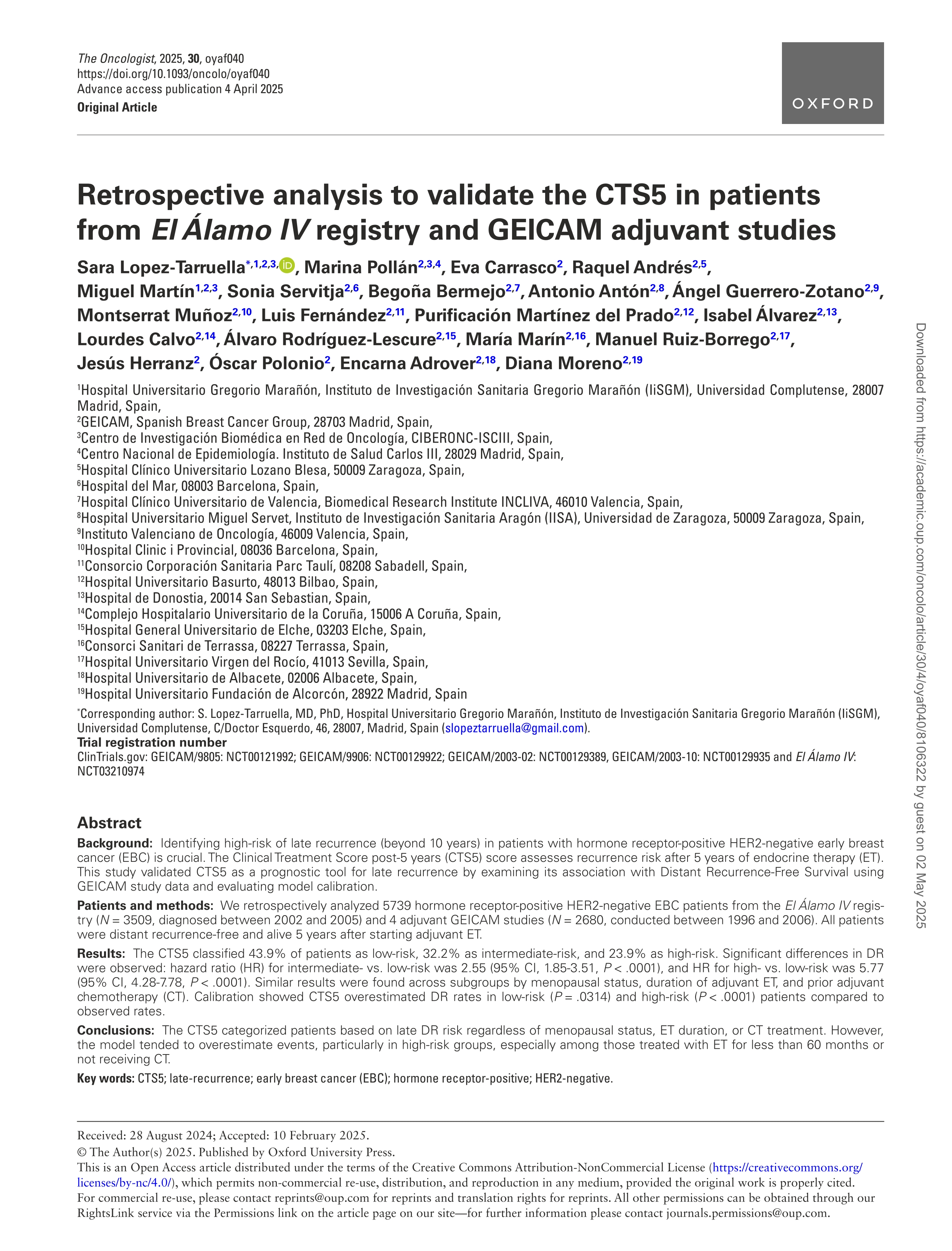
Resumen: Background
Identifying high-risk of late recurrence (beyond 10 years) in patients with hormone receptor-positive HER2-negative early breast cancer (EBC) is crucial. The Clinical Treatment Score post-5 years (CTS5) score assesses recurrence risk after 5 years of endocrine therapy (ET). This study validated CTS5 as a prognostic tool for late recurrence by examining its association with Distant Recurrence-Free Survival using GEICAM study data and evaluating model calibration.
Patients and methods
We retrospectively analyzed 5739 hormone receptor-positive HER2-negative EBC patients from the El Álamo IV registry (N = 3509, diagnosed between 2002 and 2005) and 4 adjuvant GEICAM studies (N = 2680, conducted between 1996 and 2006). All patients were distant recurrence-free and alive 5 years after starting adjuvant ET.
Results
The CTS5 classified 43.9% of patients as low-risk, 32.2% as intermediate-risk, and 23.9% as high-risk. Significant differences in DR were observed: hazard ratio (HR) for intermediate- vs. low-risk was 2.55 (95% CI, 1.85-3.51, P < .0001), and HR for high- vs. low-risk was 5.77 (95% CI, 4.28-7.78, P < .0001). Similar results were found across subgroups by menopausal status, duration of adjuvant ET, and prior adjuvant chemotherapy (CT). Calibration showed CTS5 overestimated DR rates in low-risk (P = .0314) and high-risk (P < .0001) patients compared to observed rates.
Conclusions
The CTS5 categorized patients based on late DR risk regardless of menopausal status, ET duration, or CT treatment. However, the model tended to overestimate events, particularly in high-risk groups, especially among those treated with ET for less than 60 months or not receiving CT.
Idioma: Inglés
DOI: 10.1093/oncolo/oyaf040
Año: 2025
Publicado en: ONCOLOGIST 30, 4 (2025), [9 pp.]
ISSN: 1083-7159
Tipo y forma: Artículo (Versión definitiva)
Área (Departamento): Area Medicina (Dpto. Medicina, Psiqu. y Derm.)
 Debe reconocer adecuadamente la autoría, proporcionar un enlace a la licencia e indicar si se han realizado cambios. Puede hacerlo de cualquier manera razonable, pero no de una manera que sugiera que tiene el apoyo del licenciador o lo recibe por el uso que hace. No puede utilizar el material para una finalidad comercial.
Exportado de SIDERAL (2025-10-17-14:20:05)
Visitas y descargas
Identifying high-risk of late recurrence (beyond 10 years) in patients with hormone receptor-positive HER2-negative early breast cancer (EBC) is crucial. The Clinical Treatment Score post-5 years (CTS5) score assesses recurrence risk after 5 years of endocrine therapy (ET). This study validated CTS5 as a prognostic tool for late recurrence by examining its association with Distant Recurrence-Free Survival using GEICAM study data and evaluating model calibration.
Patients and methods
We retrospectively analyzed 5739 hormone receptor-positive HER2-negative EBC patients from the El Álamo IV registry (N = 3509, diagnosed between 2002 and 2005) and 4 adjuvant GEICAM studies (N = 2680, conducted between 1996 and 2006). All patients were distant recurrence-free and alive 5 years after starting adjuvant ET.
Results
The CTS5 classified 43.9% of patients as low-risk, 32.2% as intermediate-risk, and 23.9% as high-risk. Significant differences in DR were observed: hazard ratio (HR) for intermediate- vs. low-risk was 2.55 (95% CI, 1.85-3.51, P < .0001), and HR for high- vs. low-risk was 5.77 (95% CI, 4.28-7.78, P < .0001). Similar results were found across subgroups by menopausal status, duration of adjuvant ET, and prior adjuvant chemotherapy (CT). Calibration showed CTS5 overestimated DR rates in low-risk (P = .0314) and high-risk (P < .0001) patients compared to observed rates.
Conclusions
The CTS5 categorized patients based on late DR risk regardless of menopausal status, ET duration, or CT treatment. However, the model tended to overestimate events, particularly in high-risk groups, especially among those treated with ET for less than 60 months or not receiving CT.
Idioma: Inglés
DOI: 10.1093/oncolo/oyaf040
Año: 2025
Publicado en: ONCOLOGIST 30, 4 (2025), [9 pp.]
ISSN: 1083-7159
Tipo y forma: Artículo (Versión definitiva)
Área (Departamento): Area Medicina (Dpto. Medicina, Psiqu. y Derm.)
Debe reconocer adecuadamente la autoría, proporcionar un enlace a la licencia e indicar si se han realizado cambios. Puede hacerlo de cualquier manera razonable, pero no de una manera que sugiera que tiene el apoyo del licenciador o lo recibe por el uso que hace. No puede utilizar el material para una finalidad comercial.Exportado de SIDERAL (2025-10-17-14:20:05)
Enlace permanente:
Visitas y descargas
Este artículo se encuentra en las siguientes colecciones:
Artículos > Artículos por área > Medicina
Registro creado el 2025-05-08, última modificación el 2025-10-17