Sensory profiling and quality assessment of wines derived from Graciano × Tempranillo selections
Manso-Martínez, Cristina ; Sáenz-Navajas, María Pilar (Universidad de Zaragoza) ; Hernández, María M. ; Menéndez, Cristina M.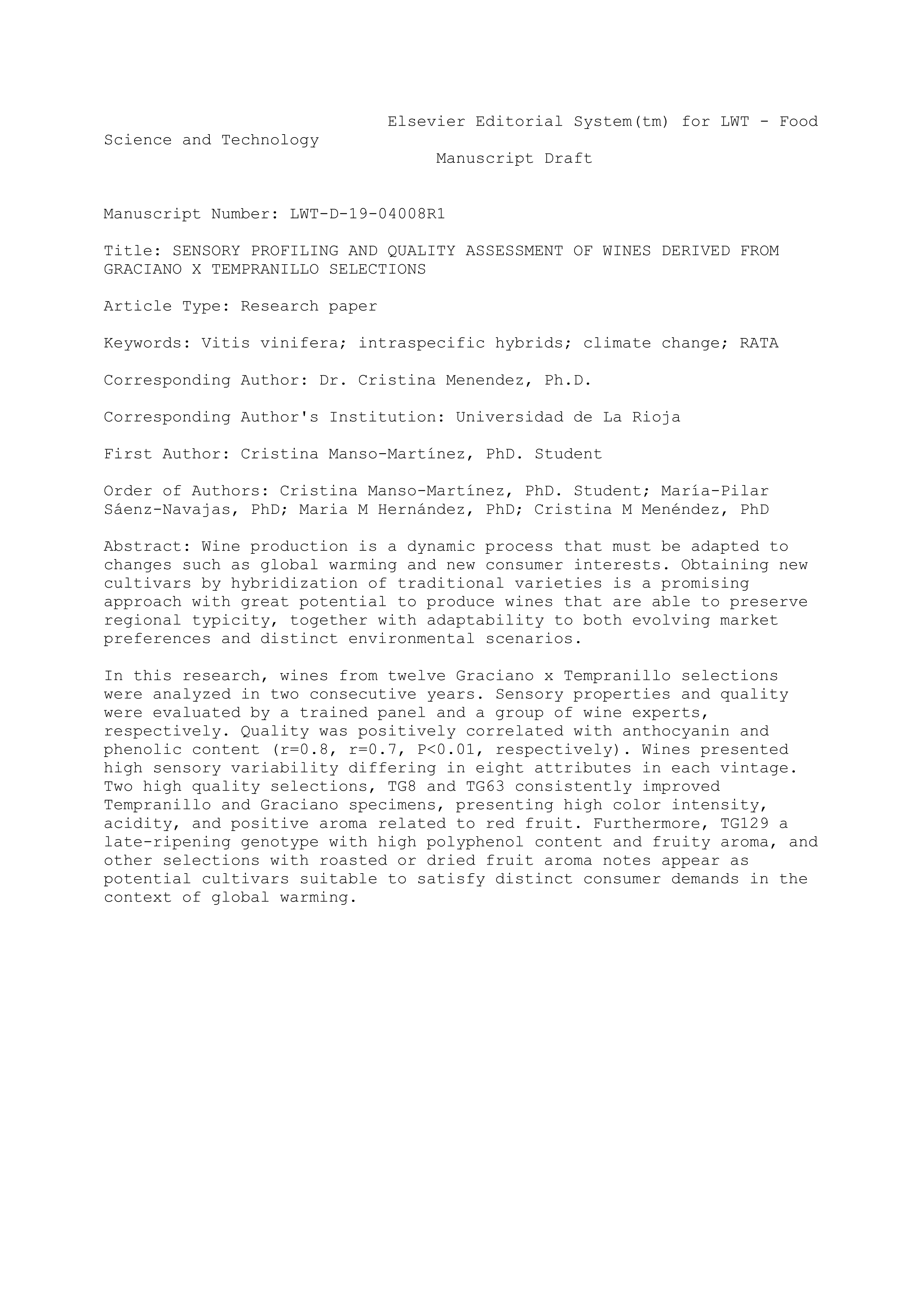
Resumen: Wine production is a dynamic process that must be adapted to changes such as global warming and new consumer interests. Obtaining new cultivars by hybridization of traditional varieties is a promising approach with great potential to produce wines that are able to preserve regional typicity, together with adaptability to both evolving market preferences and distinct environmental scenarios. In this research, wines from twelve Graciano × Tempranillo selections were analyzed in two consecutive years. Sensory properties and quality were evaluated by a trained panel and a group of wine experts, respectively. Quality was positively correlated with anthocyanin and phenolic content (r = 0.8, r = 0.7, p < 0.01, respectively). Wines presented high sensory variability differing in eight attributes in each vintage. Two high quality selections, TG8 and TG63 consistently improved Tempranillo and Graciano specimens, presenting high color intensity, acidity, and positive aroma related to red fruit. Furthermore, TG129 a late-ripening genotype with high polyphenol content and fruity aroma, and other selections with roasted or dried fruit aroma notes appear as potential cultivars suitable to satisfy distinct consumer demands in the context of global warming.
Idioma: Inglés
DOI: 10.1016/j.lwt.2020.109394
Año: 2020
Publicado en: LWT-FOOD SCIENCE AND TECHNOLOGY 127 (2020), 109394 [8 pp.]
ISSN: 0023-6438
Factor impacto JCR: 4.952 (2020)
Categ. JCR: FOOD SCIENCE & TECHNOLOGY rank: 29 / 143 = 0.203 (2020) - Q1 - T1
Factor impacto SCIMAGO: 1.258 - Food Science (Q1)
Tipo y forma: Artículo (PostPrint)
Área (Departamento): Área Química Analítica (Dpto. Química Analítica)
 Debe reconocer adecuadamente la autoría, proporcionar un enlace a la licencia e indicar si se han realizado cambios. Puede hacerlo de cualquier manera razonable, pero no de una manera que sugiera que tiene el apoyo del licenciador o lo recibe por el uso que hace. No puede utilizar el material para una finalidad comercial. Si remezcla, transforma o crea a partir del material, no puede difundir el material modificado.
Exportado de SIDERAL (2025-10-17-14:13:45)
Visitas y descargas
Idioma: Inglés
DOI: 10.1016/j.lwt.2020.109394
Año: 2020
Publicado en: LWT-FOOD SCIENCE AND TECHNOLOGY 127 (2020), 109394 [8 pp.]
ISSN: 0023-6438
Factor impacto JCR: 4.952 (2020)
Categ. JCR: FOOD SCIENCE & TECHNOLOGY rank: 29 / 143 = 0.203 (2020) - Q1 - T1
Factor impacto SCIMAGO: 1.258 - Food Science (Q1)
Tipo y forma: Artículo (PostPrint)
Área (Departamento): Área Química Analítica (Dpto. Química Analítica)
Debe reconocer adecuadamente la autoría, proporcionar un enlace a la licencia e indicar si se han realizado cambios. Puede hacerlo de cualquier manera razonable, pero no de una manera que sugiera que tiene el apoyo del licenciador o lo recibe por el uso que hace. No puede utilizar el material para una finalidad comercial. Si remezcla, transforma o crea a partir del material, no puede difundir el material modificado.Exportado de SIDERAL (2025-10-17-14:13:45)
Enlace permanente:
Visitas y descargas
Este artículo se encuentra en las siguientes colecciones:
Artículos > Artículos por área > Química Analítica
Registro creado el 2025-05-16, última modificación el 2025-10-17