Activation of CO, Isocyanides, and Alkynes by frustrated Lewis Pairs based on Cp*M/N (M = Rh, Ir) Couples
Ferrer-Bru, Carlos ; Ferrer, Joaquina (Universidad de Zaragoza) ; Lahoz, Fernando J. ; García-Orduña, Pilar ; Carmona, Daniel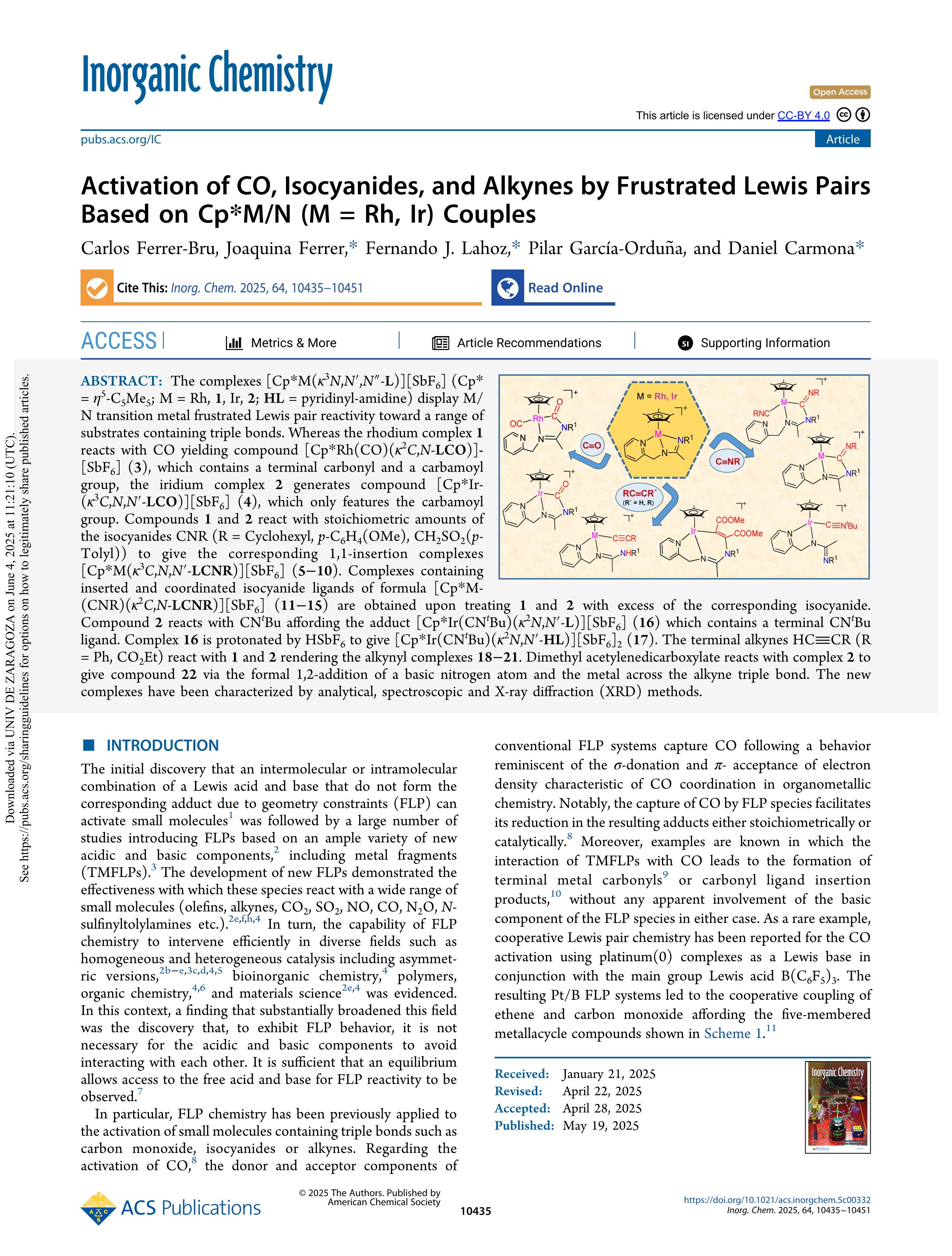
Resumen: The complexes [Cp*M(κ3N,N′,N″-L)][SbF6] (Cp* = η5-C5Me5; M = Rh, 1, Ir, 2; HL = pyridinyl-amidine) display M/N transition metal frustrated Lewis pair reactivity toward a range of substrates containing triple bonds. Whereas the rhodium complex 1 reacts with CO yielding compound [Cp*Rh(CO)(κ2C,N-LCO)][SbF6] (3), which contains a terminal carbonyl and a carbamoyl group, the iridium complex 2 generates compound [Cp*Ir(κ3C,N,N′-LCO)][SbF6] (4), which only features the carbamoyl group. Compounds 1 and 2 react with stoichiometric amounts of the isocyanides CNR (R = Cyclohexyl, p-C6H4(OMe), CH2SO2(p-Tolyl)) to give the corresponding 1,1-insertion complexes [Cp*M(κ3C,N,N′-LCNR)][SbF6] (5–10). Complexes containing inserted and coordinated isocyanide ligands of formula [Cp*M(CNR)(κ2C,N-LCNR)][SbF6] (11–15) are obtained upon treating 1 and 2 with excess of the corresponding isocyanide. Compound 2 reacts with CNtBu affording the adduct [Cp*Ir(CNtBu)(κ2N,N′-L)][SbF6] (16) which contains a terminal CNtBu ligand. Complex 16 is protonated by HSbF6 to give [Cp*Ir(CNtBu)(κ2N,N′-HL)][SbF6]2 (17). The terminal alkynes HC≡CR (R = Ph, CO2Et) react with 1 and 2 rendering the alkynyl complexes 18–21. Dimethyl acetylenedicarboxylate reacts with complex 2 to give compound 22 via the formal 1,2-addition of a basic nitrogen atom and the metal across the alkyne triple bond. The new complexes have been characterized by analytical, spectroscopic and X-ray diffraction (XRD) methods.
Idioma: Inglés
DOI: 10.1021/acs.inorgchem.5c00332
Año: 2025
Publicado en: Inorganic Chemistry 64, 21 (2025), 10435-10451
ISSN: 0020-1669
Financiación: info:eu-repo/grantAgreement/ES/DGA/E05-23R
Financiación: info:eu-repo/grantAgreement/ES/MCIU-AEI-FEDER/PID2021-122406NB-I00
Financiación: info:eu-repo/grantAgreement/ES/MCIU/CTQ2018-095561-BI00
Tipo y forma: Article (Published version)
Área (Departamento): Área Química Inorgánica (Dpto. Química Inorgánica)
 You must give appropriate credit, provide a link to the license, and indicate if changes were made. You may do so in any reasonable manner, but not in any way that suggests the licensor endorses you or your use.
Exportado de SIDERAL (2025-10-17-14:12:19)
Visitas y descargas
Idioma: Inglés
DOI: 10.1021/acs.inorgchem.5c00332
Año: 2025
Publicado en: Inorganic Chemistry 64, 21 (2025), 10435-10451
ISSN: 0020-1669
Financiación: info:eu-repo/grantAgreement/ES/DGA/E05-23R
Financiación: info:eu-repo/grantAgreement/ES/MCIU-AEI-FEDER/PID2021-122406NB-I00
Financiación: info:eu-repo/grantAgreement/ES/MCIU/CTQ2018-095561-BI00
Tipo y forma: Article (Published version)
Área (Departamento): Área Química Inorgánica (Dpto. Química Inorgánica)
You must give appropriate credit, provide a link to the license, and indicate if changes were made. You may do so in any reasonable manner, but not in any way that suggests the licensor endorses you or your use. Exportado de SIDERAL (2025-10-17-14:12:19)
Permalink:
Visitas y descargas
Este artículo se encuentra en las siguientes colecciones:
Articles > Artículos por área > Química Inorgánica
Record created 2025-06-05, last modified 2025-10-17