Activation of CO, Isocyanides, and Alkynes by frustrated Lewis Pairs based on Cp*M/N (M = Rh, Ir) Couples
Ferrer-Bru, Carlos ; Ferrer, Joaquina (Universidad de Zaragoza) ; Lahoz, Fernando J. ; García-Orduña, Pilar ; Carmona, Daniel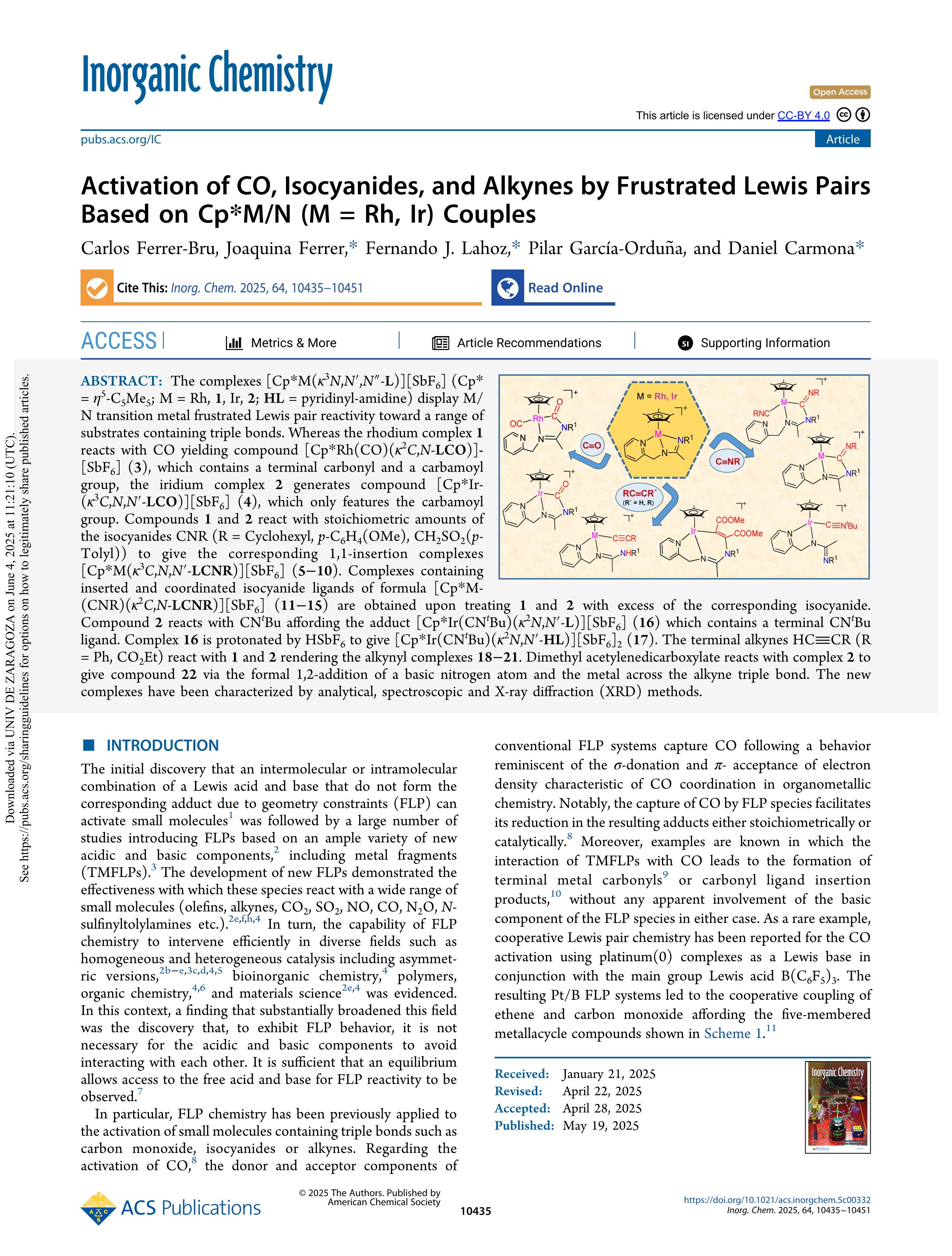
Resumen: The complexes [Cp*M(κ3N,N′,N″-L)][SbF6] (Cp* = η5-C5Me5; M = Rh, 1, Ir, 2; HL = pyridinyl-amidine) display M/N transition metal frustrated Lewis pair reactivity toward a range of substrates containing triple bonds. Whereas the rhodium complex 1 reacts with CO yielding compound [Cp*Rh(CO)(κ2C,N-LCO)][SbF6] (3), which contains a terminal carbonyl and a carbamoyl group, the iridium complex 2 generates compound [Cp*Ir(κ3C,N,N′-LCO)][SbF6] (4), which only features the carbamoyl group. Compounds 1 and 2 react with stoichiometric amounts of the isocyanides CNR (R = Cyclohexyl, p-C6H4(OMe), CH2SO2(p-Tolyl)) to give the corresponding 1,1-insertion complexes [Cp*M(κ3C,N,N′-LCNR)][SbF6] (5–10). Complexes containing inserted and coordinated isocyanide ligands of formula [Cp*M(CNR)(κ2C,N-LCNR)][SbF6] (11–15) are obtained upon treating 1 and 2 with excess of the corresponding isocyanide. Compound 2 reacts with CNtBu affording the adduct [Cp*Ir(CNtBu)(κ2N,N′-L)][SbF6] (16) which contains a terminal CNtBu ligand. Complex 16 is protonated by HSbF6 to give [Cp*Ir(CNtBu)(κ2N,N′-HL)][SbF6]2 (17). The terminal alkynes HC≡CR (R = Ph, CO2Et) react with 1 and 2 rendering the alkynyl complexes 18–21. Dimethyl acetylenedicarboxylate reacts with complex 2 to give compound 22 via the formal 1,2-addition of a basic nitrogen atom and the metal across the alkyne triple bond. The new complexes have been characterized by analytical, spectroscopic and X-ray diffraction (XRD) methods.
Idioma: Inglés
DOI: 10.1021/acs.inorgchem.5c00332
Año: 2025
Publicado en: Inorganic Chemistry 64, 21 (2025), 10435-10451
ISSN: 0020-1669
Financiación: info:eu-repo/grantAgreement/ES/DGA/E05-23R
Financiación: info:eu-repo/grantAgreement/ES/MCIU-AEI-FEDER/PID2021-122406NB-I00
Financiación: info:eu-repo/grantAgreement/ES/MCIU/CTQ2018-095561-BI00
Tipo y forma: Artículo (Versión definitiva)
Área (Departamento): Área Química Inorgánica (Dpto. Química Inorgánica)
 Debe reconocer adecuadamente la autoría, proporcionar un enlace a la licencia e indicar si se han realizado cambios. Puede hacerlo de cualquier manera razonable, pero no de una manera que sugiera que tiene el apoyo del licenciador o lo recibe por el uso que hace.
Exportado de SIDERAL (2025-10-17-14:12:19)
Visitas y descargas
Idioma: Inglés
DOI: 10.1021/acs.inorgchem.5c00332
Año: 2025
Publicado en: Inorganic Chemistry 64, 21 (2025), 10435-10451
ISSN: 0020-1669
Financiación: info:eu-repo/grantAgreement/ES/DGA/E05-23R
Financiación: info:eu-repo/grantAgreement/ES/MCIU-AEI-FEDER/PID2021-122406NB-I00
Financiación: info:eu-repo/grantAgreement/ES/MCIU/CTQ2018-095561-BI00
Tipo y forma: Artículo (Versión definitiva)
Área (Departamento): Área Química Inorgánica (Dpto. Química Inorgánica)
Debe reconocer adecuadamente la autoría, proporcionar un enlace a la licencia e indicar si se han realizado cambios. Puede hacerlo de cualquier manera razonable, pero no de una manera que sugiera que tiene el apoyo del licenciador o lo recibe por el uso que hace. Exportado de SIDERAL (2025-10-17-14:12:19)
Enlace permanente:
Visitas y descargas
Este artículo se encuentra en las siguientes colecciones:
Artículos > Artículos por área > Química Inorgánica
Registro creado el 2025-06-05, última modificación el 2025-10-17