Concomitant anti-CGRP and immunomodulatory treatments in patients with migraine: towards integrated management strategies
García-Castillo, María Clara ; Sierra-Mencía, Álvaro ; Caronna, Edoardo ; Toledo-Alfocea, Daniel ; Jaimes, Alex ; Urtiaga, Saray ; Casas-Limón, Javier ; Muñoz-Vendrell, Albert ; Santos Lasaosa, Sonia (Universidad de Zaragoza) ; García Martín, Valvanuz ; Martín Ávila, Guillermo ; Polanco, Marcos ; Villar-Martínez, Maria Dolores ; Trevino-Peinado, Cristina ; Rubio-Flores, Laura ; Sánchez-Soblechero, Antonio ; Portocarrero Sánchez, Leonardo ; Luque-Buzo, Elisa ; Lozano-Ros, Alberto ; Gago-Veiga, Ana Beatriz ; Díaz-De-Terán, Javier ; Recio García, Andrea ; Canales Rodríguez, Javiera ; Gómez García, Andrea ; González Salaices, Marta ; Campoy, Sergio ; Mínguez-Olaondo, Ane ; Maniataki, Stefania ; González-Quintanilla, Vicente ; Porta-Etessam, Jesús ; Cuadrado, María-Luz ; Guerrero Peral, Ángel Luis ; Pozo-Rosich, Patricia ; Rodríguez-Vico, Jaime ; Huerta-Villanueva, Mariano ; Pascual, Julio ; Goadsby, Peter J. ; Gonzalez-Martinez, Alicia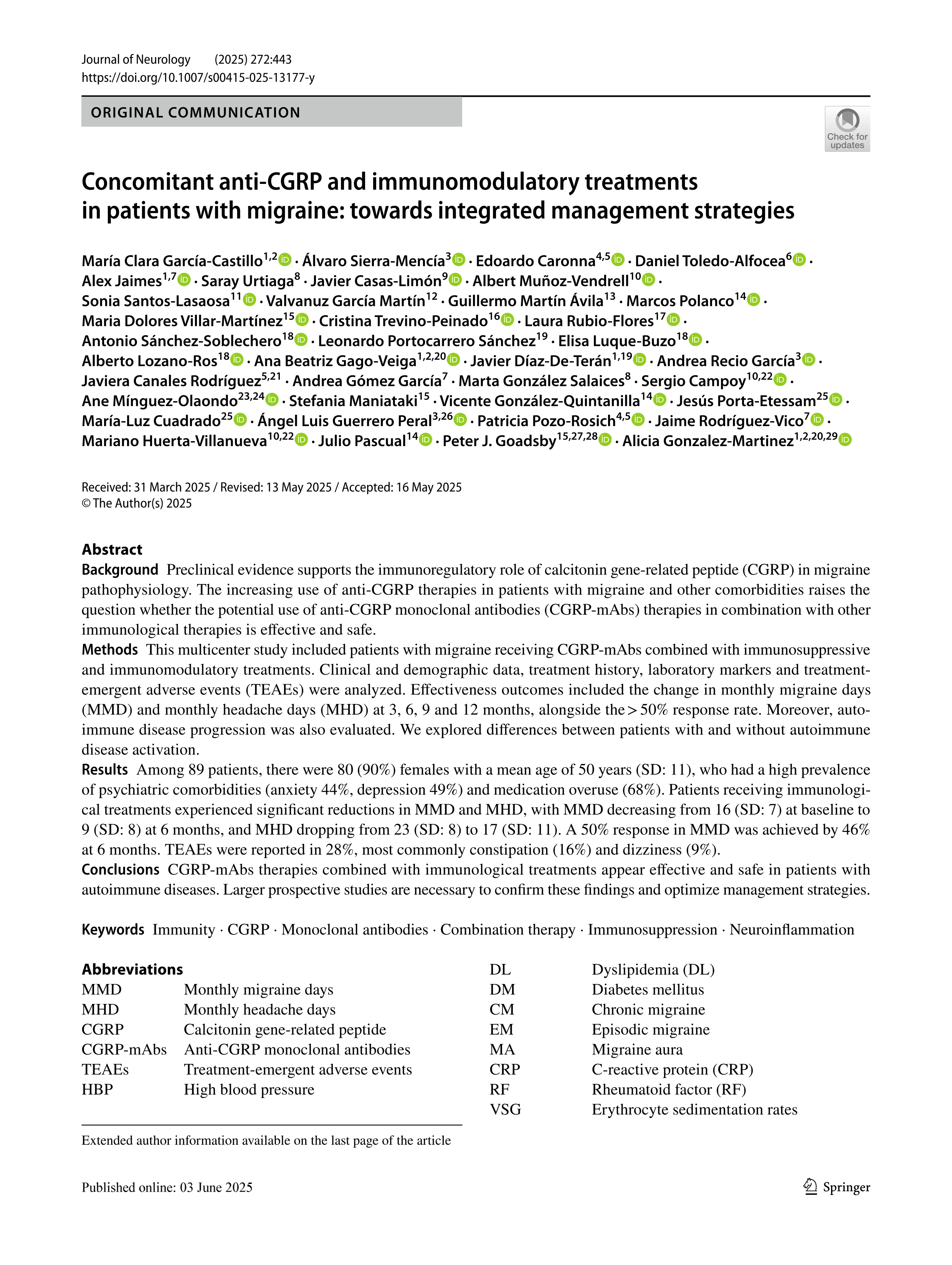
Resumen: Preclinical evidence supports the immunoregulatory role of calcitonin gene-related peptide (CGRP) in migraine pathophysiology. The increasing use of anti-CGRP therapies in patients with migraine and other comorbidities raises the question whether the potential use of anti-CGRP monoclonal antibodies (CGRP-mAbs) therapies in combination with other immunological therapies is effective and safe.
Methods. This multicenter study included patients with migraine receiving CGRP-mAbs combined with immunosuppressive and immunomodulatory treatments. Clinical and demographic data, treatment history, laboratory markers and treatment-emergent adverse events (TEAEs) were analyzed. Effectiveness outcomes included the change in monthly migraine days (MMD) and monthly headache days (MHD) at 3, 6, 9 and 12 months, alongside the > 50% response rate. Moreover, autoimmune disease progression was also evaluated. We explored differences between patients with and without autoimmune disease activation.
Results.Among 89 patients, there were 80 (90%) females with a mean age of 50 years (SD: 11), who had a high prevalence of psychiatric comorbidities (anxiety 44%, depression 49%) and medication overuse (68%). Patients receiving immunological treatments experienced significant reductions in MMD and MHD, with MMD decreasing from 16 (SD: 7) at baseline to 9 (SD: 8) at 6 months, and MHD dropping from 23 (SD: 8) to 17 (SD: 11). A 50% response in MMD was achieved by 46% at 6 months. TEAEs were reported in 28%, most commonly constipation (16%) and dizziness (9%).
Conclusions. CGRP-mAbs therapies combined with immunological treatments appear effective and safe in patients with autoimmune diseases. Larger prospective studies are necessary to confirm these findings and optimize management strategies.
Idioma: Inglés
DOI: 10.1007/s00415-025-13177-y
Año: 2025
Publicado en: Journal of Neurology 272, 6 (2025), 12 pp.
ISSN: 0340-5354
Financiación: info:eu-repo/grantAgreement/ES/ISCIII/CM21-00178
Financiación: info:eu-repo/grantAgreement/ES/ISCIII/JR23/0005
Financiación: info:eu-repo/grantAgreement/ES/ISCIII/PI24-01085
Tipo y forma: Article (Published version)
Área (Departamento): Area Medicina (Dpto. Medicina, Psiqu. y Derm.)
 You must give appropriate credit, provide a link to the license, and indicate if changes were made. You may do so in any reasonable manner, but not in any way that suggests the licensor endorses you or your use.
Exportado de SIDERAL (2025-10-17-14:17:56)
Visitas y descargas
Methods. This multicenter study included patients with migraine receiving CGRP-mAbs combined with immunosuppressive and immunomodulatory treatments. Clinical and demographic data, treatment history, laboratory markers and treatment-emergent adverse events (TEAEs) were analyzed. Effectiveness outcomes included the change in monthly migraine days (MMD) and monthly headache days (MHD) at 3, 6, 9 and 12 months, alongside the > 50% response rate. Moreover, autoimmune disease progression was also evaluated. We explored differences between patients with and without autoimmune disease activation.
Results.Among 89 patients, there were 80 (90%) females with a mean age of 50 years (SD: 11), who had a high prevalence of psychiatric comorbidities (anxiety 44%, depression 49%) and medication overuse (68%). Patients receiving immunological treatments experienced significant reductions in MMD and MHD, with MMD decreasing from 16 (SD: 7) at baseline to 9 (SD: 8) at 6 months, and MHD dropping from 23 (SD: 8) to 17 (SD: 11). A 50% response in MMD was achieved by 46% at 6 months. TEAEs were reported in 28%, most commonly constipation (16%) and dizziness (9%).
Conclusions. CGRP-mAbs therapies combined with immunological treatments appear effective and safe in patients with autoimmune diseases. Larger prospective studies are necessary to confirm these findings and optimize management strategies.
Idioma: Inglés
DOI: 10.1007/s00415-025-13177-y
Año: 2025
Publicado en: Journal of Neurology 272, 6 (2025), 12 pp.
ISSN: 0340-5354
Financiación: info:eu-repo/grantAgreement/ES/ISCIII/CM21-00178
Financiación: info:eu-repo/grantAgreement/ES/ISCIII/JR23/0005
Financiación: info:eu-repo/grantAgreement/ES/ISCIII/PI24-01085
Tipo y forma: Article (Published version)
Área (Departamento): Area Medicina (Dpto. Medicina, Psiqu. y Derm.)
You must give appropriate credit, provide a link to the license, and indicate if changes were made. You may do so in any reasonable manner, but not in any way that suggests the licensor endorses you or your use. Exportado de SIDERAL (2025-10-17-14:17:56)
Permalink:
Visitas y descargas
Este artículo se encuentra en las siguientes colecciones:
Articles > Artículos por área > Medicina
Record created 2025-06-16, last modified 2025-10-17