Concomitant anti-CGRP and immunomodulatory treatments in patients with migraine: towards integrated management strategies
García-Castillo, María Clara ; Sierra-Mencía, Álvaro ; Caronna, Edoardo ; Toledo-Alfocea, Daniel ; Jaimes, Alex ; Urtiaga, Saray ; Casas-Limón, Javier ; Muñoz-Vendrell, Albert ; Santos Lasaosa, Sonia (Universidad de Zaragoza) ; García Martín, Valvanuz ; Martín Ávila, Guillermo ; Polanco, Marcos ; Villar-Martínez, Maria Dolores ; Trevino-Peinado, Cristina ; Rubio-Flores, Laura ; Sánchez-Soblechero, Antonio ; Portocarrero Sánchez, Leonardo ; Luque-Buzo, Elisa ; Lozano-Ros, Alberto ; Gago-Veiga, Ana Beatriz ; Díaz-De-Terán, Javier ; Recio García, Andrea ; Canales Rodríguez, Javiera ; Gómez García, Andrea ; González Salaices, Marta ; Campoy, Sergio ; Mínguez-Olaondo, Ane ; Maniataki, Stefania ; González-Quintanilla, Vicente ; Porta-Etessam, Jesús ; Cuadrado, María-Luz ; Guerrero Peral, Ángel Luis ; Pozo-Rosich, Patricia ; Rodríguez-Vico, Jaime ; Huerta-Villanueva, Mariano ; Pascual, Julio ; Goadsby, Peter J. ; Gonzalez-Martinez, Alicia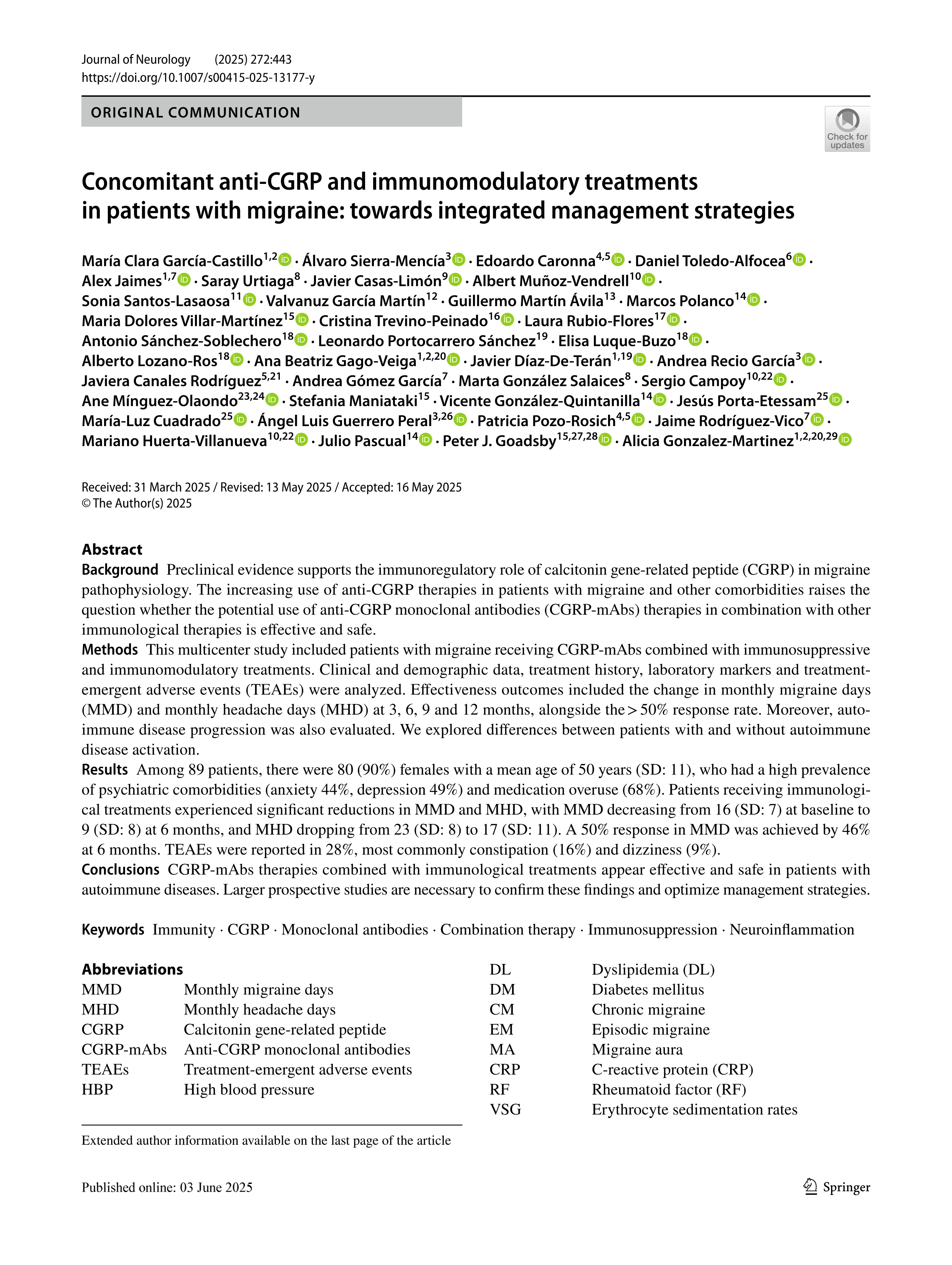
Resumen: Preclinical evidence supports the immunoregulatory role of calcitonin gene-related peptide (CGRP) in migraine pathophysiology. The increasing use of anti-CGRP therapies in patients with migraine and other comorbidities raises the question whether the potential use of anti-CGRP monoclonal antibodies (CGRP-mAbs) therapies in combination with other immunological therapies is effective and safe.
Methods. This multicenter study included patients with migraine receiving CGRP-mAbs combined with immunosuppressive and immunomodulatory treatments. Clinical and demographic data, treatment history, laboratory markers and treatment-emergent adverse events (TEAEs) were analyzed. Effectiveness outcomes included the change in monthly migraine days (MMD) and monthly headache days (MHD) at 3, 6, 9 and 12 months, alongside the > 50% response rate. Moreover, autoimmune disease progression was also evaluated. We explored differences between patients with and without autoimmune disease activation.
Results.Among 89 patients, there were 80 (90%) females with a mean age of 50 years (SD: 11), who had a high prevalence of psychiatric comorbidities (anxiety 44%, depression 49%) and medication overuse (68%). Patients receiving immunological treatments experienced significant reductions in MMD and MHD, with MMD decreasing from 16 (SD: 7) at baseline to 9 (SD: 8) at 6 months, and MHD dropping from 23 (SD: 8) to 17 (SD: 11). A 50% response in MMD was achieved by 46% at 6 months. TEAEs were reported in 28%, most commonly constipation (16%) and dizziness (9%).
Conclusions. CGRP-mAbs therapies combined with immunological treatments appear effective and safe in patients with autoimmune diseases. Larger prospective studies are necessary to confirm these findings and optimize management strategies.
Idioma: Inglés
DOI: 10.1007/s00415-025-13177-y
Año: 2025
Publicado en: Journal of Neurology 272, 6 (2025), 12 pp.
ISSN: 0340-5354
Financiación: info:eu-repo/grantAgreement/ES/ISCIII/CM21-00178
Financiación: info:eu-repo/grantAgreement/ES/ISCIII/JR23/0005
Financiación: info:eu-repo/grantAgreement/ES/ISCIII/PI24-01085
Tipo y forma: Artículo (Versión definitiva)
Área (Departamento): Area Medicina (Dpto. Medicina, Psiqu. y Derm.)
 Debe reconocer adecuadamente la autoría, proporcionar un enlace a la licencia e indicar si se han realizado cambios. Puede hacerlo de cualquier manera razonable, pero no de una manera que sugiera que tiene el apoyo del licenciador o lo recibe por el uso que hace.
Exportado de SIDERAL (2025-10-17-14:17:56)
Visitas y descargas
Methods. This multicenter study included patients with migraine receiving CGRP-mAbs combined with immunosuppressive and immunomodulatory treatments. Clinical and demographic data, treatment history, laboratory markers and treatment-emergent adverse events (TEAEs) were analyzed. Effectiveness outcomes included the change in monthly migraine days (MMD) and monthly headache days (MHD) at 3, 6, 9 and 12 months, alongside the > 50% response rate. Moreover, autoimmune disease progression was also evaluated. We explored differences between patients with and without autoimmune disease activation.
Results.Among 89 patients, there were 80 (90%) females with a mean age of 50 years (SD: 11), who had a high prevalence of psychiatric comorbidities (anxiety 44%, depression 49%) and medication overuse (68%). Patients receiving immunological treatments experienced significant reductions in MMD and MHD, with MMD decreasing from 16 (SD: 7) at baseline to 9 (SD: 8) at 6 months, and MHD dropping from 23 (SD: 8) to 17 (SD: 11). A 50% response in MMD was achieved by 46% at 6 months. TEAEs were reported in 28%, most commonly constipation (16%) and dizziness (9%).
Conclusions. CGRP-mAbs therapies combined with immunological treatments appear effective and safe in patients with autoimmune diseases. Larger prospective studies are necessary to confirm these findings and optimize management strategies.
Idioma: Inglés
DOI: 10.1007/s00415-025-13177-y
Año: 2025
Publicado en: Journal of Neurology 272, 6 (2025), 12 pp.
ISSN: 0340-5354
Financiación: info:eu-repo/grantAgreement/ES/ISCIII/CM21-00178
Financiación: info:eu-repo/grantAgreement/ES/ISCIII/JR23/0005
Financiación: info:eu-repo/grantAgreement/ES/ISCIII/PI24-01085
Tipo y forma: Artículo (Versión definitiva)
Área (Departamento): Area Medicina (Dpto. Medicina, Psiqu. y Derm.)
Debe reconocer adecuadamente la autoría, proporcionar un enlace a la licencia e indicar si se han realizado cambios. Puede hacerlo de cualquier manera razonable, pero no de una manera que sugiera que tiene el apoyo del licenciador o lo recibe por el uso que hace. Exportado de SIDERAL (2025-10-17-14:17:56)
Enlace permanente:
Visitas y descargas
Este artículo se encuentra en las siguientes colecciones:
Artículos > Artículos por área > Medicina
Registro creado el 2025-06-16, última modificación el 2025-10-17