Fake news in educational communication: a systematic review
Soler-Costa, Rebeca (Universidad de Zaragoza) ; Lafarga-Ostariz, Pablo ; Ballesteros-Regaña, Cristóbal ; Mellado-Moreno, Pedro C.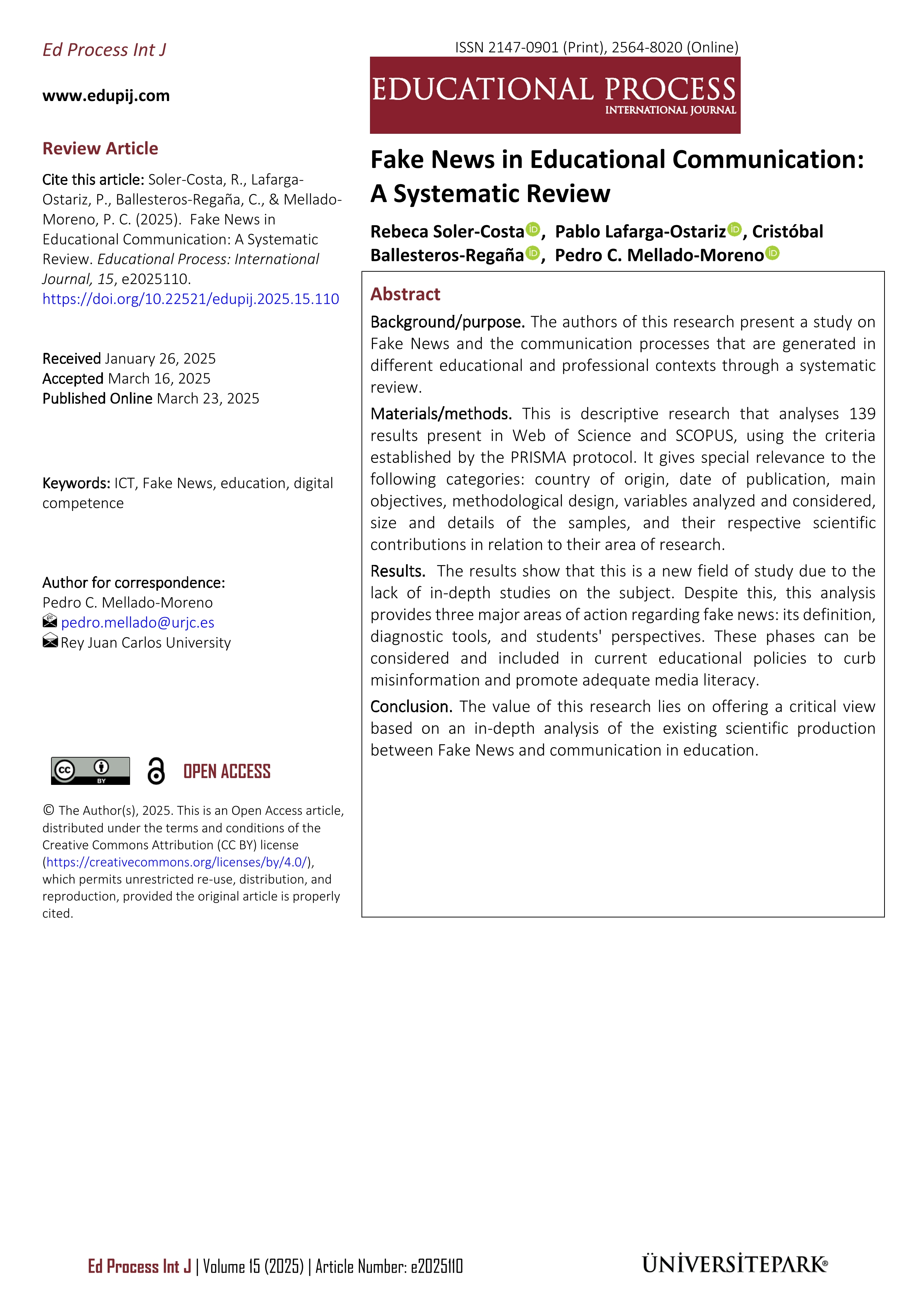
Resumen: Background/purpose.
The authors of this research present a study on Fake News and the communication processes that are generated in different educational and professional contexts through a systematic review.
Materials/methods.
This is descriptive research that analyses 139 results present in Web of Science and SCOPUS, using the criteria established by the PRISMA protocol. It gives special relevance to the following categories: country of origin, date of publication, main objectives, methodological design, variables analyzed and considered, size and details of the samples, and their respective scientific contributions in relation to their area of research.
Results.
The results show that this is a new field of study due to the lack of in-depth studies on the subject. Despite this, this analysis provides three major areas of action regarding fake news: its definition, diagnostic tools, and students' perspectives. These phases can be considered and included in current educational policies to curb misinformation and promote adequate media literacy.
Conclusion.
The value of this research lies on offering a critical view based on an in-depth analysis of the existing scientific production between Fake News and communication in education.
Idioma: Inglés
DOI: 10.22521/edupij.2025.15.110
Año: 2025
Publicado en: Educational Process: International Journal 15 (2025), e2025110 [23 pp.]
ISSN: 2147-0901
Tipo y forma: Article (Published version)
Área (Departamento): Área Didáctica y Organiz. Esc. (Dpto. Ciencias de la Educación)
 You must give appropriate credit, provide a link to the license, and indicate if changes were made. You may do so in any reasonable manner, but not in any way that suggests the licensor endorses you or your use.
Exportado de SIDERAL (2025-10-17-14:12:46)
Visitas y descargas
The authors of this research present a study on Fake News and the communication processes that are generated in different educational and professional contexts through a systematic review.
Materials/methods.
This is descriptive research that analyses 139 results present in Web of Science and SCOPUS, using the criteria established by the PRISMA protocol. It gives special relevance to the following categories: country of origin, date of publication, main objectives, methodological design, variables analyzed and considered, size and details of the samples, and their respective scientific contributions in relation to their area of research.
Results.
The results show that this is a new field of study due to the lack of in-depth studies on the subject. Despite this, this analysis provides three major areas of action regarding fake news: its definition, diagnostic tools, and students' perspectives. These phases can be considered and included in current educational policies to curb misinformation and promote adequate media literacy.
Conclusion.
The value of this research lies on offering a critical view based on an in-depth analysis of the existing scientific production between Fake News and communication in education.
Idioma: Inglés
DOI: 10.22521/edupij.2025.15.110
Año: 2025
Publicado en: Educational Process: International Journal 15 (2025), e2025110 [23 pp.]
ISSN: 2147-0901
Tipo y forma: Article (Published version)
Área (Departamento): Área Didáctica y Organiz. Esc. (Dpto. Ciencias de la Educación)
You must give appropriate credit, provide a link to the license, and indicate if changes were made. You may do so in any reasonable manner, but not in any way that suggests the licensor endorses you or your use. Exportado de SIDERAL (2025-10-17-14:12:46)
Permalink:
Visitas y descargas
Este artículo se encuentra en las siguientes colecciones:
Articles > Artículos por área > Didáctica y Organización Escolar
Record created 2025-07-02, last modified 2025-10-17