Heart Rate Profiles During Exercise and Incident Parkinson's Disease
van Duijvenboden, Stefan ; Ramírez, Julia (Universidad de Zaragoza) ; Scheurink, Job ; Darweesh, Sirwan K. L. ; Orini, Michele ; Tinker, Andrew ; Munroe, Patricia B. ; Thannhauser, Jos ; Evers, Luc ; IntHout, Joanna ; Lambiase, Pier D. ; Bloem, Bastiaan R. ; Doherty, Aiden ; Brouwer, Marc A.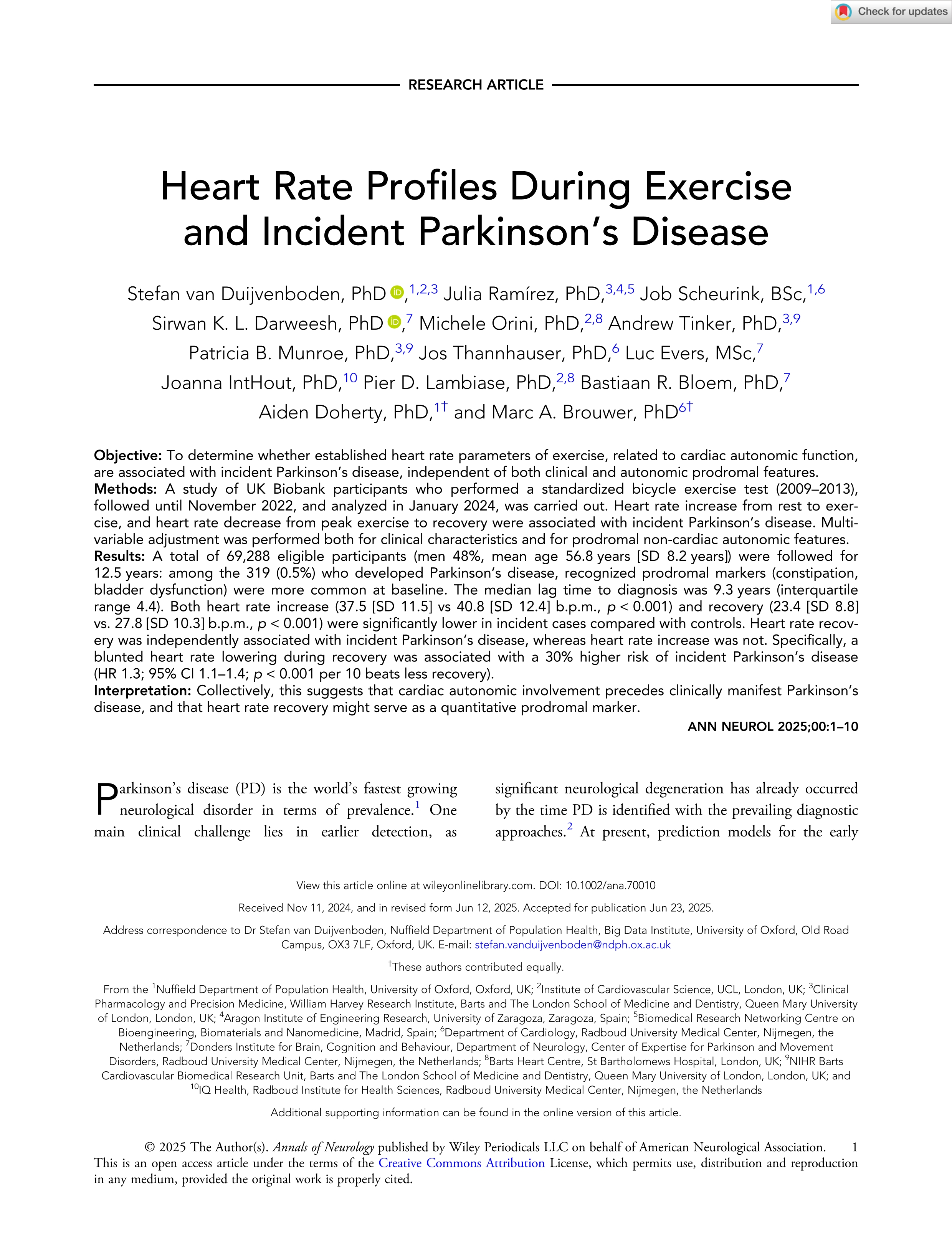
Resumen: Objective: To determine whether established heart rate parameters of exercise, related to cardiac autonomic function, are associated with incident Parkinson’s disease, independent of both clinical and autonomic prodromal features.
Methods: A study of UK Biobank participants who performed a standardized bicycle exercise test (2009–2013), followed until November 2022, and analyzed in January 2024, was carried out. Heart rate increase from rest to exer-
cise, and heart rate decrease from peak exercise to recovery were associated with incident Parkinson’s disease. Multivariable adjustment was performed both for clinical characteristics and for prodromal non-cardiac autonomic features.
Results: A total of 69,288 eligible participants (men 48%, mean age 56.8 years [SD 8.2 years]) were followed for 12.5 years: among the 319 (0.5%) who developed Parkinson’s disease, recognized prodromal markers (constipation, bladder dysfunction) were more common at baseline. The median lag time to diagnosis was 9.3 years (interquartile range 4.4). Both heart rate increase (37.5 [SD 11.5] vs 40.8 [SD 12.4] b.p.m., p < 0.001) and recovery (23.4 [SD 8.8] vs. 27.8 [SD 10.3] b.p.m., p < 0.001) were significantly lower in incident cases compared with controls. Heart rate recovery was independently associated with incident Parkinson’s disease, whereas heart rate increase was not. Specifically, a blunted heart rate lowering during recovery was associated with a 30% higher risk of incident Parkinson’s disease (HR 1.3; 95% CI 1.1–1.4; p < 0.001 per 10 beats less recovery).
Interpretation: Collectively, this suggests that cardiac autonomic involvement precedes clinically manifest Parkinson’s disease, and that heart rate recovery might serve as a quantitative prodromal marker.
Idioma: Inglés
DOI: 10.1002/ana.70010
Año: 2025
Publicado en: ANNALS OF NEUROLOGY (2025), [10 pp.]
ISSN: 0364-5134
Tipo y forma: Artículo (Versión definitiva)
Área (Departamento): Área Teoría Señal y Comunicac. (Dpto. Ingeniería Electrón.Com.)
 Debe reconocer adecuadamente la autoría, proporcionar un enlace a la licencia e indicar si se han realizado cambios. Puede hacerlo de cualquier manera razonable, pero no de una manera que sugiera que tiene el apoyo del licenciador o lo recibe por el uso que hace.
Exportado de SIDERAL (2025-10-17-14:18:24)
Visitas y descargas
Methods: A study of UK Biobank participants who performed a standardized bicycle exercise test (2009–2013), followed until November 2022, and analyzed in January 2024, was carried out. Heart rate increase from rest to exer-
cise, and heart rate decrease from peak exercise to recovery were associated with incident Parkinson’s disease. Multivariable adjustment was performed both for clinical characteristics and for prodromal non-cardiac autonomic features.
Results: A total of 69,288 eligible participants (men 48%, mean age 56.8 years [SD 8.2 years]) were followed for 12.5 years: among the 319 (0.5%) who developed Parkinson’s disease, recognized prodromal markers (constipation, bladder dysfunction) were more common at baseline. The median lag time to diagnosis was 9.3 years (interquartile range 4.4). Both heart rate increase (37.5 [SD 11.5] vs 40.8 [SD 12.4] b.p.m., p < 0.001) and recovery (23.4 [SD 8.8] vs. 27.8 [SD 10.3] b.p.m., p < 0.001) were significantly lower in incident cases compared with controls. Heart rate recovery was independently associated with incident Parkinson’s disease, whereas heart rate increase was not. Specifically, a blunted heart rate lowering during recovery was associated with a 30% higher risk of incident Parkinson’s disease (HR 1.3; 95% CI 1.1–1.4; p < 0.001 per 10 beats less recovery).
Interpretation: Collectively, this suggests that cardiac autonomic involvement precedes clinically manifest Parkinson’s disease, and that heart rate recovery might serve as a quantitative prodromal marker.
Idioma: Inglés
DOI: 10.1002/ana.70010
Año: 2025
Publicado en: ANNALS OF NEUROLOGY (2025), [10 pp.]
ISSN: 0364-5134
Tipo y forma: Artículo (Versión definitiva)
Área (Departamento): Área Teoría Señal y Comunicac. (Dpto. Ingeniería Electrón.Com.)
Debe reconocer adecuadamente la autoría, proporcionar un enlace a la licencia e indicar si se han realizado cambios. Puede hacerlo de cualquier manera razonable, pero no de una manera que sugiera que tiene el apoyo del licenciador o lo recibe por el uso que hace. Exportado de SIDERAL (2025-10-17-14:18:24)
Enlace permanente:
Visitas y descargas
Este artículo se encuentra en las siguientes colecciones:
Artículos > Artículos por área > Teoría de la Señal y Comunicaciones
Registro creado el 2025-09-19, última modificación el 2025-10-17