Multifunctional 3D-Printed Wound Dressings Containing a Combination of Synergistic Antimicrobials in the Management of MRSA Infected Topical Wounds
Mattar, Iman ; Landa, Guillermo (Universidad de Zaragoza) ; Frutos-Lizano, Marina ; Izquierdo, Natalia ; Tapia, Elena (Universidad de Zaragoza) ; Perez, Marta (Universidad de Zaragoza) ; Lujan, Lluis (Universidad de Zaragoza) ; Irusta, Silvia ; Mendoza, Gracia ; Arruebo, Manuel (Universidad de Zaragoza)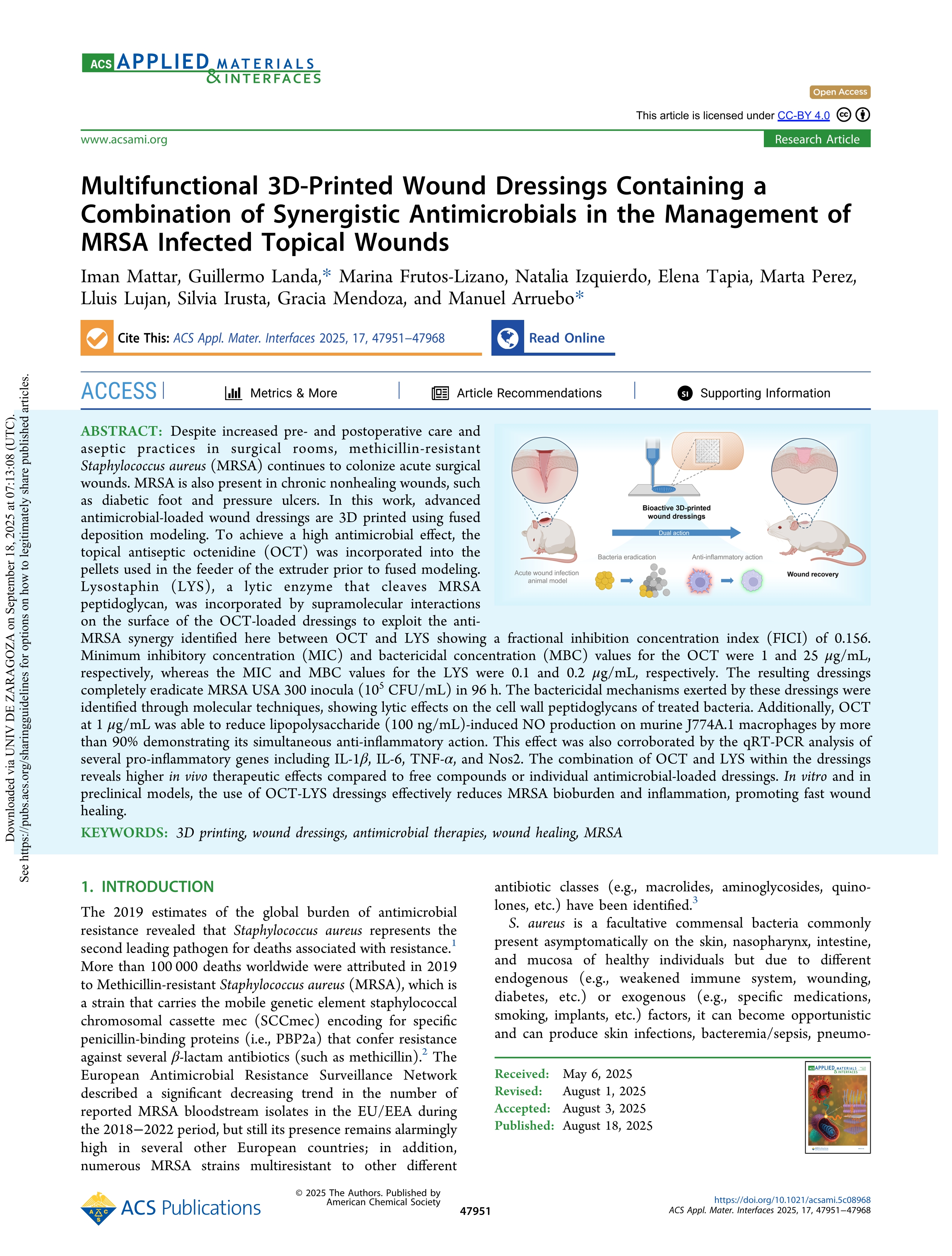
Resumen: Despite increased pre- and postoperative care and aseptic practices in surgical rooms, methicillin-resistant Staphylococcus aureus (MRSA) continues to colonize acute surgical wounds. MRSA is also present in chronic nonhealing wounds, such as diabetic foot and pressure ulcers. In this work, advanced antimicrobial-loaded wound dressings are 3D printed using fused deposition modeling. To achieve a high antimicrobial effect, the topical antiseptic octenidine (OCT) was incorporated into the pellets used in the feeder of the extruder prior to fused modeling. Lysostaphin (LYS), a lytic enzyme that cleaves MRSA peptidoglycan, was incorporated by supramolecular interactions on the surface of the OCT-loaded dressings to exploit the anti-MRSA synergy identified here between OCT and LYS showing a fractional inhibition concentration index (FICI) of 0.156. Minimum inhibitory concentration (MIC) and bactericidal concentration (MBC) values for the OCT were 1 and 25 μg/mL, respectively, whereas the MIC and MBC values for the LYS were 0.1 and 0.2 μg/mL, respectively. The resulting dressings completely eradicate MRSA USA 300 inocula (105 CFU/mL) in 96 h. The bactericidal mechanisms exerted by these dressings were identified through molecular techniques, showing lytic effects on the cell wall peptidoglycans of treated bacteria. Additionally, OCT at 1 μg/mL was able to reduce lipopolysaccharide (100 ng/mL)-induced NO production on murine J774A.1 macrophages by more than 90% demonstrating its simultaneous anti-inflammatory action. This effect was also corroborated by the qRT-PCR analysis of several pro-inflammatory genes including IL-1β, IL-6, TNF-α, and Nos2. The combination of OCT and LYS within the dressings reveals higher in vivo therapeutic effects compared to free compounds or individual antimicrobial-loaded dressings. In vitro and in preclinical models, the use of OCT-LYS dressings effectively reduces MRSA bioburden and inflammation, promoting fast wound healing.
Idioma: Inglés
DOI: 10.1021/acsami.5c08968
Año: 2025
Publicado en: ACS applied materials & interfaces 17, 34 (2025), 47951-47968
ISSN: 1944-8244
Financiación: info:eu-repo/grantAgreement/ES/AEI/CEX2023-001286-S
Financiación: info:eu-repo/grantAgreement/ES/ISCIII/FORT23-00028
Financiación: info:eu-repo/grantAgreement/ES/ISCIII/MS19-00092
Financiación: info:eu-repo/grantAgreement/ES/MICINN/PID2020-113987RB-I00
Financiación: info:eu-repo/grantAgreement/ES/MICINN/PID2023-146091OB-I00
Financiación: info:eu-repo/grantAgreement/ES/MICINN PRE2022-105709
Financiación: info:eu-repo/grantAgreement/ES/UZ/LMA-ELECMI ICTS
Tipo y forma: Article (Published version)
Área (Departamento): Área Anatom.Anatom.Patológ.Com (Dpto. Anatom.,Embri.Genét.Ani.)
Área (Departamento): Área Sanidad Animal (Dpto. Patología Animal)
Área (Departamento): Área Ingeniería Química (Dpto. Ing.Quím.Tecnol.Med.Amb.)
Área (Departamento): Servicios. División Biomédica (S. Gral. Apoyo Investig. - SAI)
 You must give appropriate credit, provide a link to the license, and indicate if changes were made. You may do so in any reasonable manner, but not in any way that suggests the licensor endorses you or your use.
Exportado de SIDERAL (2025-10-17-14:22:02)
Visitas y descargas
Idioma: Inglés
DOI: 10.1021/acsami.5c08968
Año: 2025
Publicado en: ACS applied materials & interfaces 17, 34 (2025), 47951-47968
ISSN: 1944-8244
Financiación: info:eu-repo/grantAgreement/ES/AEI/CEX2023-001286-S
Financiación: info:eu-repo/grantAgreement/ES/ISCIII/FORT23-00028
Financiación: info:eu-repo/grantAgreement/ES/ISCIII/MS19-00092
Financiación: info:eu-repo/grantAgreement/ES/MICINN/PID2020-113987RB-I00
Financiación: info:eu-repo/grantAgreement/ES/MICINN/PID2023-146091OB-I00
Financiación: info:eu-repo/grantAgreement/ES/MICINN PRE2022-105709
Financiación: info:eu-repo/grantAgreement/ES/UZ/LMA-ELECMI ICTS
Tipo y forma: Article (Published version)
Área (Departamento): Área Anatom.Anatom.Patológ.Com (Dpto. Anatom.,Embri.Genét.Ani.)
Área (Departamento): Área Sanidad Animal (Dpto. Patología Animal)
Área (Departamento): Área Ingeniería Química (Dpto. Ing.Quím.Tecnol.Med.Amb.)
Área (Departamento): Servicios. División Biomédica (S. Gral. Apoyo Investig. - SAI)
You must give appropriate credit, provide a link to the license, and indicate if changes were made. You may do so in any reasonable manner, but not in any way that suggests the licensor endorses you or your use. Exportado de SIDERAL (2025-10-17-14:22:02)
Permalink:
Visitas y descargas
Este artículo se encuentra en las siguientes colecciones:
Articles > Artículos por área > Anatomía y Anatomía Patológica Comparadas
Articles > Artículos por área > Ingeniería Química
Articles > Artículos por área > Sanidad Animal
Record created 2025-09-19, last modified 2025-10-17