Multifunctional 3D-Printed Wound Dressings Containing a Combination of Synergistic Antimicrobials in the Management of MRSA Infected Topical Wounds
Mattar, Iman ; Landa, Guillermo (Universidad de Zaragoza) ; Frutos-Lizano, Marina ; Izquierdo, Natalia ; Tapia, Elena (Universidad de Zaragoza) ; Perez, Marta (Universidad de Zaragoza) ; Lujan, Lluis (Universidad de Zaragoza) ; Irusta, Silvia ; Mendoza, Gracia ; Arruebo, Manuel (Universidad de Zaragoza)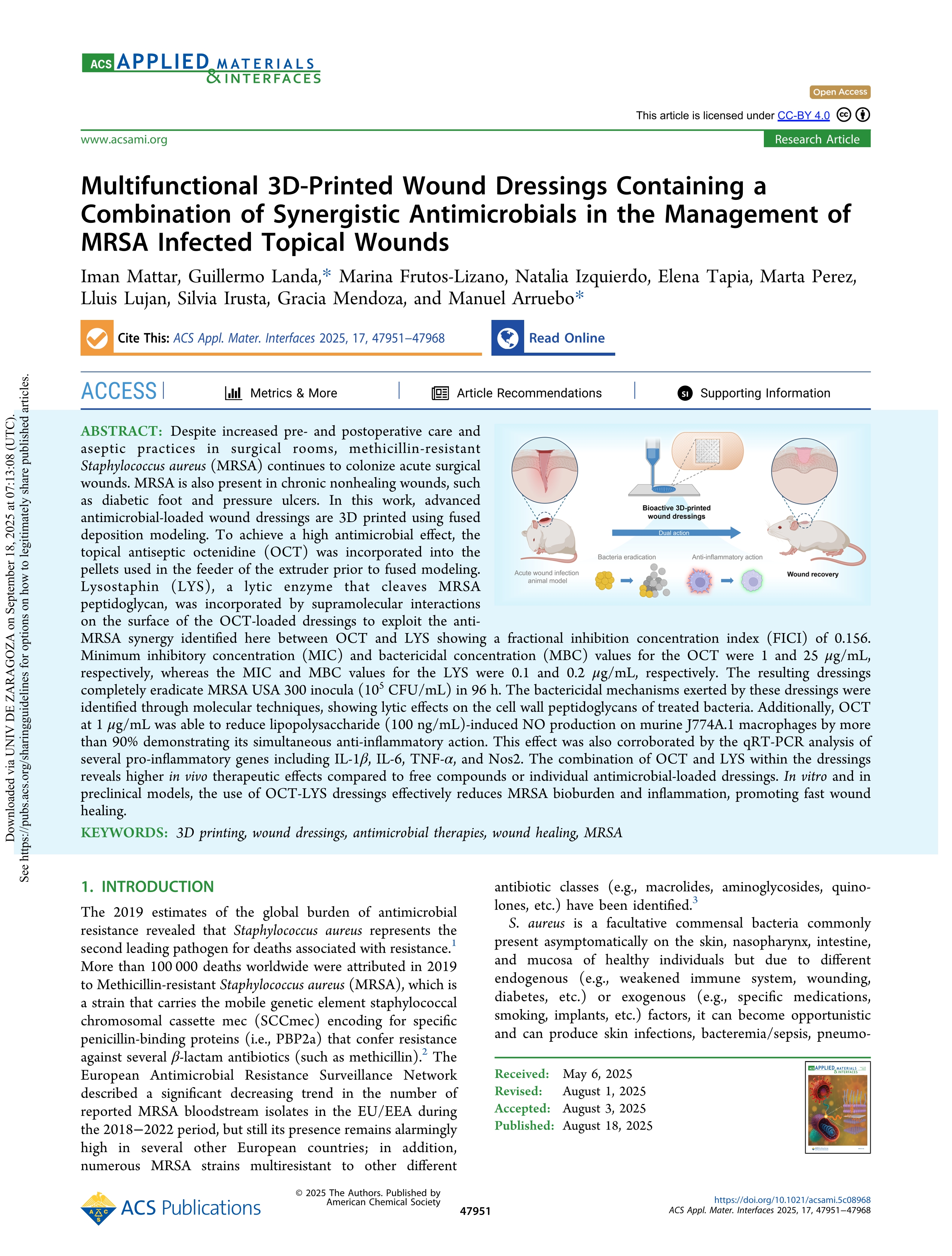
Resumen: Despite increased pre- and postoperative care and aseptic practices in surgical rooms, methicillin-resistant Staphylococcus aureus (MRSA) continues to colonize acute surgical wounds. MRSA is also present in chronic nonhealing wounds, such as diabetic foot and pressure ulcers. In this work, advanced antimicrobial-loaded wound dressings are 3D printed using fused deposition modeling. To achieve a high antimicrobial effect, the topical antiseptic octenidine (OCT) was incorporated into the pellets used in the feeder of the extruder prior to fused modeling. Lysostaphin (LYS), a lytic enzyme that cleaves MRSA peptidoglycan, was incorporated by supramolecular interactions on the surface of the OCT-loaded dressings to exploit the anti-MRSA synergy identified here between OCT and LYS showing a fractional inhibition concentration index (FICI) of 0.156. Minimum inhibitory concentration (MIC) and bactericidal concentration (MBC) values for the OCT were 1 and 25 μg/mL, respectively, whereas the MIC and MBC values for the LYS were 0.1 and 0.2 μg/mL, respectively. The resulting dressings completely eradicate MRSA USA 300 inocula (105 CFU/mL) in 96 h. The bactericidal mechanisms exerted by these dressings were identified through molecular techniques, showing lytic effects on the cell wall peptidoglycans of treated bacteria. Additionally, OCT at 1 μg/mL was able to reduce lipopolysaccharide (100 ng/mL)-induced NO production on murine J774A.1 macrophages by more than 90% demonstrating its simultaneous anti-inflammatory action. This effect was also corroborated by the qRT-PCR analysis of several pro-inflammatory genes including IL-1β, IL-6, TNF-α, and Nos2. The combination of OCT and LYS within the dressings reveals higher in vivo therapeutic effects compared to free compounds or individual antimicrobial-loaded dressings. In vitro and in preclinical models, the use of OCT-LYS dressings effectively reduces MRSA bioburden and inflammation, promoting fast wound healing.
Idioma: Inglés
DOI: 10.1021/acsami.5c08968
Año: 2025
Publicado en: ACS applied materials & interfaces 17, 34 (2025), 47951-47968
ISSN: 1944-8244
Financiación: info:eu-repo/grantAgreement/ES/AEI/CEX2023-001286-S
Financiación: info:eu-repo/grantAgreement/ES/ISCIII/FORT23-00028
Financiación: info:eu-repo/grantAgreement/ES/ISCIII/MS19-00092
Financiación: info:eu-repo/grantAgreement/ES/MICINN/PID2020-113987RB-I00
Financiación: info:eu-repo/grantAgreement/ES/MICINN/PID2023-146091OB-I00
Financiación: info:eu-repo/grantAgreement/ES/MICINN PRE2022-105709
Financiación: info:eu-repo/grantAgreement/ES/UZ/LMA-ELECMI ICTS
Tipo y forma: Artículo (Versión definitiva)
Área (Departamento): Área Anatom.Anatom.Patológ.Com (Dpto. Anatom.,Embri.Genét.Ani.)
Área (Departamento): Área Sanidad Animal (Dpto. Patología Animal)
Área (Departamento): Área Ingeniería Química (Dpto. Ing.Quím.Tecnol.Med.Amb.)
Área (Departamento): Servicios. División Biomédica (S. Gral. Apoyo Investig. - SAI)
 Debe reconocer adecuadamente la autoría, proporcionar un enlace a la licencia e indicar si se han realizado cambios. Puede hacerlo de cualquier manera razonable, pero no de una manera que sugiera que tiene el apoyo del licenciador o lo recibe por el uso que hace.
Exportado de SIDERAL (2025-10-17-14:22:02)
Visitas y descargas
Idioma: Inglés
DOI: 10.1021/acsami.5c08968
Año: 2025
Publicado en: ACS applied materials & interfaces 17, 34 (2025), 47951-47968
ISSN: 1944-8244
Financiación: info:eu-repo/grantAgreement/ES/AEI/CEX2023-001286-S
Financiación: info:eu-repo/grantAgreement/ES/ISCIII/FORT23-00028
Financiación: info:eu-repo/grantAgreement/ES/ISCIII/MS19-00092
Financiación: info:eu-repo/grantAgreement/ES/MICINN/PID2020-113987RB-I00
Financiación: info:eu-repo/grantAgreement/ES/MICINN/PID2023-146091OB-I00
Financiación: info:eu-repo/grantAgreement/ES/MICINN PRE2022-105709
Financiación: info:eu-repo/grantAgreement/ES/UZ/LMA-ELECMI ICTS
Tipo y forma: Artículo (Versión definitiva)
Área (Departamento): Área Anatom.Anatom.Patológ.Com (Dpto. Anatom.,Embri.Genét.Ani.)
Área (Departamento): Área Sanidad Animal (Dpto. Patología Animal)
Área (Departamento): Área Ingeniería Química (Dpto. Ing.Quím.Tecnol.Med.Amb.)
Área (Departamento): Servicios. División Biomédica (S. Gral. Apoyo Investig. - SAI)
Debe reconocer adecuadamente la autoría, proporcionar un enlace a la licencia e indicar si se han realizado cambios. Puede hacerlo de cualquier manera razonable, pero no de una manera que sugiera que tiene el apoyo del licenciador o lo recibe por el uso que hace. Exportado de SIDERAL (2025-10-17-14:22:02)
Enlace permanente:
Visitas y descargas
Este artículo se encuentra en las siguientes colecciones:
Artículos > Artículos por área > Anatomía y Anatomía Patológica Comparadas
Artículos > Artículos por área > Ingeniería Química
Artículos > Artículos por área > Sanidad Animal
Registro creado el 2025-09-19, última modificación el 2025-10-17