Teaching history from an intercultural perspective: an action research study
Piazuelo-Rodríguez, Ismael (Universidad de Zaragoza) ; Rivero-Gracia, Pilar (Universidad de Zaragoza)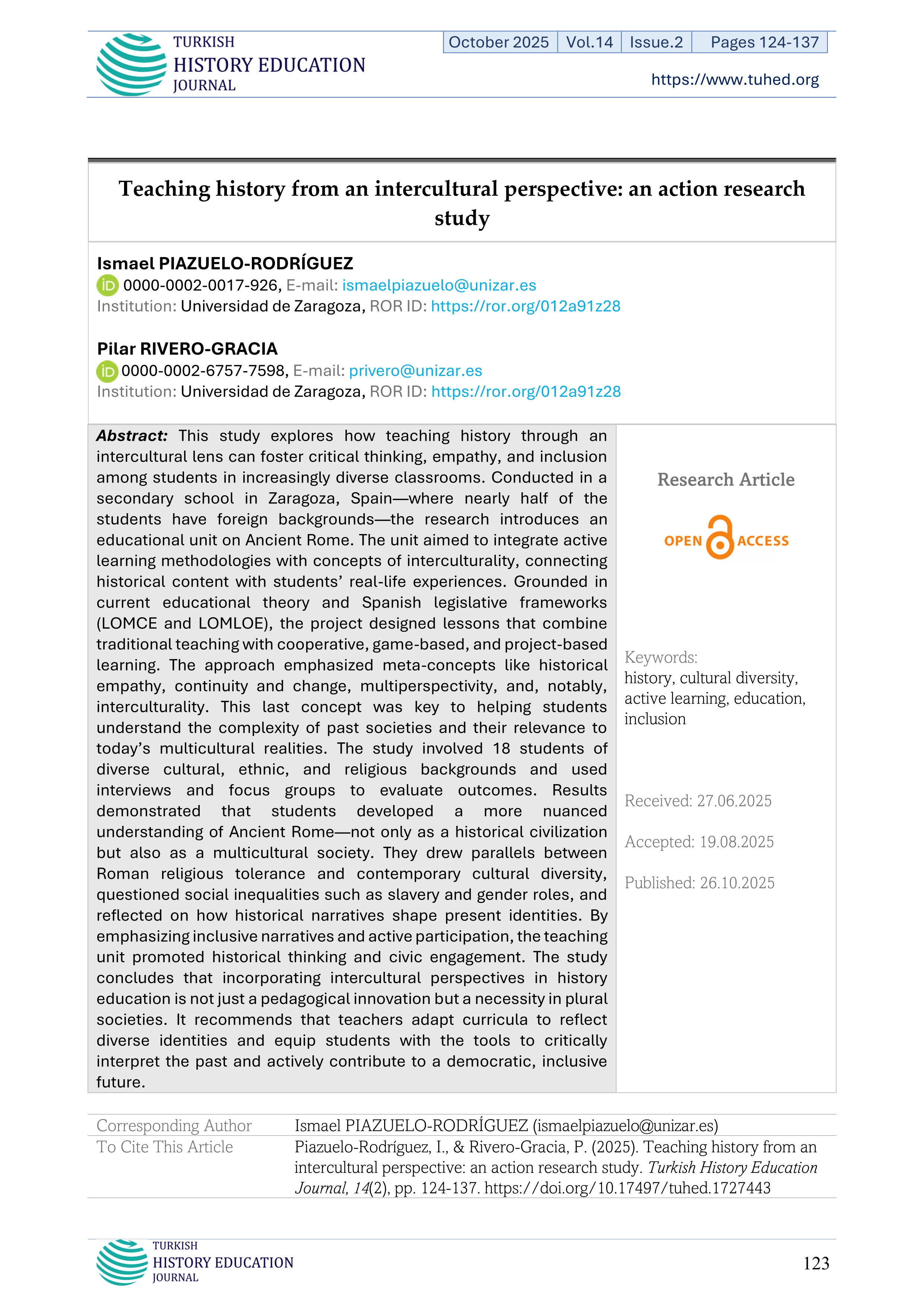
Resumen: This study explores how teaching history through an intercultural lens can foster critical thinking, empathy, and inclusion among students in increasingly diverse classrooms. Conducted in a secondary school in Zaragoza, Spain—where nearly half of the students have foreign backgrounds—the research introduces an educational unit on Ancient Rome. The unit aimed to integrate active learning methodologies with concepts of interculturality, connecting historical content with students’ real-life experiences. Grounded in current educational theory and Spanish legislative frameworks (LOMCE and LOMLOE), the project designed lessons that combine traditional teaching with cooperative, game-based, and project-based learning. The approach emphasized meta-concepts like historical empathy, continuity and change, multiperspectivity, and, notably, interculturality. This last concept was key to helping students understand the complexity of past societies and their relevance to today’s multicultural realities. The study involved 18 students of diverse cultural, ethnic, and religious backgrounds and used interviews and focus groups to evaluate outcomes. Results demonstrated that students developed a more nuanced understanding of Ancient Rome—not only as a historical civilization but also as a multicultural society. They drew parallels between Roman religious tolerance and contemporary cultural diversity, questioned social inequalities such as slavery and gender roles, and reflected on how historical narratives shape present identities. By emphasizing inclusive narratives and active participation, the teaching unit promoted historical thinking and civic engagement. The study concludes that incorporating intercultural perspectives in history education is not just a pedagogical innovation but a necessity in plural societies. It recommends that teachers adapt curricula to reflect diverse identities and equip students with the tools to critically interpret the past and actively contribute to a democratic, inclusive future.
Idioma: Inglés
DOI: 10.17497/tuhed.1727443
Año: 2025
Publicado en: Turkish History Education Journal 14, 2 (2025), 123-137
ISSN: 2147-4516
Financiación: info:eu-repo/grantAgreement/ES/DGA/S50-23R
Financiación: info:eu-repo/grantAgreement/ES/MICINN/PID2020-115288RB-I00
Tipo y forma: Article (Published version)
Área (Departamento): Área Didáctica Ciencias Socia. (Dpto. Didácticas Específicas)
 You must give appropriate credit, provide a link to the license, and indicate if changes were made. You may do so in any reasonable manner, but not in any way that suggests the licensor endorses you or your use. You may not use the material for commercial purposes.
Exportado de SIDERAL (2025-10-30-14:40:14)
Visitas y descargas
Idioma: Inglés
DOI: 10.17497/tuhed.1727443
Año: 2025
Publicado en: Turkish History Education Journal 14, 2 (2025), 123-137
ISSN: 2147-4516
Financiación: info:eu-repo/grantAgreement/ES/DGA/S50-23R
Financiación: info:eu-repo/grantAgreement/ES/MICINN/PID2020-115288RB-I00
Tipo y forma: Article (Published version)
Área (Departamento): Área Didáctica Ciencias Socia. (Dpto. Didácticas Específicas)
You must give appropriate credit, provide a link to the license, and indicate if changes were made. You may do so in any reasonable manner, but not in any way that suggests the licensor endorses you or your use. You may not use the material for commercial purposes. Exportado de SIDERAL (2025-10-30-14:40:14)
Permalink:
Visitas y descargas
Este artículo se encuentra en las siguientes colecciones:
Articles > Artículos por área > Didáctica de las Ciencias Sociales
Record created 2025-10-30, last modified 2025-10-30