Soccer helps build strong bones during growth: a systematic review and meta-analysis
Lozano-Berges, G. (Universidad de Zaragoza) ; Matute-Llorente, Á. (Universidad de Zaragoza) ; González-Agüero, A. (Universidad de Zaragoza) ; Gómez-Bruton, A. ; Gómez-Cabello, A. ; Vicente-Rodríguez, G. (Universidad de Zaragoza) ; Casajús, J.A. (Universidad de Zaragoza)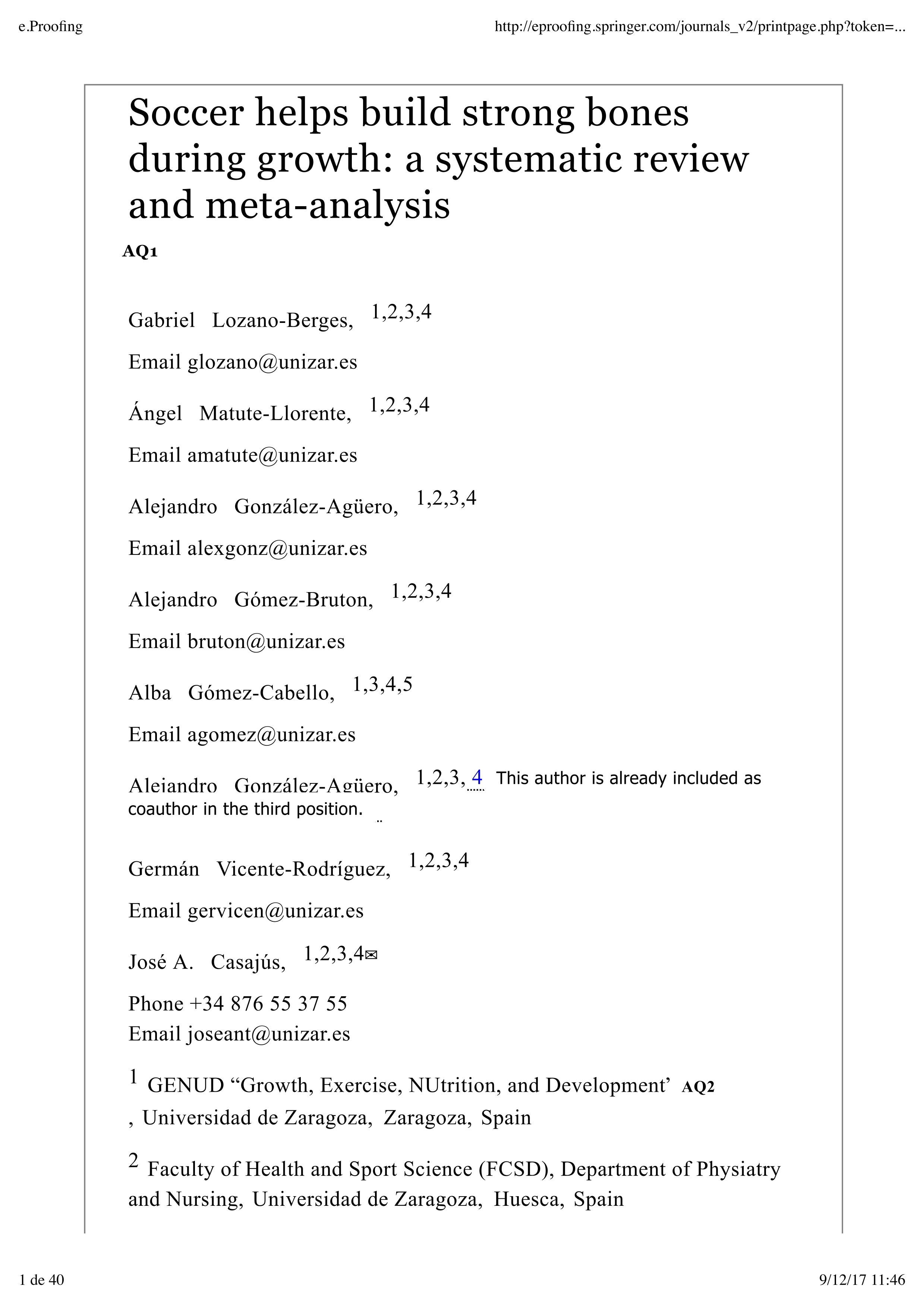
Resumen: The aim of this study was to analyze the effects of soccer practice on bone in male and female children and adolescents. MEDLINE, PubMed, SPORTDiscus and Web of Science databases were searched for scientific articles published up to and including October 2016. Twenty-seven studies were included in this systematic review (13 in the meta-analysis). The meta-analysis was performed by using OpenMeta[Analyst] software. It is well documented that soccer practice during childhood provides positive effects on bone mineral content (BMC) and density (BMD) compared to sedentary behaviors and other sports, such as tennis, weightlifting, or swimming. Furthermore, soccer players present higher BMC and BMD in most weight-bearing sites such as the whole body, lumbar spine, hip, and legs. Moreover, bone differences were minimized between groups during prepuberty. Therefore, the maturity status should be considered when evaluating bone. According to meta-analysis results, soccer practice was positively associated with whole-body BMD either in males (mean difference 0.061; 95%CI, 0.042–0.079) or in females (mean difference 0.063; 95%CI, 0.026–0.099). Conclusion: Soccer may be considered a sport that positively affects bone mass during growth. Pubertal soccer players presented increased bone mass compared to controls or other athletes; however, these bone differences are minimized during the prepubertal stage.(Table presented.)
Idioma: Inglés
DOI: 10.1007/s00431-017-3060-3
Año: 2017
Publicado en: European Journal of Pediatrics 177 (2017), 295 - 310
ISSN: 0340-6199
Factor impacto JCR: 2.242 (2017)
Categ. JCR: PEDIATRICS rank: 42 / 124 = 0.339 (2017) - Q2 - T2
Factor impacto SCIMAGO: 0.992 - Pediatrics, Perinatology and Child Health (Q1)
Tipo y forma: Article (PostPrint)
Área (Departamento): Área Educación Física y Depor. (Dpto. Fisiatría y Enfermería)
 All rights reserved by journal editor
Exportado de SIDERAL (2025-11-13-14:57:40)
Visitas y descargas
Idioma: Inglés
DOI: 10.1007/s00431-017-3060-3
Año: 2017
Publicado en: European Journal of Pediatrics 177 (2017), 295 - 310
ISSN: 0340-6199
Factor impacto JCR: 2.242 (2017)
Categ. JCR: PEDIATRICS rank: 42 / 124 = 0.339 (2017) - Q2 - T2
Factor impacto SCIMAGO: 0.992 - Pediatrics, Perinatology and Child Health (Q1)
Tipo y forma: Article (PostPrint)
Área (Departamento): Área Educación Física y Depor. (Dpto. Fisiatría y Enfermería)
All rights reserved by journal editorExportado de SIDERAL (2025-11-13-14:57:40)
Permalink:
Visitas y descargas
Este artículo se encuentra en las siguientes colecciones:
Articles > Artículos por área > Educación Física y Deportiva
Record created 2025-11-13, last modified 2025-11-13