Factors associated with burnout among Family and Community Medicine and Nursing residents: secondary analysis of a multicentre study
Chacón-Docampo, Macarena ; Asensio-Martínez, Ángela (Universidad de Zaragoza) ; Rodríguez-Pastoriza, Sara ; Liñares-Mariñas, David ; Martín-Miguel, María Victoria ; Bartolomé-Moreno, Cruz (Universidad de Zaragoza) ; González-Formoso, Clara ; Clavería, Ana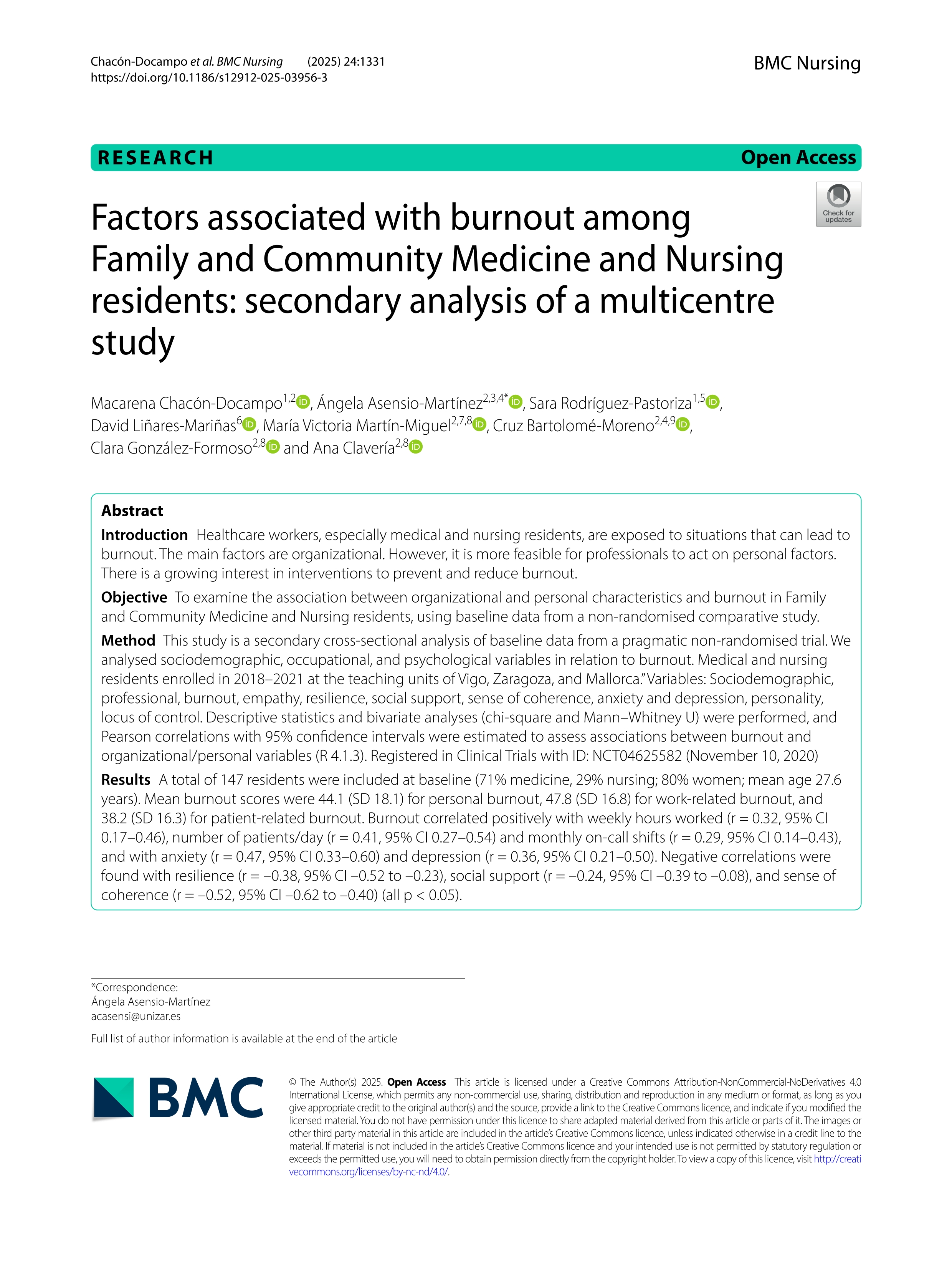
Resumen: Introduction: Healthcare workers, especially medical and nursing residents, are exposed to situations that can lead to burnout. The main factors are organizational. However, it is more feasible for professionals to act on personal factors. There is a growing interest in interventions to prevent and reduce burnout.
Objective: To examine the association between organizational and personal characteristics and burnout in Family and Community Medicine and Nursing residents, using baseline data from a non-randomised comparative study.
Method: This study is a secondary cross-sectional analysis of baseline data from a pragmatic non-randomised trial. We analysed sociodemographic, occupational, and psychological variables in relation to burnout. Medical and nursing residents enrolled in 2018–2021 at the teaching units of Vigo, Zaragoza, and Mallorca.” Variables: Sociodemographic, professional, burnout, empathy, resilience, social support, sense of coherence, anxiety and depression, personality, locus of control. Descriptive statistics and bivariate analyses (chi-square and Mann–Whitney U) were performed, and Pearson correlations with 95% confidence intervals were estimated to assess associations between burnout and organizational/personal variables (R 4.1.3). Registered in Clinical Trials with ID: NCT04625582 (November 10, 2020)
Results: A total of 147 residents were included at baseline (71% medicine, 29% nursing; 80% women; mean age 27.6 years). Mean burnout scores were 44.1 (SD 18.1) for personal burnout, 47.8 (SD 16.8) for work-related burnout, and 38.2 (SD 16.3) for patient-related burnout. Burnout correlated positively with weekly hours worked (r = 0.32, 95% CI 0.17–0.46), number of patients/day (r = 0.41, 95% CI 0.27–0.54) and monthly on-call shifts (r = 0.29, 95% CI 0.14–0.43), and with anxiety (r = 0.47, 95% CI 0.33–0.60) and depression (r = 0.36, 95% CI 0.21–0.50). Negative correlations were found with resilience (r = –0.38, 95% CI –0.52 to –0.23), social support (r = –0.24, 95% CI –0.39 to –0.08), and sense of coherence (r = –0.52, 95% CI –0.62 to –0.40) (all p < 0.05).
Conclusions: Burnout in Family and Community Medicine and Nursing residents is associated with both organizational factors (workload, on-call duties, patient volume) and personal resources (resilience, empathy, sense of coherence). These findings underscore the importance of addressing structural workload while simultaneously enhancing coping resources to prevent burnout during residency training.
Idioma: Inglés
DOI: 10.1186/s12912-025-03956-3
Año: 2025
Publicado en: BMC Nursing 24 (2025), 1331 [8 pp.]
ISSN: 1472-6955
Tipo y forma: Artículo (Versión definitiva)
Área (Departamento): Área Psicología Social (Dpto. Psicología y Sociología)
Área (Departamento): Area Medicina (Dpto. Medicina, Psiqu. y Derm.)
 Debe reconocer adecuadamente la autoría, proporcionar un enlace a la licencia e indicar si se han realizado cambios. Puede hacerlo de cualquier manera razonable, pero no de una manera que sugiera que tiene el apoyo del licenciador o lo recibe por el uso que hace. No puede utilizar el material para una finalidad comercial. Si remezcla, transforma o crea a partir del material, no puede difundir el material modificado.
Exportado de SIDERAL (2026-03-26-14:48:25)
Visitas y descargas
Objective: To examine the association between organizational and personal characteristics and burnout in Family and Community Medicine and Nursing residents, using baseline data from a non-randomised comparative study.
Method: This study is a secondary cross-sectional analysis of baseline data from a pragmatic non-randomised trial. We analysed sociodemographic, occupational, and psychological variables in relation to burnout. Medical and nursing residents enrolled in 2018–2021 at the teaching units of Vigo, Zaragoza, and Mallorca.” Variables: Sociodemographic, professional, burnout, empathy, resilience, social support, sense of coherence, anxiety and depression, personality, locus of control. Descriptive statistics and bivariate analyses (chi-square and Mann–Whitney U) were performed, and Pearson correlations with 95% confidence intervals were estimated to assess associations between burnout and organizational/personal variables (R 4.1.3). Registered in Clinical Trials with ID: NCT04625582 (November 10, 2020)
Results: A total of 147 residents were included at baseline (71% medicine, 29% nursing; 80% women; mean age 27.6 years). Mean burnout scores were 44.1 (SD 18.1) for personal burnout, 47.8 (SD 16.8) for work-related burnout, and 38.2 (SD 16.3) for patient-related burnout. Burnout correlated positively with weekly hours worked (r = 0.32, 95% CI 0.17–0.46), number of patients/day (r = 0.41, 95% CI 0.27–0.54) and monthly on-call shifts (r = 0.29, 95% CI 0.14–0.43), and with anxiety (r = 0.47, 95% CI 0.33–0.60) and depression (r = 0.36, 95% CI 0.21–0.50). Negative correlations were found with resilience (r = –0.38, 95% CI –0.52 to –0.23), social support (r = –0.24, 95% CI –0.39 to –0.08), and sense of coherence (r = –0.52, 95% CI –0.62 to –0.40) (all p < 0.05).
Conclusions: Burnout in Family and Community Medicine and Nursing residents is associated with both organizational factors (workload, on-call duties, patient volume) and personal resources (resilience, empathy, sense of coherence). These findings underscore the importance of addressing structural workload while simultaneously enhancing coping resources to prevent burnout during residency training.
Idioma: Inglés
DOI: 10.1186/s12912-025-03956-3
Año: 2025
Publicado en: BMC Nursing 24 (2025), 1331 [8 pp.]
ISSN: 1472-6955
Tipo y forma: Artículo (Versión definitiva)
Área (Departamento): Área Psicología Social (Dpto. Psicología y Sociología)
Área (Departamento): Area Medicina (Dpto. Medicina, Psiqu. y Derm.)
Debe reconocer adecuadamente la autoría, proporcionar un enlace a la licencia e indicar si se han realizado cambios. Puede hacerlo de cualquier manera razonable, pero no de una manera que sugiera que tiene el apoyo del licenciador o lo recibe por el uso que hace. No puede utilizar el material para una finalidad comercial. Si remezcla, transforma o crea a partir del material, no puede difundir el material modificado.Exportado de SIDERAL (2026-03-26-14:48:25)
Enlace permanente:
Visitas y descargas
Este artículo se encuentra en las siguientes colecciones:
Artículos > Artículos por área > Psicología Social
Artículos > Artículos por área > Medicina
Registro creado el 2025-11-13, última modificación el 2026-03-26