Acrosomal Status and PARP-1 Nuclear Markers Could Improve Discrimination of Potential Fertility in Good‐Quality Boar Semen Doses
Ausejo-Marcos, Raquel (Universidad de Zaragoza) ; Miguel-Jiménez, Sara ; Tejedor, M. Teresa (Universidad de Zaragoza) ; Gómez-Giménez, Belén ; Soriano-Úbeda, Cristina ; Martinez-Pastor, Felipe ; Mendoza, Noelia ; Vicente-Carrillo, Alejandro ; Hurtado, William Fernando ; Ávila Holguín, Celia ; Moreno, Bernardino (Universidad de Zaragoza) ; Falceto, María Victoria (Universidad de Zaragoza)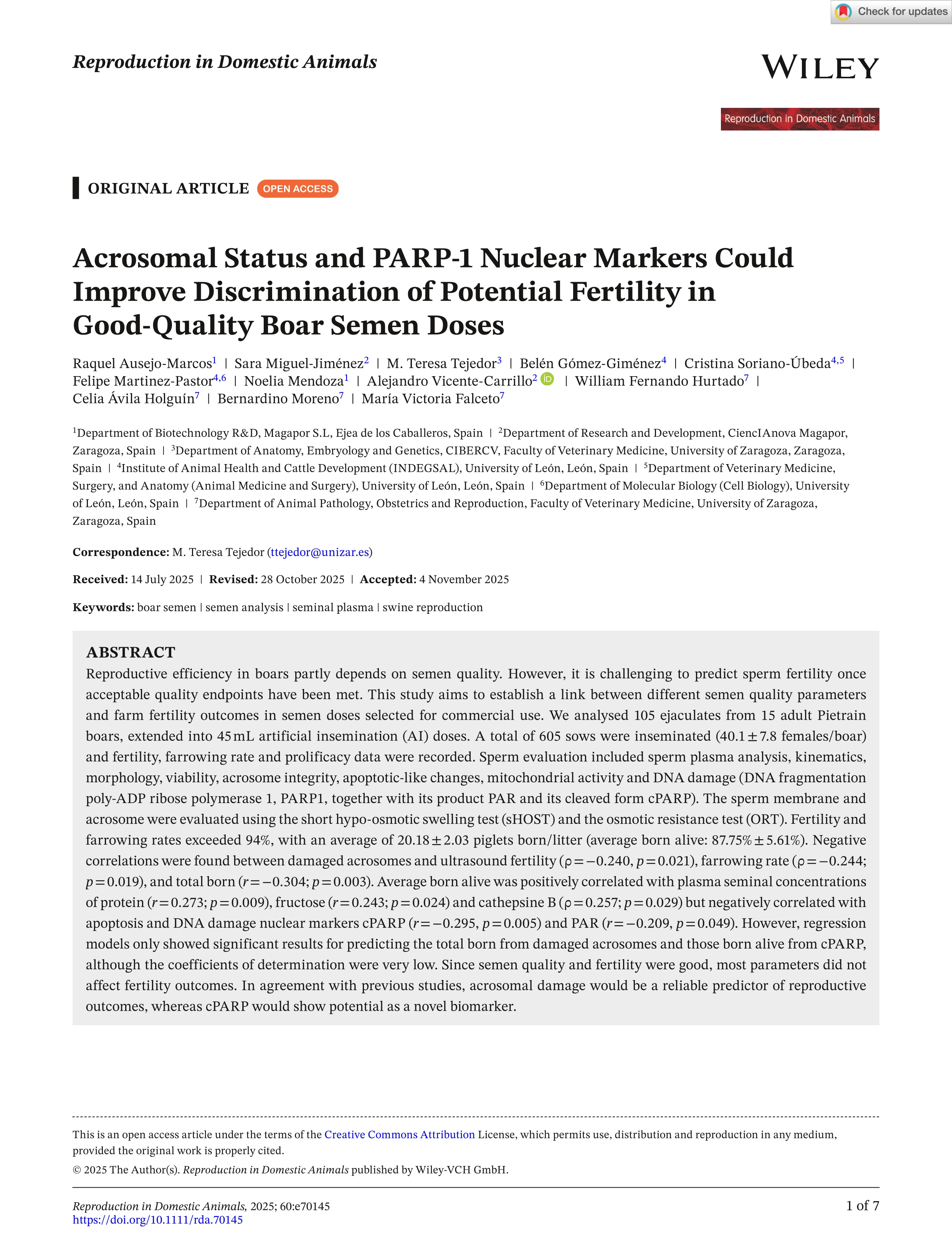
Resumen: Reproductive efficiency in boars partly depends on semen quality. However, it is challenging to predict sperm fertility once acceptable quality endpoints have been met. This study aims to establish a link between different semen quality parameters and farm fertility outcomes in semen doses selected for commercial use. We analysed 105 ejaculates from 15 adult Pietrain boars, extended into 45 mL artificial insemination (AI) doses. A total of 605 sows were inseminated (40.1 ± 7.8 females/boar) and fertility, farrowing rate and prolificacy data were recorded. Sperm evaluation included sperm plasma analysis, kinematics, morphology, viability, acrosome integrity, apoptotic-like changes, mitochondrial activity and DNA damage (DNA fragmentation poly-ADP ribose polymerase 1, PARP1, together with its product PAR and its cleaved form cPARP). The sperm membrane and acrosome were evaluated using the short hypo-osmotic swelling test (sHOST) and the osmotic resistance test (ORT). Fertility and farrowing rates exceeded 94%, with an average of 20.18 ± 2.03 piglets born/litter (average born alive: 87.75% ± 5.61%). Negative correlations were found between damaged acrosomes and ultrasound fertility (ρ = −0.240, p = 0.021), farrowing rate (ρ = −0.244; p = 0.019), and total born (r = −0.304; p = 0.003). Average born alive was positively correlated with plasma seminal concentrations of protein (r = 0.273; p = 0.009), fructose (r = 0.243; p = 0.024) and cathepsine B (ρ = 0.257; p = 0.029) but negatively correlated with apoptosis and DNA damage nuclear markers cPARP (r = −0.295, p = 0.005) and PAR (r = −0.209, p = 0.049). However, regression models only showed significant results for predicting the total born from damaged acrosomes and those born alive from cPARP, although the coefficients of determination were very low. Since semen quality and fertility were good, most parameters did not affect fertility outcomes. In agreement with previous studies, acrosomal damage would be a reliable predictor of reproductive outcomes, whereas cPARP would show potential as a novel biomarker.
Idioma: Inglés
DOI: 10.1111/rda.70145
Año: 2025
Publicado en: Reproduction in Domestic Animals 60, 11 (2025), e70145 [7 pp.]
ISSN: 0936-6768
Tipo y forma: Article (Published version)
Área (Departamento): Área Genética (Dpto. Anatom.,Embri.Genét.Ani.)
Área (Departamento): Área Sanidad Animal (Dpto. Patología Animal)
Área (Departamento): Área Medicina y Cirugía Animal (Dpto. Patología Animal)
Exportado de SIDERAL (2025-11-21-14:25:27)
Visitas y descargas
Idioma: Inglés
DOI: 10.1111/rda.70145
Año: 2025
Publicado en: Reproduction in Domestic Animals 60, 11 (2025), e70145 [7 pp.]
ISSN: 0936-6768
Tipo y forma: Article (Published version)
Área (Departamento): Área Genética (Dpto. Anatom.,Embri.Genét.Ani.)
Área (Departamento): Área Sanidad Animal (Dpto. Patología Animal)
Área (Departamento): Área Medicina y Cirugía Animal (Dpto. Patología Animal)
Exportado de SIDERAL (2025-11-21-14:25:27)
Permalink:
Visitas y descargas
Este artículo se encuentra en las siguientes colecciones:
articulos > articulos-por-area > medicina_y_cirugia_animal
articulos > articulos-por-area > sanidad_animal
articulos > articulos-por-area > genetica
Notice créée le 2025-11-21, modifiée le 2025-11-21