Hemilability Modulation via Phosphane-Triazole Ligand Design: Impact on Catalytic Formic Acid Dehydrogenation
García-Abellán, Susana ; Pérez-García, Andrea (Universidad de Zaragoza) ; Barrena-Espés, Daniel ; Casado, Miguel A. (Universidad de Zaragoza) ; Munarriz, Julen (Universidad de Zaragoza) ; Passarelli, Vincenzo ; Iglesias, Manuel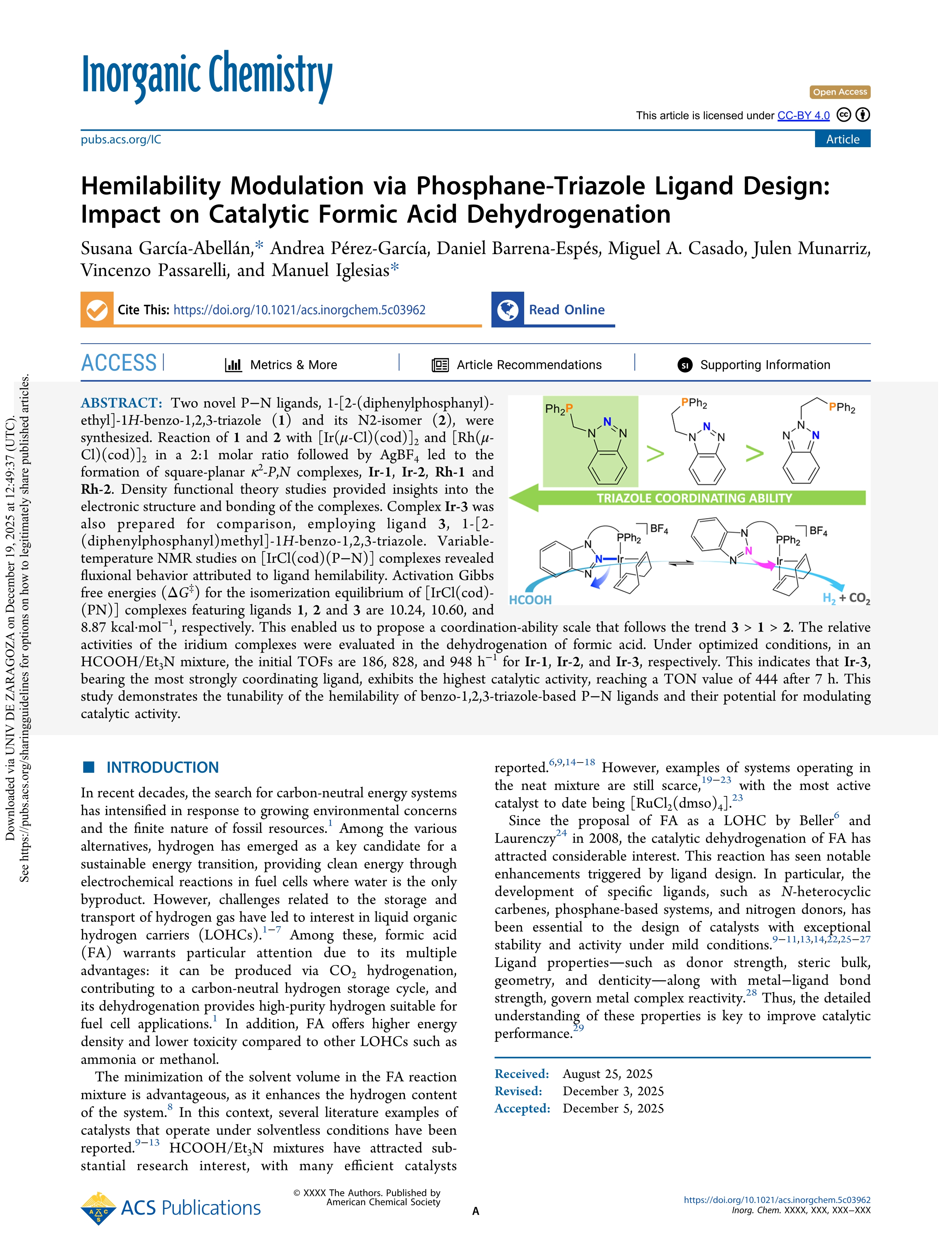
Resumen: Two novel P–N ligands, 1-[2-(diphenylphosphanyl)ethyl]-1H-benzo-1,2,3-triazole (1) and its N2-isomer (2), were synthesized. Reaction of 1 and 2 with [Ir(μ-Cl)(cod)]2 and [Rh(μ-Cl)(cod)]2 in a 2:1 molar ratio followed by AgBF4 led to the formation of square-planar κ2-P,N complexes, Ir-1, Ir-2, Rh-1 and Rh-2. Density functional theory studies provided insights into the electronic structure and bonding of the complexes. Complex Ir-3 was also prepared for comparison, employing ligand 3, 1-[2-(diphenylphosphanyl)methyl]-1H-benzo-1,2,3-triazole. Variable-temperature NMR studies on [IrCl(cod)(P–N)] complexes revealed fluxional behavior attributed to ligand hemilability. Activation Gibbs free energies (ΔG‡) for the isomerization equilibrium of [IrCl(cod)(PN)] complexes featuring ligands 1, 2 and 3 are 10.24, 10.60, and 8.87 kcal·mol–1, respectively. This enabled us to propose a coordination-ability scale that follows the trend 3 > 1 > 2. The relative activities of the iridium complexes were evaluated in the dehydrogenation of formic acid. Under optimized conditions, in an HCOOH/Et3N mixture, the initial TOFs are 186, 828, and 948 h–1 for Ir-1, Ir-2, and Ir-3, respectively. This indicates that Ir-3, bearing the most strongly coordinating ligand, exhibits the highest catalytic activity, reaching a TON value of 444 after 7 h. This study demonstrates the tunability of the hemilability of benzo-1,2,3-triazole-based P–N ligands and their potential for modulating catalytic activity.
Idioma: Inglés
DOI: 10.1021/acs.inorgchem.5c03962
Año: 2025
Publicado en: Inorganic Chemistry 64, 50 (2025), 24539-24552
ISSN: 0020-1669
Financiación: info:eu-repo/grantAgreement/ES/DGA/E42-23R
Financiación: info:eu-repo/grantAgreement/ES/MICINN/PID2021-122763NB-I00
Financiación: info:eu-repo/grantAgreement/ES/MICINN/PID2021-126212OB-I00
Tipo y forma: Article (Published version)
Área (Departamento): Área Química Inorgánica (Dpto. Química Inorgánica)
Área (Departamento): Área Química Física (Dpto. Química Física)
 You must give appropriate credit, provide a link to the license, and indicate if changes were made. You may do so in any reasonable manner, but not in any way that suggests the licensor endorses you or your use.
Exportado de SIDERAL (2026-04-18-11:05:08)
Visitas y descargas
Idioma: Inglés
DOI: 10.1021/acs.inorgchem.5c03962
Año: 2025
Publicado en: Inorganic Chemistry 64, 50 (2025), 24539-24552
ISSN: 0020-1669
Financiación: info:eu-repo/grantAgreement/ES/DGA/E42-23R
Financiación: info:eu-repo/grantAgreement/ES/MICINN/PID2021-122763NB-I00
Financiación: info:eu-repo/grantAgreement/ES/MICINN/PID2021-126212OB-I00
Tipo y forma: Article (Published version)
Área (Departamento): Área Química Inorgánica (Dpto. Química Inorgánica)
Área (Departamento): Área Química Física (Dpto. Química Física)
You must give appropriate credit, provide a link to the license, and indicate if changes were made. You may do so in any reasonable manner, but not in any way that suggests the licensor endorses you or your use. Exportado de SIDERAL (2026-04-18-11:05:08)
Permalink:
Visitas y descargas
Este artículo se encuentra en las siguientes colecciones:
Articles > Artículos por área > Química Inorgánica
Articles > Artículos por área > Química Física
Record created 2025-12-19, last modified 2026-04-18