Hemilability Modulation via Phosphane-Triazole Ligand Design: Impact on Catalytic Formic Acid Dehydrogenation
García-Abellán, Susana ; Pérez-García, Andrea (Universidad de Zaragoza) ; Barrena-Espés, Daniel ; Casado, Miguel A. (Universidad de Zaragoza) ; Munarriz, Julen (Universidad de Zaragoza) ; Passarelli, Vincenzo ; Iglesias, Manuel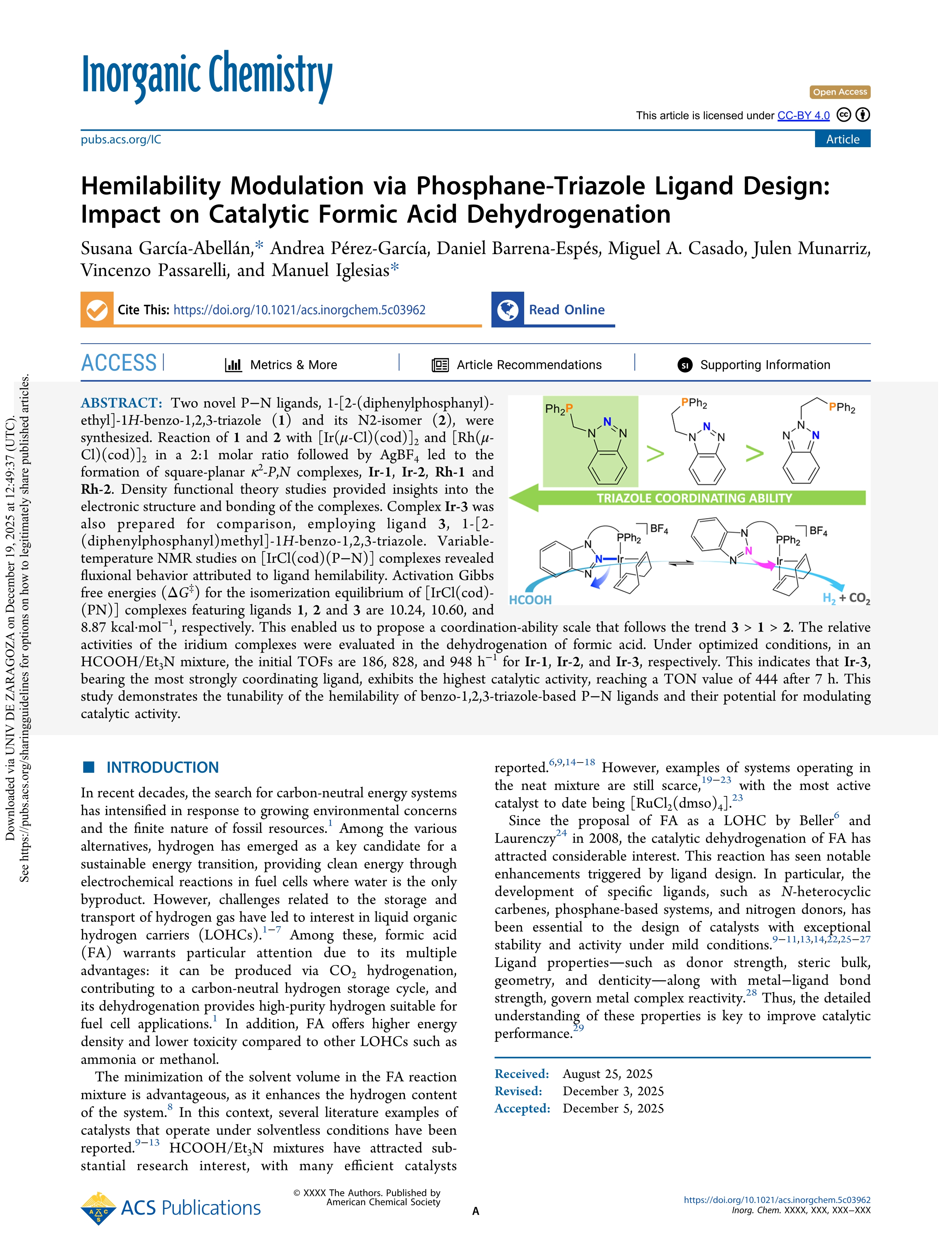
Resumen: Two novel P–N ligands, 1-[2-(diphenylphosphanyl)ethyl]-1H-benzo-1,2,3-triazole (1) and its N2-isomer (2), were synthesized. Reaction of 1 and 2 with [Ir(μ-Cl)(cod)]2 and [Rh(μ-Cl)(cod)]2 in a 2:1 molar ratio followed by AgBF4 led to the formation of square-planar κ2-P,N complexes, Ir-1, Ir-2, Rh-1 and Rh-2. Density functional theory studies provided insights into the electronic structure and bonding of the complexes. Complex Ir-3 was also prepared for comparison, employing ligand 3, 1-[2-(diphenylphosphanyl)methyl]-1H-benzo-1,2,3-triazole. Variable-temperature NMR studies on [IrCl(cod)(P–N)] complexes revealed fluxional behavior attributed to ligand hemilability. Activation Gibbs free energies (ΔG‡) for the isomerization equilibrium of [IrCl(cod)(PN)] complexes featuring ligands 1, 2 and 3 are 10.24, 10.60, and 8.87 kcal·mol–1, respectively. This enabled us to propose a coordination-ability scale that follows the trend 3 > 1 > 2. The relative activities of the iridium complexes were evaluated in the dehydrogenation of formic acid. Under optimized conditions, in an HCOOH/Et3N mixture, the initial TOFs are 186, 828, and 948 h–1 for Ir-1, Ir-2, and Ir-3, respectively. This indicates that Ir-3, bearing the most strongly coordinating ligand, exhibits the highest catalytic activity, reaching a TON value of 444 after 7 h. This study demonstrates the tunability of the hemilability of benzo-1,2,3-triazole-based P–N ligands and their potential for modulating catalytic activity.
Idioma: Inglés
DOI: 10.1021/acs.inorgchem.5c03962
Año: 2025
Publicado en: Inorganic Chemistry 64, 50 (2025), 24539-24552
ISSN: 0020-1669
Financiación: info:eu-repo/grantAgreement/ES/DGA/E42-23R
Financiación: info:eu-repo/grantAgreement/ES/MICINN/PID2021-122763NB-I00
Financiación: info:eu-repo/grantAgreement/ES/MICINN/PID2021-126212OB-I00
Tipo y forma: Artículo (Versión definitiva)
Área (Departamento): Área Química Inorgánica (Dpto. Química Inorgánica)
Área (Departamento): Área Química Física (Dpto. Química Física)
 Debe reconocer adecuadamente la autoría, proporcionar un enlace a la licencia e indicar si se han realizado cambios. Puede hacerlo de cualquier manera razonable, pero no de una manera que sugiera que tiene el apoyo del licenciador o lo recibe por el uso que hace.
Exportado de SIDERAL (2026-04-18-11:05:08)
Visitas y descargas
Idioma: Inglés
DOI: 10.1021/acs.inorgchem.5c03962
Año: 2025
Publicado en: Inorganic Chemistry 64, 50 (2025), 24539-24552
ISSN: 0020-1669
Financiación: info:eu-repo/grantAgreement/ES/DGA/E42-23R
Financiación: info:eu-repo/grantAgreement/ES/MICINN/PID2021-122763NB-I00
Financiación: info:eu-repo/grantAgreement/ES/MICINN/PID2021-126212OB-I00
Tipo y forma: Artículo (Versión definitiva)
Área (Departamento): Área Química Inorgánica (Dpto. Química Inorgánica)
Área (Departamento): Área Química Física (Dpto. Química Física)
Debe reconocer adecuadamente la autoría, proporcionar un enlace a la licencia e indicar si se han realizado cambios. Puede hacerlo de cualquier manera razonable, pero no de una manera que sugiera que tiene el apoyo del licenciador o lo recibe por el uso que hace. Exportado de SIDERAL (2026-04-18-11:05:08)
Enlace permanente:
Visitas y descargas
Este artículo se encuentra en las siguientes colecciones:
Artículos > Artículos por área > Química Inorgánica
Artículos > Artículos por área > Química Física
Registro creado el 2025-12-19, última modificación el 2026-04-18