Antimicrobial activity and potential of Olive leaf extract as a topical agent to combat Staphylococcus aureus and MRSA strains: an in vitro evaluation
Clusa, Laura ; Latorre-Millán, Miriam ; Milagro, Ana María ; Tristancho-Baró, Alexander ; Lopez-Calleja, Ana Isabel ; García-Lechuz, Juan Manuel ; Fortuño, Blanca ; Villar, Nuno del ; Asensio, Mario ; Martín-Belloso, Olga ; Odriozola-Serrano, Isabel ; Martínez-Beamonte Roberto (Universidad de Zaragoza) ; Osada, Jesús (Universidad de Zaragoza) ; Rezusta, Antonio ; Gilaberte, Yolanda (Universidad de Zaragoza)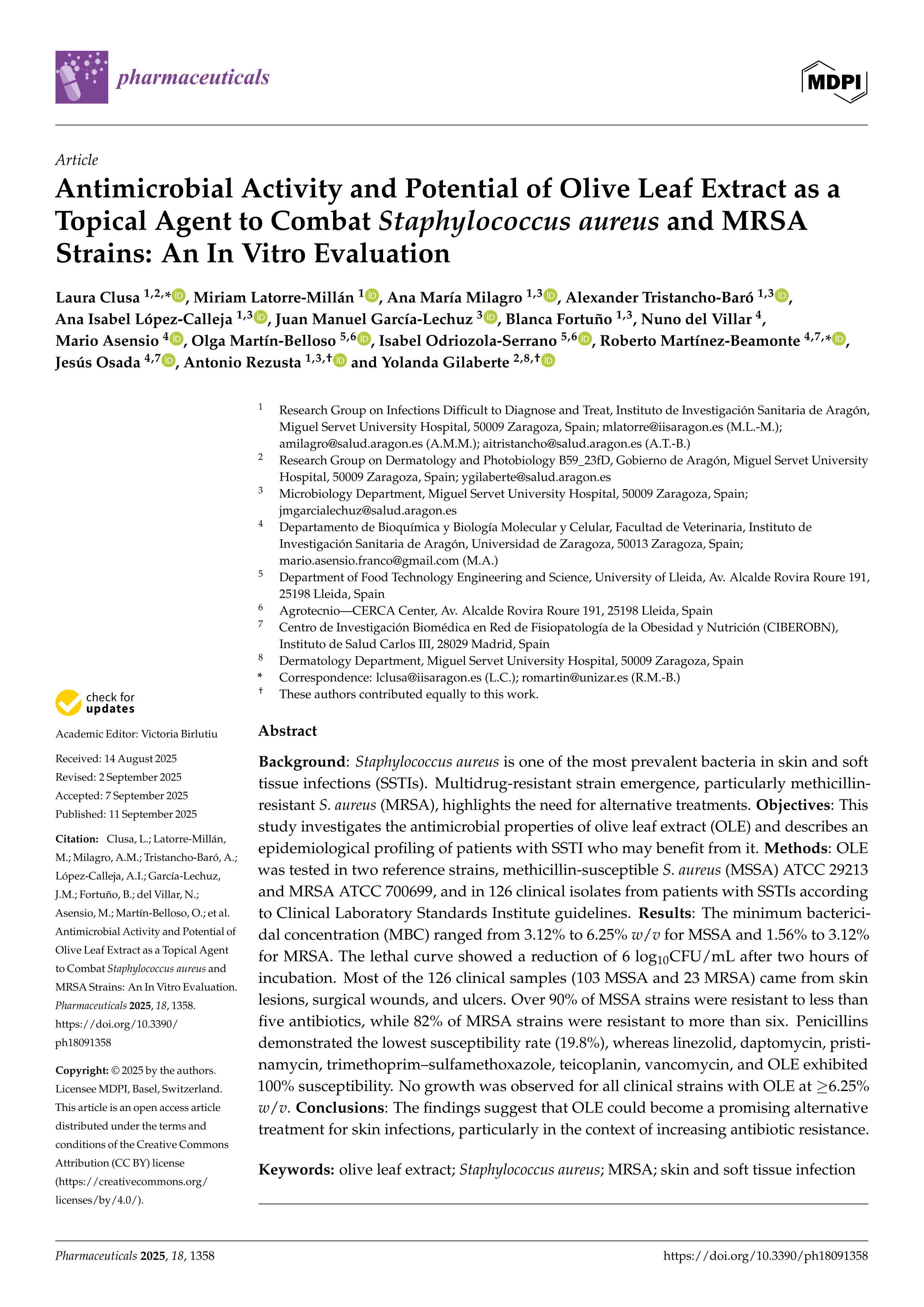
Resumen: Background: Staphylococcus aureus is one of the most prevalent bacteria in skin and soft tissue infections (SSTIs). Multidrug-resistant strain emergence, particularly methicillin-resistant S. aureus (MRSA), highlights the need for alternative treatments. Objectives: This study investigates the antimicrobial properties of olive leaf extract (OLE) and describes an epidemiological profiling of patients with SSTI who may benefit from it. Methods: OLE was tested in two reference strains, methicillin-susceptible S. aureus (MSSA) ATCC 29213 and MRSA ATCC 700699, and in 126 clinical isolates from patients with SSTIs according to Clinical Laboratory Standards Institute guidelines. Results: The minimum bactericidal concentration (MBC) ranged from 3.12% to 6.25% w/v for MSSA and 1.56% to 3.12% for MRSA. The lethal curve showed a reduction of 6 log10CFU/mL after two hours of incubation. Most of the 126 clinical samples (103 MSSA and 23 MRSA) came from skin lesions, surgical wounds, and ulcers. Over 90% of MSSA strains were resistant to less than five antibiotics, while 82% of MRSA strains were resistant to more than six. Penicillins demonstrated the lowest susceptibility rate (19.8%), whereas linezolid, daptomycin, pristinamycin, trimethoprim–sulfamethoxazole, teicoplanin, vancomycin, and OLE exhibited 100% susceptibility. No growth was observed for all clinical strains with OLE at ≥6.25% w/v. Conclusions: The findings suggest that OLE could become a promising alternative treatment for skin infections, particularly in the context of increasing antibiotic resistance.
Idioma: Inglés
Año: 2024
Publicado en: Pharmaceuticals 18, 9 (2024), 1358 [18 pp.]
ISSN: 1424-8247
Factor impacto JCR: 4.8 (2024)
Categ. JCR: PHARMACOLOGY & PHARMACY rank: 51 / 352 = 0.145 (2024) - Q1 - T1
Categ. JCR: CHEMISTRY, MEDICINAL rank: 18 / 72 = 0.25 (2024) - Q1 - T1
Factor impacto CITESCORE: 7.7 - Pharmaceutical Science (Q1) - Drug Discovery (Q2) - Molecular Medicine (Q2)
Factor impacto SCIMAGO: 1.019 - Drug Discovery (Q1) - Pharmaceutical Science (Q1) - Molecular Medicine (Q2)
Financiación: info:eu-repo/grantAgreement/ES/CIBERObn/CB06-03-1012
Financiación: info:eu-repo/grantAgreement/ES/DGA/B10-23R
Financiación: info:eu-repo/grantAgreement/ES/DGA/B16-23R
Financiación: info:eu-repo/grantAgreement/ES/DGA/B59-23D
Financiación: info:eu-repo/grantAgreement/ES/MICINN-AEI/PRTR-C17.I1
Financiación: info:eu-repo/grantAgreement/ES/MCINN/PID2022-136414OB-I00
Tipo y forma: Article (Published version)
Área (Departamento): Área Bioquímica y Biolog.Mole. (Dpto. Bioq.Biolog.Mol. Celular)
Área (Departamento): Área Biología Celular (Dpto. Bioq.Biolog.Mol. Celular)
Área (Departamento): Área Dermatología (Dpto. Medicina, Psiqu. y Derm.)
 You must give appropriate credit, provide a link to the license, and indicate if changes were made. You may do so in any reasonable manner, but not in any way that suggests the licensor endorses you or your use.
Exportado de SIDERAL (2026-02-17-20:49:24)
Visitas y descargas
Idioma: Inglés
Año: 2024
Publicado en: Pharmaceuticals 18, 9 (2024), 1358 [18 pp.]
ISSN: 1424-8247
Factor impacto JCR: 4.8 (2024)
Categ. JCR: PHARMACOLOGY & PHARMACY rank: 51 / 352 = 0.145 (2024) - Q1 - T1
Categ. JCR: CHEMISTRY, MEDICINAL rank: 18 / 72 = 0.25 (2024) - Q1 - T1
Factor impacto CITESCORE: 7.7 - Pharmaceutical Science (Q1) - Drug Discovery (Q2) - Molecular Medicine (Q2)
Factor impacto SCIMAGO: 1.019 - Drug Discovery (Q1) - Pharmaceutical Science (Q1) - Molecular Medicine (Q2)
Financiación: info:eu-repo/grantAgreement/ES/CIBERObn/CB06-03-1012
Financiación: info:eu-repo/grantAgreement/ES/DGA/B10-23R
Financiación: info:eu-repo/grantAgreement/ES/DGA/B16-23R
Financiación: info:eu-repo/grantAgreement/ES/DGA/B59-23D
Financiación: info:eu-repo/grantAgreement/ES/MICINN-AEI/PRTR-C17.I1
Financiación: info:eu-repo/grantAgreement/ES/MCINN/PID2022-136414OB-I00
Tipo y forma: Article (Published version)
Área (Departamento): Área Bioquímica y Biolog.Mole. (Dpto. Bioq.Biolog.Mol. Celular)
Área (Departamento): Área Biología Celular (Dpto. Bioq.Biolog.Mol. Celular)
Área (Departamento): Área Dermatología (Dpto. Medicina, Psiqu. y Derm.)
You must give appropriate credit, provide a link to the license, and indicate if changes were made. You may do so in any reasonable manner, but not in any way that suggests the licensor endorses you or your use. Exportado de SIDERAL (2026-02-17-20:49:24)
Permalink:
Visitas y descargas
Este artículo se encuentra en las siguientes colecciones:
Articles > Artículos por área > Bioquímica y Biología Molecular
Articles > Artículos por área > biologia_celular
Articles > Artículos por área > Dermatología
Record created 2026-01-13, last modified 2026-02-17