Antimicrobial activity and potential of Olive leaf extract as a topical agent to combat Staphylococcus aureus and MRSA strains: an in vitro evaluation
Clusa, Laura ; Latorre-Millán, Miriam ; Milagro, Ana María ; Tristancho-Baró, Alexander ; Lopez-Calleja, Ana Isabel ; García-Lechuz, Juan Manuel ; Fortuño, Blanca ; Villar, Nuno del ; Asensio, Mario ; Martín-Belloso, Olga ; Odriozola-Serrano, Isabel ; Martínez-Beamonte Roberto (Universidad de Zaragoza) ; Osada, Jesús (Universidad de Zaragoza) ; Rezusta, Antonio ; Gilaberte, Yolanda (Universidad de Zaragoza)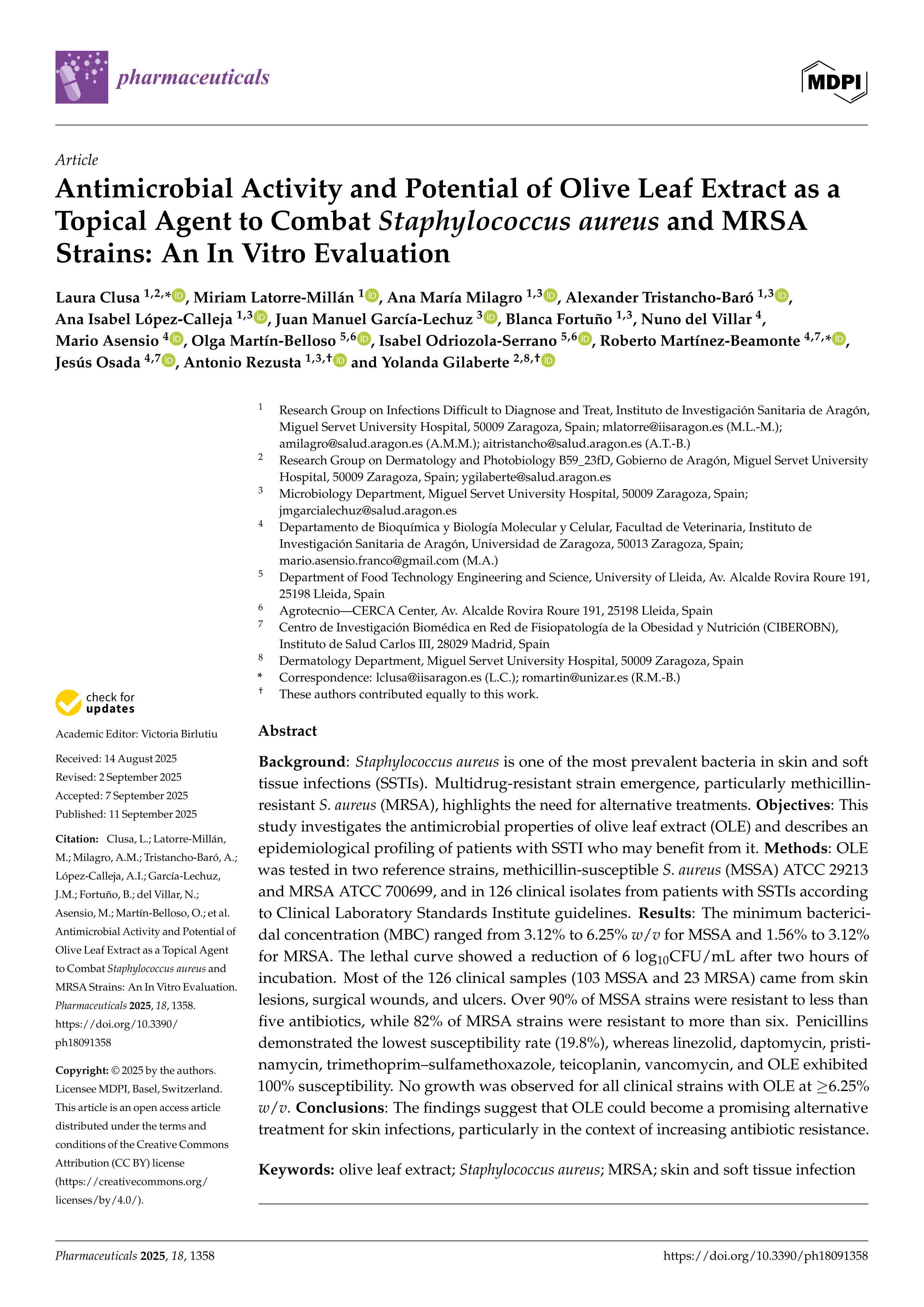
Resumen: Background: Staphylococcus aureus is one of the most prevalent bacteria in skin and soft tissue infections (SSTIs). Multidrug-resistant strain emergence, particularly methicillin-resistant S. aureus (MRSA), highlights the need for alternative treatments. Objectives: This study investigates the antimicrobial properties of olive leaf extract (OLE) and describes an epidemiological profiling of patients with SSTI who may benefit from it. Methods: OLE was tested in two reference strains, methicillin-susceptible S. aureus (MSSA) ATCC 29213 and MRSA ATCC 700699, and in 126 clinical isolates from patients with SSTIs according to Clinical Laboratory Standards Institute guidelines. Results: The minimum bactericidal concentration (MBC) ranged from 3.12% to 6.25% w/v for MSSA and 1.56% to 3.12% for MRSA. The lethal curve showed a reduction of 6 log10CFU/mL after two hours of incubation. Most of the 126 clinical samples (103 MSSA and 23 MRSA) came from skin lesions, surgical wounds, and ulcers. Over 90% of MSSA strains were resistant to less than five antibiotics, while 82% of MRSA strains were resistant to more than six. Penicillins demonstrated the lowest susceptibility rate (19.8%), whereas linezolid, daptomycin, pristinamycin, trimethoprim–sulfamethoxazole, teicoplanin, vancomycin, and OLE exhibited 100% susceptibility. No growth was observed for all clinical strains with OLE at ≥6.25% w/v. Conclusions: The findings suggest that OLE could become a promising alternative treatment for skin infections, particularly in the context of increasing antibiotic resistance.
Idioma: Inglés
Año: 2024
Publicado en: Pharmaceuticals 18, 9 (2024), 1358 [18 pp.]
ISSN: 1424-8247
Factor impacto JCR: 4.8 (2024)
Categ. JCR: PHARMACOLOGY & PHARMACY rank: 51 / 352 = 0.145 (2024) - Q1 - T1
Categ. JCR: CHEMISTRY, MEDICINAL rank: 18 / 72 = 0.25 (2024) - Q1 - T1
Factor impacto CITESCORE: 7.7 - Pharmaceutical Science (Q1) - Drug Discovery (Q2) - Molecular Medicine (Q2)
Factor impacto SCIMAGO: 1.019 - Drug Discovery (Q1) - Pharmaceutical Science (Q1) - Molecular Medicine (Q2)
Financiación: info:eu-repo/grantAgreement/ES/CIBERObn/CB06-03-1012
Financiación: info:eu-repo/grantAgreement/ES/DGA/B10-23R
Financiación: info:eu-repo/grantAgreement/ES/DGA/B16-23R
Financiación: info:eu-repo/grantAgreement/ES/DGA/B59-23D
Financiación: info:eu-repo/grantAgreement/ES/MICINN-AEI/PRTR-C17.I1
Financiación: info:eu-repo/grantAgreement/ES/MCINN/PID2022-136414OB-I00
Tipo y forma: Article (Published version)
Área (Departamento): Área Bioquímica y Biolog.Mole. (Dpto. Bioq.Biolog.Mol. Celular)
Área (Departamento): Área Biología Celular (Dpto. Bioq.Biolog.Mol. Celular)
Área (Departamento): Área Dermatología (Dpto. Medicina, Psiqu. y Derm.)
Exportado de SIDERAL (2026-02-17-20:49:24)
Visitas y descargas
Idioma: Inglés
Año: 2024
Publicado en: Pharmaceuticals 18, 9 (2024), 1358 [18 pp.]
ISSN: 1424-8247
Factor impacto JCR: 4.8 (2024)
Categ. JCR: PHARMACOLOGY & PHARMACY rank: 51 / 352 = 0.145 (2024) - Q1 - T1
Categ. JCR: CHEMISTRY, MEDICINAL rank: 18 / 72 = 0.25 (2024) - Q1 - T1
Factor impacto CITESCORE: 7.7 - Pharmaceutical Science (Q1) - Drug Discovery (Q2) - Molecular Medicine (Q2)
Factor impacto SCIMAGO: 1.019 - Drug Discovery (Q1) - Pharmaceutical Science (Q1) - Molecular Medicine (Q2)
Financiación: info:eu-repo/grantAgreement/ES/CIBERObn/CB06-03-1012
Financiación: info:eu-repo/grantAgreement/ES/DGA/B10-23R
Financiación: info:eu-repo/grantAgreement/ES/DGA/B16-23R
Financiación: info:eu-repo/grantAgreement/ES/DGA/B59-23D
Financiación: info:eu-repo/grantAgreement/ES/MICINN-AEI/PRTR-C17.I1
Financiación: info:eu-repo/grantAgreement/ES/MCINN/PID2022-136414OB-I00
Tipo y forma: Article (Published version)
Área (Departamento): Área Bioquímica y Biolog.Mole. (Dpto. Bioq.Biolog.Mol. Celular)
Área (Departamento): Área Biología Celular (Dpto. Bioq.Biolog.Mol. Celular)
Área (Departamento): Área Dermatología (Dpto. Medicina, Psiqu. y Derm.)
Exportado de SIDERAL (2026-02-17-20:49:24)
Permalink:
Visitas y descargas
Este artículo se encuentra en las siguientes colecciones:
articulos > articulos-por-area > bioquimica_y_biologia_molecular
articulos > articulos-por-area > biologia_celular
articulos > articulos-por-area > dermatologia
Notice créée le 2026-01-13, modifiée le 2026-02-17