Atogepant after anti-CGRP monoclonal antibodies failure in migraine: a multicenter real-world study of effectiveness, safety, persistence and predictors of response
Muñoz-Vendrell, Albert ; Campoy-Díaz, Sergio ; Valín-Villanueva, Paloma ; Casas-Limón, Javier ; Fernández-Lázaro, Iris ; González-García, Nuria ; Santos-Lasaosa, Sonia (Universidad de Zaragoza) ; González Osorio, Yésica ; Gonzalez-Martinez, Alicia ; Campdelacreu, Jaume ; Portocarrero-Sánchez, Leonardo ; Cano Sánchez, Luis Miguel ; García Sánchez, Sonia María ; Pérez-de-la-parte, Alba ; Morollón Sánchez-Mateos, Noemí ; López-Bravo, Alba ; Mínguez-Olaondo, Ane ; Sánchez-Soblechero, Antonio ; Lozano Ros, Alberto ; Morales Hernández, Cristian ; Andrés López, Alberto ; Layos-Romero, Almudena ; Caronna, Edoardo ; Torres-Ferrús, Marta ; Alpuente, Alicia ; Pozo-Rosich, Patricia ; Belvís, Robert ; Garcia-Azorin, David ; Díaz-de-Terán, Javier ; Guerrero-Peral, Ángel Luis ; Gago-Veiga, Ana Beatriz ; Huerta-Villanueva, Mariano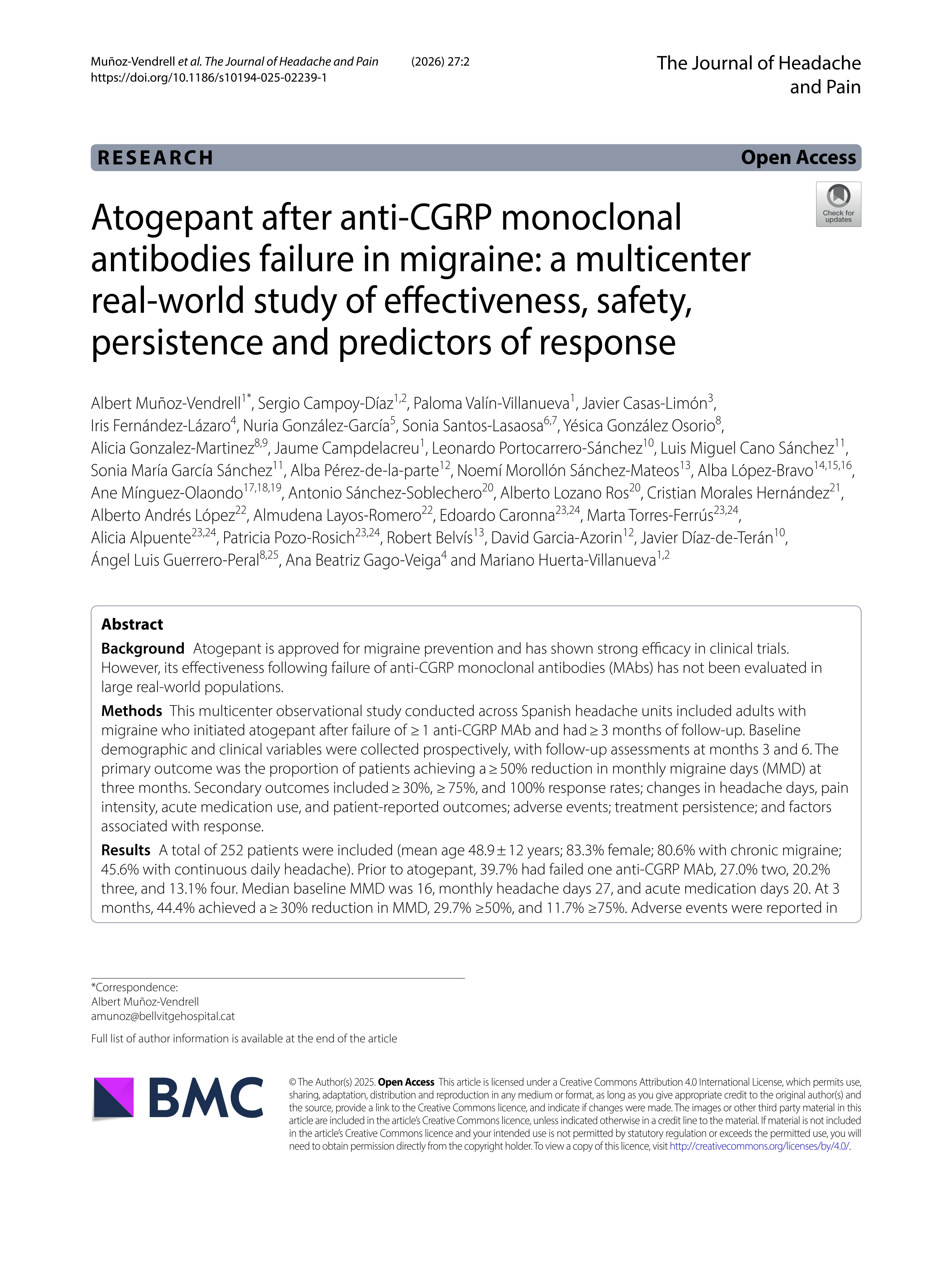
Resumen: Background Atogepant is approved for migraine prevention and has shown strong efficacy in clinical trials. However, its effectiveness following failure of anti-CGRP monoclonal antibodies (MAbs) has not been evaluated in large real-world populations. Methods This multicenter observational study conducted across Spanish headache units included adults with migraine who initiated atogepant after failure of ≥1 anti-CGRP MAb and had≥3 months of follow-up. Baseline demographic and clinical variables were collected prospectively, with follow-up assessments at months 3 and 6. The primary outcome was the proportion of patients achieving a≥50% reduction in monthly migraine days (MMD) at three months. Secondary outcomes included≥30%, ≥75%, and 100% response rates; changes in headache days, pain intensity, acute medication use, and patient-reported outcomes; adverse events; treatment persistence; and factors associated with response. Results A total of 252 patients were included (mean age 48.9±12 years; 83.3% female; 80.6% with chronic migraine; 45.6% with continuous daily headache). Prior to atogepant, 39.7% had failed one anti-CGRP MAb, 27.0% two, 20.2% three, and 13.1% four. Median baseline MMD was 16, monthly headache days 27, and acute medication days 20. At 3 months, 44.4% achieved a≥30% reduction in MMD, 29.7% ≥50%, and 11.7% ≥75%. Adverse events were reported in 52.5% of patients, most commonly constipation (30%) and nausea (25%). At three months, 26.2% had discontinued treatment (65.1% due to inefficacy, 28.8% due to intolerance). Treatment persistence at 180 days was 61% (95% CI 54 to 69%). A higher number of previously failed MAbs was independently associated with reduced odds of ≥50% response (RR 0.79, 95% CI 0.64 to 0.97). Moreover, a higher number of previously failed MAbs was associated with diminished improvements across multiple clinical endpoints, including headache frequency, intensity, acute medication use, and disability measures. Conclusion Atogepant may represent a viable treatment option for patients with migraine who have failed antiCGRP MAbs. In this large real-world cohort, approximately one-third of patients achieved a≥50% response, despite a
treatment-refractory profile. However, the likelihood of response decreases with a higher number of previously failed MAbs, and mild adverse events are frequent.
Idioma: Inglés
DOI: 10.1186/s10194-025-02239-1
Año: 2025
Publicado en: The Journal of headache and pain 27, 2 (2025), [12 pp.]
ISSN: 1129-2369
Tipo y forma: Article (Published version)
Área (Departamento): Area Medicina (Dpto. Medicina, Psiqu. y Derm.)
 You must give appropriate credit, provide a link to the license, and indicate if changes were made. You may do so in any reasonable manner, but not in any way that suggests the licensor endorses you or your use.
Exportado de SIDERAL (2026-01-15-21:57:08)
Visitas y descargas
treatment-refractory profile. However, the likelihood of response decreases with a higher number of previously failed MAbs, and mild adverse events are frequent.
Idioma: Inglés
DOI: 10.1186/s10194-025-02239-1
Año: 2025
Publicado en: The Journal of headache and pain 27, 2 (2025), [12 pp.]
ISSN: 1129-2369
Tipo y forma: Article (Published version)
Área (Departamento): Area Medicina (Dpto. Medicina, Psiqu. y Derm.)
You must give appropriate credit, provide a link to the license, and indicate if changes were made. You may do so in any reasonable manner, but not in any way that suggests the licensor endorses you or your use. Exportado de SIDERAL (2026-01-15-21:57:08)
Permalink:
Visitas y descargas
Este artículo se encuentra en las siguientes colecciones:
Articles > Artículos por área > Medicina
Record created 2026-01-15, last modified 2026-01-16