Atogepant after anti-CGRP monoclonal antibodies failure in migraine: a multicenter real-world study of effectiveness, safety, persistence and predictors of response
Muñoz-Vendrell, Albert ; Campoy-Díaz, Sergio ; Valín-Villanueva, Paloma ; Casas-Limón, Javier ; Fernández-Lázaro, Iris ; González-García, Nuria ; Santos-Lasaosa, Sonia (Universidad de Zaragoza) ; González Osorio, Yésica ; Gonzalez-Martinez, Alicia ; Campdelacreu, Jaume ; Portocarrero-Sánchez, Leonardo ; Cano Sánchez, Luis Miguel ; García Sánchez, Sonia María ; Pérez-de-la-parte, Alba ; Morollón Sánchez-Mateos, Noemí ; López-Bravo, Alba ; Mínguez-Olaondo, Ane ; Sánchez-Soblechero, Antonio ; Lozano Ros, Alberto ; Morales Hernández, Cristian ; Andrés López, Alberto ; Layos-Romero, Almudena ; Caronna, Edoardo ; Torres-Ferrús, Marta ; Alpuente, Alicia ; Pozo-Rosich, Patricia ; Belvís, Robert ; Garcia-Azorin, David ; Díaz-de-Terán, Javier ; Guerrero-Peral, Ángel Luis ; Gago-Veiga, Ana Beatriz ; Huerta-Villanueva, Mariano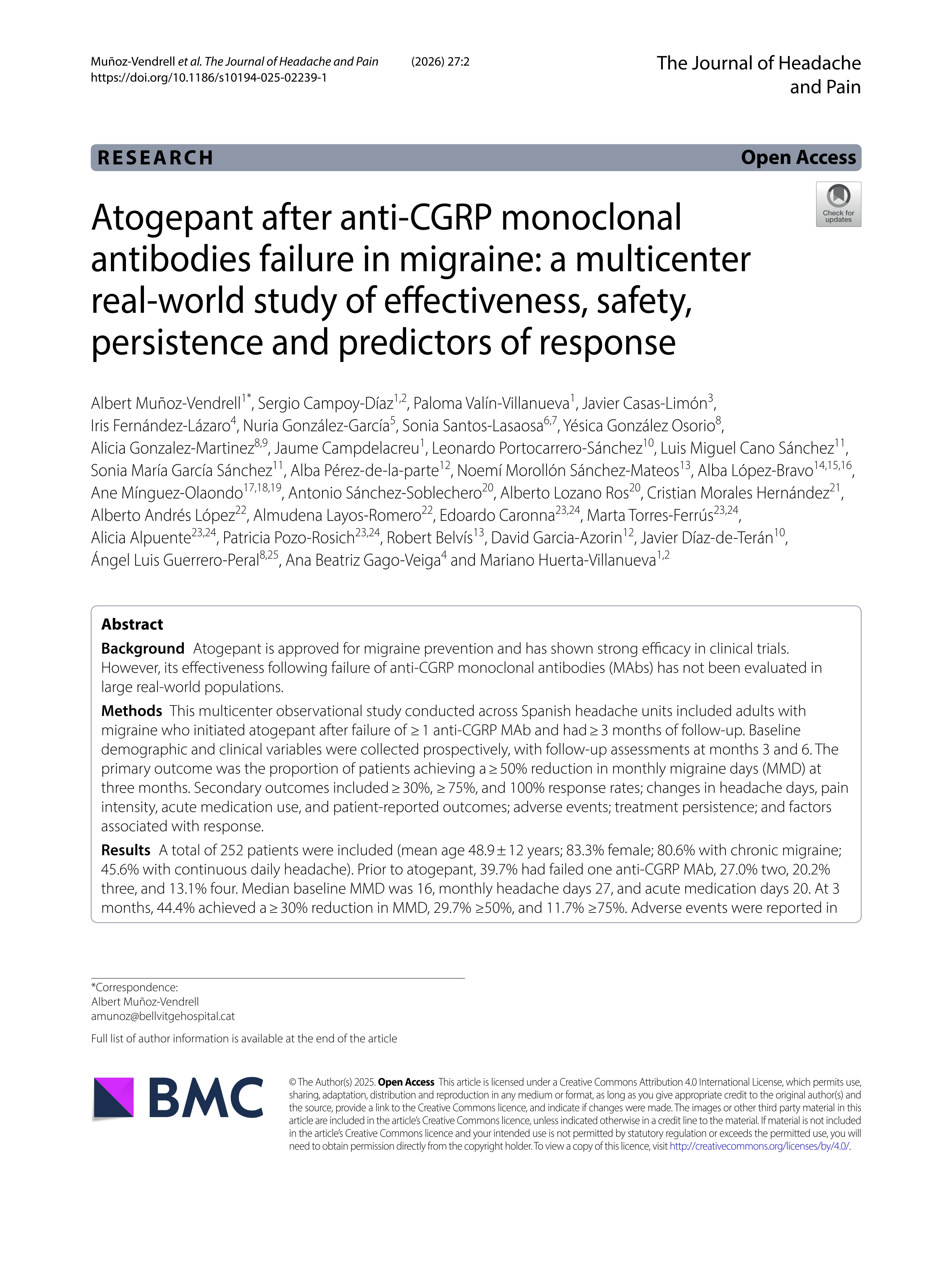
Resumen: Background Atogepant is approved for migraine prevention and has shown strong efficacy in clinical trials. However, its effectiveness following failure of anti-CGRP monoclonal antibodies (MAbs) has not been evaluated in large real-world populations. Methods This multicenter observational study conducted across Spanish headache units included adults with migraine who initiated atogepant after failure of ≥1 anti-CGRP MAb and had≥3 months of follow-up. Baseline demographic and clinical variables were collected prospectively, with follow-up assessments at months 3 and 6. The primary outcome was the proportion of patients achieving a≥50% reduction in monthly migraine days (MMD) at three months. Secondary outcomes included≥30%, ≥75%, and 100% response rates; changes in headache days, pain intensity, acute medication use, and patient-reported outcomes; adverse events; treatment persistence; and factors associated with response. Results A total of 252 patients were included (mean age 48.9±12 years; 83.3% female; 80.6% with chronic migraine; 45.6% with continuous daily headache). Prior to atogepant, 39.7% had failed one anti-CGRP MAb, 27.0% two, 20.2% three, and 13.1% four. Median baseline MMD was 16, monthly headache days 27, and acute medication days 20. At 3 months, 44.4% achieved a≥30% reduction in MMD, 29.7% ≥50%, and 11.7% ≥75%. Adverse events were reported in 52.5% of patients, most commonly constipation (30%) and nausea (25%). At three months, 26.2% had discontinued treatment (65.1% due to inefficacy, 28.8% due to intolerance). Treatment persistence at 180 days was 61% (95% CI 54 to 69%). A higher number of previously failed MAbs was independently associated with reduced odds of ≥50% response (RR 0.79, 95% CI 0.64 to 0.97). Moreover, a higher number of previously failed MAbs was associated with diminished improvements across multiple clinical endpoints, including headache frequency, intensity, acute medication use, and disability measures. Conclusion Atogepant may represent a viable treatment option for patients with migraine who have failed antiCGRP MAbs. In this large real-world cohort, approximately one-third of patients achieved a≥50% response, despite a
treatment-refractory profile. However, the likelihood of response decreases with a higher number of previously failed MAbs, and mild adverse events are frequent.
Idioma: Inglés
DOI: 10.1186/s10194-025-02239-1
Año: 2025
Publicado en: The Journal of headache and pain 27, 2 (2025), [12 pp.]
ISSN: 1129-2369
Tipo y forma: Artículo (Versión definitiva)
Área (Departamento): Area Medicina (Dpto. Medicina, Psiqu. y Derm.)
 Debe reconocer adecuadamente la autoría, proporcionar un enlace a la licencia e indicar si se han realizado cambios. Puede hacerlo de cualquier manera razonable, pero no de una manera que sugiera que tiene el apoyo del licenciador o lo recibe por el uso que hace.
Exportado de SIDERAL (2026-01-15-21:57:08)
Visitas y descargas
treatment-refractory profile. However, the likelihood of response decreases with a higher number of previously failed MAbs, and mild adverse events are frequent.
Idioma: Inglés
DOI: 10.1186/s10194-025-02239-1
Año: 2025
Publicado en: The Journal of headache and pain 27, 2 (2025), [12 pp.]
ISSN: 1129-2369
Tipo y forma: Artículo (Versión definitiva)
Área (Departamento): Area Medicina (Dpto. Medicina, Psiqu. y Derm.)
Debe reconocer adecuadamente la autoría, proporcionar un enlace a la licencia e indicar si se han realizado cambios. Puede hacerlo de cualquier manera razonable, pero no de una manera que sugiera que tiene el apoyo del licenciador o lo recibe por el uso que hace. Exportado de SIDERAL (2026-01-15-21:57:08)
Enlace permanente:
Visitas y descargas
Este artículo se encuentra en las siguientes colecciones:
Artículos > Artículos por área > Medicina
Registro creado el 2026-01-15, última modificación el 2026-01-16