Continuous smartwatch monitoring after atrial fibrillation ablation: feasibility of burden estimation and association with quality of life
Almeida, João G. ; Dias, Duarte ; Silva-Teixeira, Rafael ; Carrington, Mafalda ; Fonseca, Paulo ; Oliveira, Marco ; Gonçalves, Helena ; Primo, João ; Fontes-Carvalho, Ricardo ; Azevedo, Luís ; Barra, Sérgio ; Martínez, Juan Pablo (Universidad de Zaragoza) ; Almeida, Rute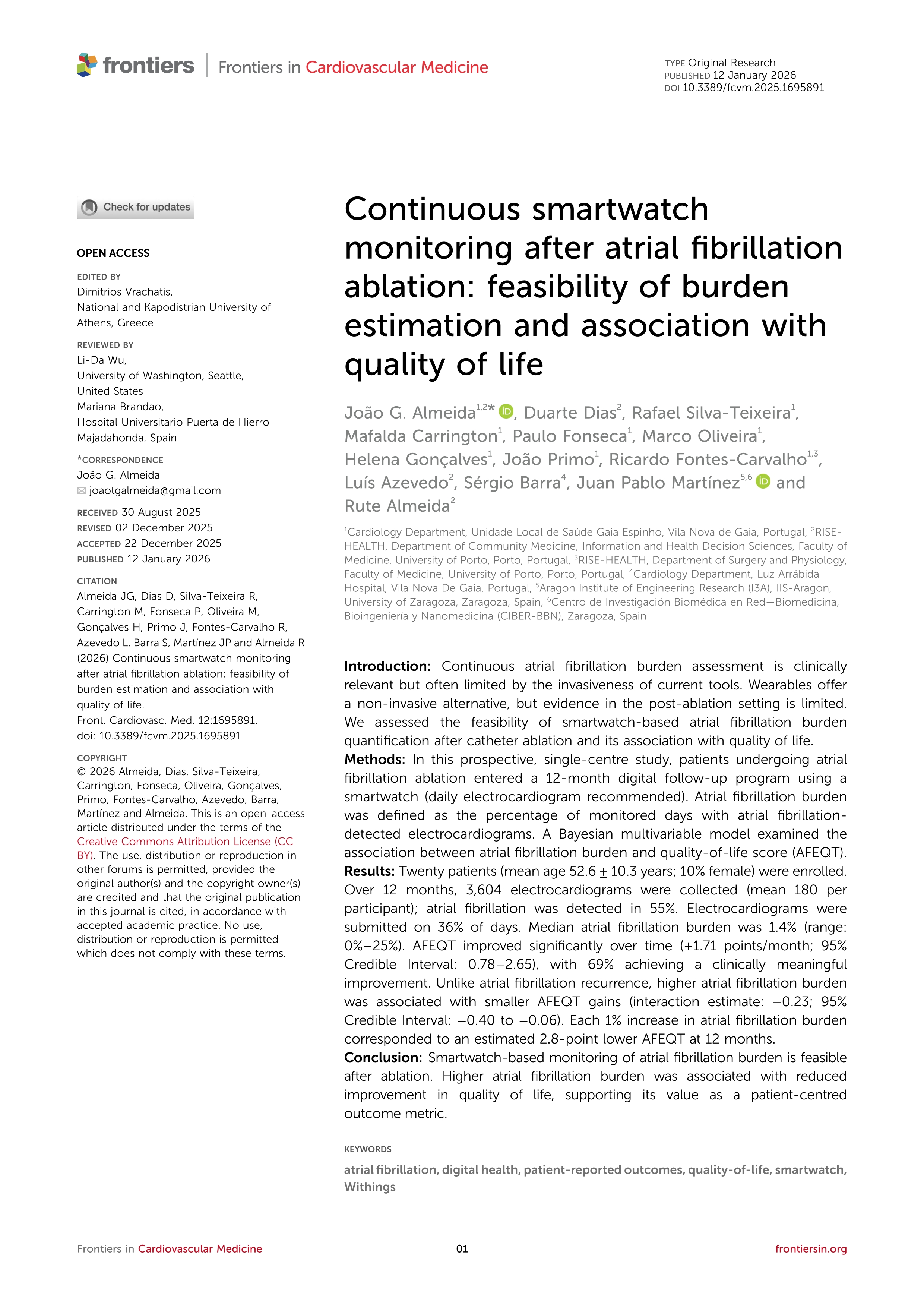
Resumen: Introduction: Continuous atrial fibrillation burden assessment is clinically relevant but often limited by the invasiveness of current tools. Wearables offer a non-invasive alternative, but evidence in the post-ablation setting is limited. We assessed the feasibility of smartwatch-based atrial fibrillation burden quantification after catheter ablation and its association with quality of life.
Methods: In this prospective, single-centre study, patients undergoing atrial fibrillation ablation entered a 12-month digital follow-up program using a smartwatch (daily electrocardiogram recommended). Atrial fibrillation burden was defined as the percentage of monitored days with atrial fibrillation-detected electrocardiograms. A Bayesian multivariable model examined the association between atrial fibrillation burden and quality-of-life score (AFEQT).
Results: Twenty patients (mean age 52.6 ± 10.3 years; 10% female) were enrolled. Over 12 months, 3,604 electrocardiograms were collected (mean 180 per participant); atrial fibrillation was detected in 55%. Electrocardiograms were submitted on 36% of days. Median atrial fibrillation burden was 1.4% (range: 0%–25%). AFEQT improved significantly over time (+1.71 points/month; 95% Credible Interval: 0.78–2.65), with 69% achieving a clinically meaningful improvement. Unlike atrial fibrillation recurrence, higher atrial fibrillation burden was associated with smaller AFEQT gains (interaction estimate: −0.23; 95% Credible Interval: −0.40 to −0.06). Each 1% increase in atrial fibrillation burden corresponded to an estimated 2.8-point lower AFEQT at 12 months.
Conclusion: Smartwatch-based monitoring of atrial fibrillation burden is feasible after ablation. Higher atrial fibrillation burden was associated with reduced improvement in quality of life, supporting its value as a patient-centred outcome metric.
Idioma: Inglés
DOI: 10.3389/fcvm.2025.1695891
Año: 2025
Publicado en: Frontiers in cardiovascular medicine 12 (2025), [11 pp.]
ISSN: 2297-055X
Financiación: info:eu-repo/grantAgreement/ES/DGA-FEDER/T39-23R-BSICoS
Financiación: info:eu-repo/grantAgreement/ES/MICINN/PID2022-140556OB-I00
Tipo y forma: Article (Published version)
Área (Departamento): Área Teoría Señal y Comunicac. (Dpto. Ingeniería Electrón.Com.)
 You must give appropriate credit, provide a link to the license, and indicate if changes were made. You may do so in any reasonable manner, but not in any way that suggests the licensor endorses you or your use.
Exportado de SIDERAL (2026-02-05-14:36:52)
Visitas y descargas
Methods: In this prospective, single-centre study, patients undergoing atrial fibrillation ablation entered a 12-month digital follow-up program using a smartwatch (daily electrocardiogram recommended). Atrial fibrillation burden was defined as the percentage of monitored days with atrial fibrillation-detected electrocardiograms. A Bayesian multivariable model examined the association between atrial fibrillation burden and quality-of-life score (AFEQT).
Results: Twenty patients (mean age 52.6 ± 10.3 years; 10% female) were enrolled. Over 12 months, 3,604 electrocardiograms were collected (mean 180 per participant); atrial fibrillation was detected in 55%. Electrocardiograms were submitted on 36% of days. Median atrial fibrillation burden was 1.4% (range: 0%–25%). AFEQT improved significantly over time (+1.71 points/month; 95% Credible Interval: 0.78–2.65), with 69% achieving a clinically meaningful improvement. Unlike atrial fibrillation recurrence, higher atrial fibrillation burden was associated with smaller AFEQT gains (interaction estimate: −0.23; 95% Credible Interval: −0.40 to −0.06). Each 1% increase in atrial fibrillation burden corresponded to an estimated 2.8-point lower AFEQT at 12 months.
Conclusion: Smartwatch-based monitoring of atrial fibrillation burden is feasible after ablation. Higher atrial fibrillation burden was associated with reduced improvement in quality of life, supporting its value as a patient-centred outcome metric.
Idioma: Inglés
DOI: 10.3389/fcvm.2025.1695891
Año: 2025
Publicado en: Frontiers in cardiovascular medicine 12 (2025), [11 pp.]
ISSN: 2297-055X
Financiación: info:eu-repo/grantAgreement/ES/DGA-FEDER/T39-23R-BSICoS
Financiación: info:eu-repo/grantAgreement/ES/MICINN/PID2022-140556OB-I00
Tipo y forma: Article (Published version)
Área (Departamento): Área Teoría Señal y Comunicac. (Dpto. Ingeniería Electrón.Com.)
You must give appropriate credit, provide a link to the license, and indicate if changes were made. You may do so in any reasonable manner, but not in any way that suggests the licensor endorses you or your use. Exportado de SIDERAL (2026-02-05-14:36:52)
Permalink:
Visitas y descargas
Este artículo se encuentra en las siguientes colecciones:
Articles > Artículos por área > Teoría de la Señal y Comunicaciones
Record created 2026-02-05, last modified 2026-02-05