Continuous smartwatch monitoring after atrial fibrillation ablation: feasibility of burden estimation and association with quality of life
Almeida, João G. ; Dias, Duarte ; Silva-Teixeira, Rafael ; Carrington, Mafalda ; Fonseca, Paulo ; Oliveira, Marco ; Gonçalves, Helena ; Primo, João ; Fontes-Carvalho, Ricardo ; Azevedo, Luís ; Barra, Sérgio ; Martínez, Juan Pablo (Universidad de Zaragoza) ; Almeida, Rute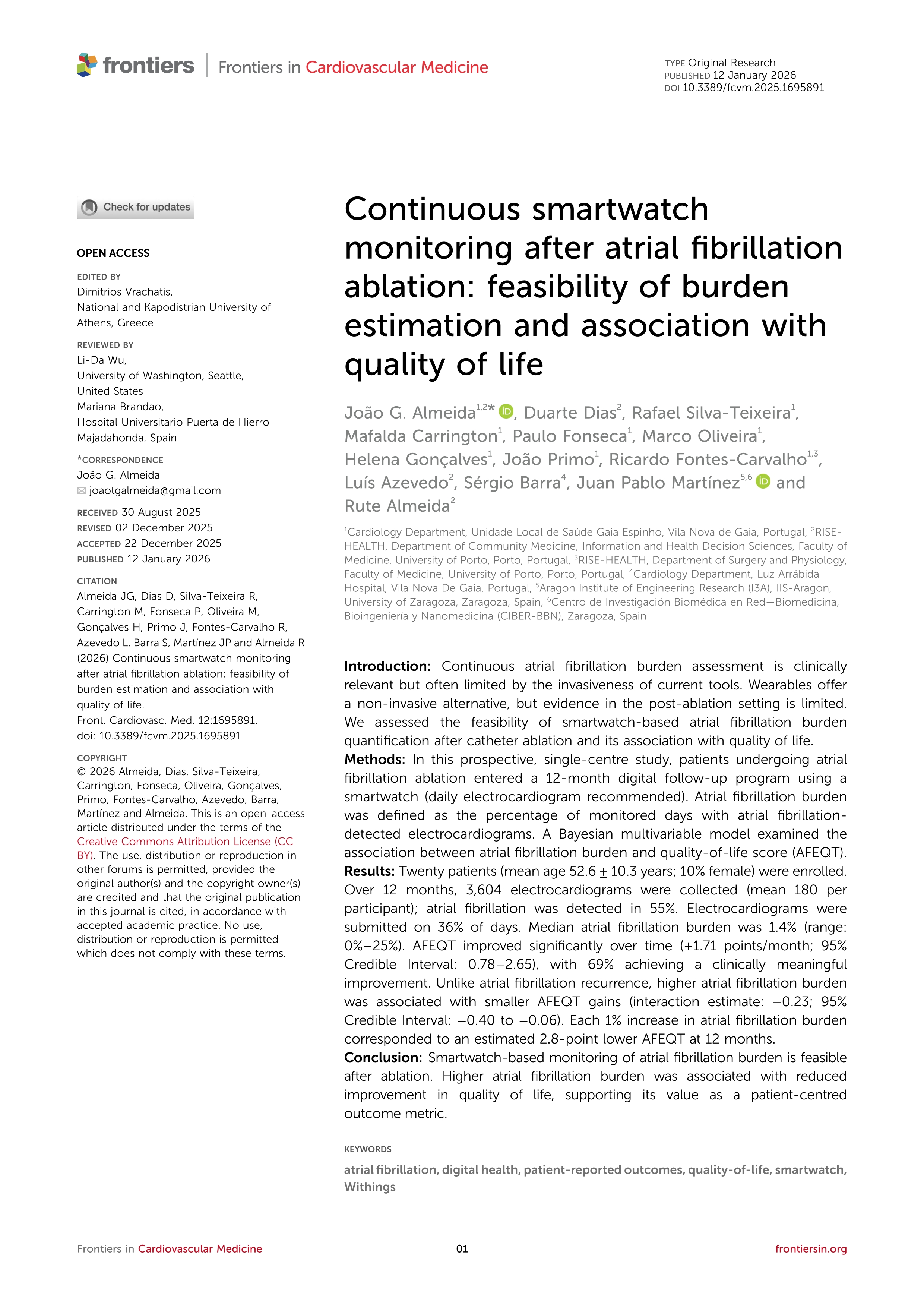
Resumen: Introduction: Continuous atrial fibrillation burden assessment is clinically relevant but often limited by the invasiveness of current tools. Wearables offer a non-invasive alternative, but evidence in the post-ablation setting is limited. We assessed the feasibility of smartwatch-based atrial fibrillation burden quantification after catheter ablation and its association with quality of life.
Methods: In this prospective, single-centre study, patients undergoing atrial fibrillation ablation entered a 12-month digital follow-up program using a smartwatch (daily electrocardiogram recommended). Atrial fibrillation burden was defined as the percentage of monitored days with atrial fibrillation-detected electrocardiograms. A Bayesian multivariable model examined the association between atrial fibrillation burden and quality-of-life score (AFEQT).
Results: Twenty patients (mean age 52.6 ± 10.3 years; 10% female) were enrolled. Over 12 months, 3,604 electrocardiograms were collected (mean 180 per participant); atrial fibrillation was detected in 55%. Electrocardiograms were submitted on 36% of days. Median atrial fibrillation burden was 1.4% (range: 0%–25%). AFEQT improved significantly over time (+1.71 points/month; 95% Credible Interval: 0.78–2.65), with 69% achieving a clinically meaningful improvement. Unlike atrial fibrillation recurrence, higher atrial fibrillation burden was associated with smaller AFEQT gains (interaction estimate: −0.23; 95% Credible Interval: −0.40 to −0.06). Each 1% increase in atrial fibrillation burden corresponded to an estimated 2.8-point lower AFEQT at 12 months.
Conclusion: Smartwatch-based monitoring of atrial fibrillation burden is feasible after ablation. Higher atrial fibrillation burden was associated with reduced improvement in quality of life, supporting its value as a patient-centred outcome metric.
Idioma: Inglés
DOI: 10.3389/fcvm.2025.1695891
Año: 2025
Publicado en: Frontiers in cardiovascular medicine 12 (2025), [11 pp.]
ISSN: 2297-055X
Financiación: info:eu-repo/grantAgreement/ES/DGA-FEDER/T39-23R-BSICoS
Financiación: info:eu-repo/grantAgreement/ES/MICINN/PID2022-140556OB-I00
Tipo y forma: Artículo (Versión definitiva)
Área (Departamento): Área Teoría Señal y Comunicac. (Dpto. Ingeniería Electrón.Com.)
 Debe reconocer adecuadamente la autoría, proporcionar un enlace a la licencia e indicar si se han realizado cambios. Puede hacerlo de cualquier manera razonable, pero no de una manera que sugiera que tiene el apoyo del licenciador o lo recibe por el uso que hace.
Exportado de SIDERAL (2026-02-05-14:36:52)
Visitas y descargas
Methods: In this prospective, single-centre study, patients undergoing atrial fibrillation ablation entered a 12-month digital follow-up program using a smartwatch (daily electrocardiogram recommended). Atrial fibrillation burden was defined as the percentage of monitored days with atrial fibrillation-detected electrocardiograms. A Bayesian multivariable model examined the association between atrial fibrillation burden and quality-of-life score (AFEQT).
Results: Twenty patients (mean age 52.6 ± 10.3 years; 10% female) were enrolled. Over 12 months, 3,604 electrocardiograms were collected (mean 180 per participant); atrial fibrillation was detected in 55%. Electrocardiograms were submitted on 36% of days. Median atrial fibrillation burden was 1.4% (range: 0%–25%). AFEQT improved significantly over time (+1.71 points/month; 95% Credible Interval: 0.78–2.65), with 69% achieving a clinically meaningful improvement. Unlike atrial fibrillation recurrence, higher atrial fibrillation burden was associated with smaller AFEQT gains (interaction estimate: −0.23; 95% Credible Interval: −0.40 to −0.06). Each 1% increase in atrial fibrillation burden corresponded to an estimated 2.8-point lower AFEQT at 12 months.
Conclusion: Smartwatch-based monitoring of atrial fibrillation burden is feasible after ablation. Higher atrial fibrillation burden was associated with reduced improvement in quality of life, supporting its value as a patient-centred outcome metric.
Idioma: Inglés
DOI: 10.3389/fcvm.2025.1695891
Año: 2025
Publicado en: Frontiers in cardiovascular medicine 12 (2025), [11 pp.]
ISSN: 2297-055X
Financiación: info:eu-repo/grantAgreement/ES/DGA-FEDER/T39-23R-BSICoS
Financiación: info:eu-repo/grantAgreement/ES/MICINN/PID2022-140556OB-I00
Tipo y forma: Artículo (Versión definitiva)
Área (Departamento): Área Teoría Señal y Comunicac. (Dpto. Ingeniería Electrón.Com.)
Debe reconocer adecuadamente la autoría, proporcionar un enlace a la licencia e indicar si se han realizado cambios. Puede hacerlo de cualquier manera razonable, pero no de una manera que sugiera que tiene el apoyo del licenciador o lo recibe por el uso que hace. Exportado de SIDERAL (2026-02-05-14:36:52)
Enlace permanente:
Visitas y descargas
Este artículo se encuentra en las siguientes colecciones:
Artículos > Artículos por área > Teoría de la Señal y Comunicaciones
Registro creado el 2026-02-05, última modificación el 2026-02-05