FEM modeling of hamburger pan cooking: Fat content influence and neural network-based prediction of fat loss
Hernández-Alhambra, E. (Universidad de Zaragoza) ; Guiu, P. (Universidad de Zaragoza) ; Ferrer-Mairal, A. (Universidad de Zaragoza) ; Martínez, M.A. (Universidad de Zaragoza) ; Calvo, B. (Universidad de Zaragoza) ; Grasa, J. (Universidad de Zaragoza) ; Salvador, M.L. (Universidad de Zaragoza)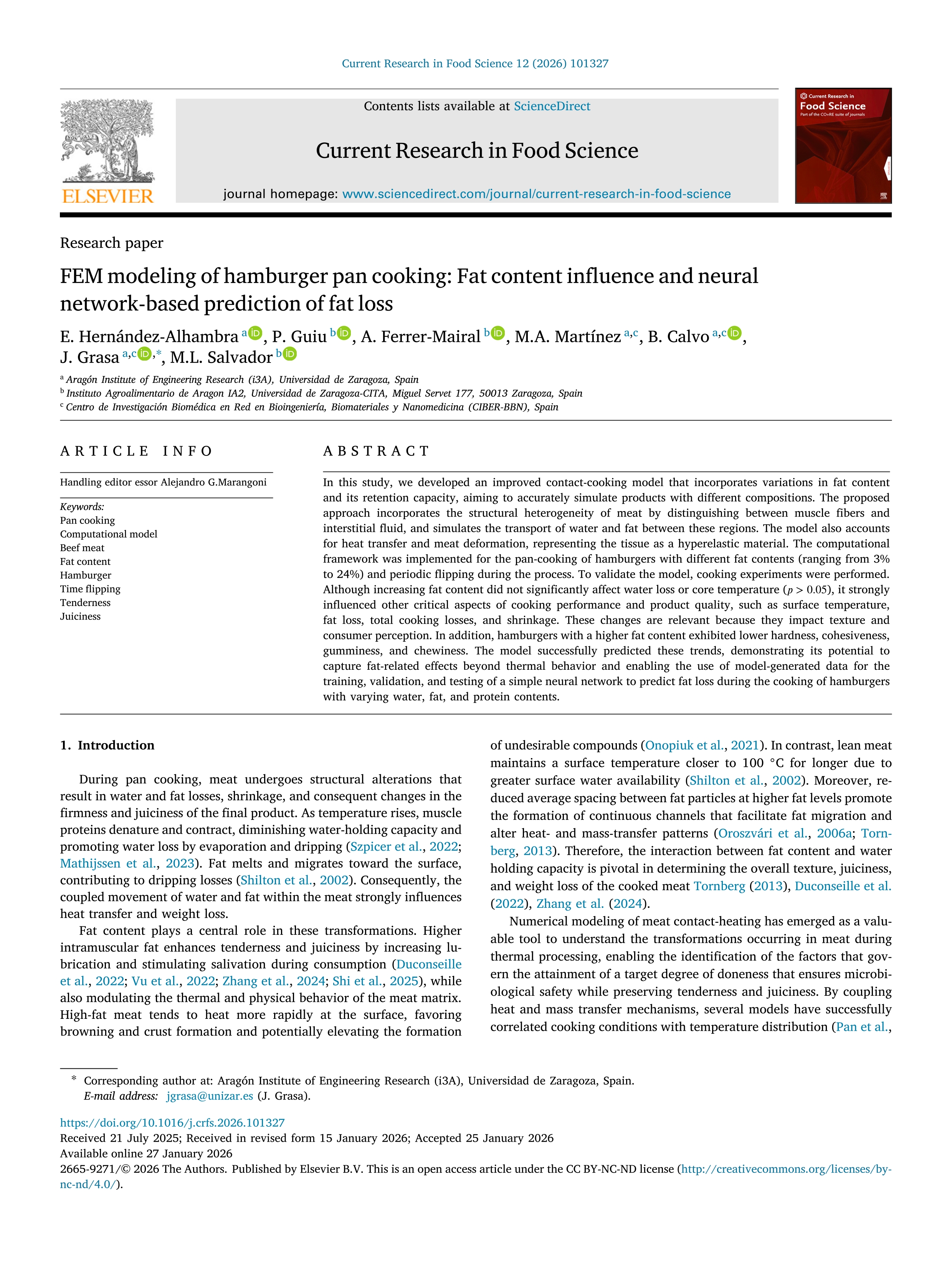
Resumen: In this study, we developed an improved contact-cooking model that incorporates variations in fat content and its retention capacity, aiming to accurately simulate products with different compositions. The proposed approach incorporates the structural heterogeneity of meat by distinguishing between muscle fibers and interstitial fluid, and simulates the transport of water and fat between these regions. The model also accounts for heat transfer and meat deformation, representing the tissue as a hyperelastic material. The computational framework was implemented for the pan-cooking of hamburgers with different fat contents (ranging from 3% to 24%) and periodic flipping during the process. To validate the model, cooking experiments were performed. Although increasing fat content did not significantly affect water loss or core temperature (p>0.05), it strongly influenced other critical aspects of cooking performance and product quality, such as surface temperature, fat loss, total cooking losses, and shrinkage. These changes are relevant because they impact texture and consumer perception. In addition, hamburgers with a higher fat content exhibited lower hardness, cohesiveness, gumminess, and chewiness. The model successfully predicted these trends, demonstrating its potential to capture fat-related effects beyond thermal behavior and enabling the use of model-generated data for the training, validation, and testing of a simple neural network to predict fat loss during the cooking of hamburgers with varying water, fat, and protein contents.
Idioma: Inglés
DOI: 10.1016/j.crfs.2026.101327
Año: 2026
Publicado en: Current Research in Food Science 12 (2026), 101327 [17 pp.]
ISSN: 2665-9271
Financiación: info:eu-repo/grantAgreement/EUR/AEI/CPP2021-008938
Financiación: info:eu-repo/grantAgreement/ES/DGA/PROY_T03_24 IACOOK
Financiación: info:eu-repo/grantAgreement/ES/DGA/T07-23R
Financiación: info:eu-repo/grantAgreement/ES/DGA/T24-23R
Tipo y forma: Artículo (Versión definitiva)
Área (Departamento): Área Ingeniería Química (Dpto. Ing.Quím.Tecnol.Med.Amb.)
Área (Departamento): Área Mec.Med.Cont. y Teor.Est. (Dpto. Ingeniería Mecánica)
Área (Departamento): Área Tecnología de Alimentos (Dpto. Produc.Animal Cienc.Ali.)
 Debe reconocer adecuadamente la autoría, proporcionar un enlace a la licencia e indicar si se han realizado cambios. Puede hacerlo de cualquier manera razonable, pero no de una manera que sugiera que tiene el apoyo del licenciador o lo recibe por el uso que hace. No puede utilizar el material para una finalidad comercial. Si remezcla, transforma o crea a partir del material, no puede difundir el material modificado.
Exportado de SIDERAL (2026-02-12-20:38:38)
Visitas y descargas
Idioma: Inglés
DOI: 10.1016/j.crfs.2026.101327
Año: 2026
Publicado en: Current Research in Food Science 12 (2026), 101327 [17 pp.]
ISSN: 2665-9271
Financiación: info:eu-repo/grantAgreement/EUR/AEI/CPP2021-008938
Financiación: info:eu-repo/grantAgreement/ES/DGA/PROY_T03_24 IACOOK
Financiación: info:eu-repo/grantAgreement/ES/DGA/T07-23R
Financiación: info:eu-repo/grantAgreement/ES/DGA/T24-23R
Tipo y forma: Artículo (Versión definitiva)
Área (Departamento): Área Ingeniería Química (Dpto. Ing.Quím.Tecnol.Med.Amb.)
Área (Departamento): Área Mec.Med.Cont. y Teor.Est. (Dpto. Ingeniería Mecánica)
Área (Departamento): Área Tecnología de Alimentos (Dpto. Produc.Animal Cienc.Ali.)
Debe reconocer adecuadamente la autoría, proporcionar un enlace a la licencia e indicar si se han realizado cambios. Puede hacerlo de cualquier manera razonable, pero no de una manera que sugiera que tiene el apoyo del licenciador o lo recibe por el uso que hace. No puede utilizar el material para una finalidad comercial. Si remezcla, transforma o crea a partir del material, no puede difundir el material modificado.Exportado de SIDERAL (2026-02-12-20:38:38)
Enlace permanente:
Visitas y descargas
Este artículo se encuentra en las siguientes colecciones:
Artículos > Artículos por área > Mec. de Medios Contínuos y Teor. de Estructuras
Artículos > Artículos por área > Tecnología de Alimentos
Artículos > Artículos por área > Ingeniería Química
Registro creado el 2026-02-12, última modificación el 2026-02-12