Detection of circulating immune complexes in feline leishmaniosis: first evidence and diagnostic implications
González, Ana (Universidad de Zaragoza) ; Parody, Nuria ; Renshaw, Ana ; Navarro, Gemma ; Montañés, Leticia ; Lebrero, María Eugenia (Universidad de Zaragoza) ; Villanueva-Saz, Sergio (Universidad de Zaragoza) ; Fisa, Roser ; Marteles-Aragüés, Diana (Universidad de Zaragoza) ; Roca-Geronès, Xavier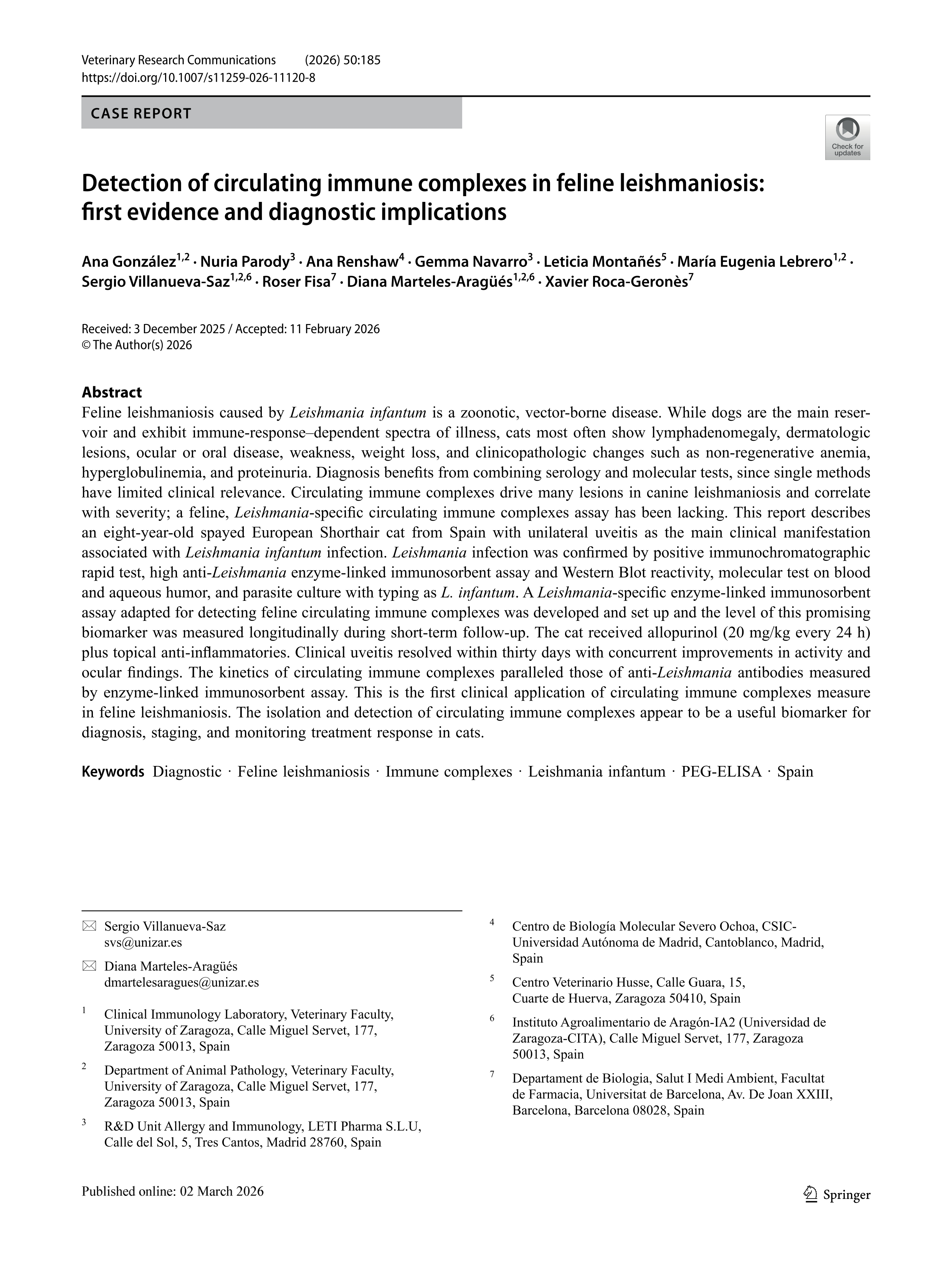
Resumen: Feline leishmaniosis caused by Leishmania infantum is a zoonotic, vector-borne disease. While dogs are the main reservoir and exhibit immune-response–dependent spectra of illness, cats most often show lymphadenomegaly, dermatologic lesions, ocular or oral disease, weakness, weight loss, and clinicopathologic changes such as non-regenerative anemia, hyperglobulinemia, and proteinuria. Diagnosis benefits from combining serology and molecular tests, since single methods have limited clinical relevance. Circulating immune complexes drive many lesions in canine leishmaniosis and correlate with severity; a feline, Leishmania-specific circulating immune complexes assay has been lacking. This report describes an eight-year-old spayed European Shorthair cat from Spain with unilateral uveitis as the main clinical manifestation associated with Leishmania infantum infection. Leishmania infection was confirmed by positive immunochromatographic rapid test, high anti-Leishmania enzyme-linked immunosorbent assay and Western Blot reactivity, molecular test on blood and aqueous humor, and parasite culture with typing as L. infantum. A Leishmania-specific enzyme-linked immunosorbent assay adapted for detecting feline circulating immune complexes was developed and set up and the level of this promising biomarker was measured longitudinally during short-term follow-up. The cat received allopurinol (20 mg/kg every 24 h) plus topical anti-inflammatories. Clinical uveitis resolved within thirty days with concurrent improvements in activity and ocular findings. The kinetics of circulating immune complexes paralleled those of anti-Leishmania antibodies measured by enzyme-linked immunosorbent assay. This is the first clinical application of circulating immune complexes measure
in feline leishmaniosis. The isolation and detection of circulating immune complexes appear to be a useful biomarker for diagnosis, staging, and monitoring treatment response in cats.
Idioma: Inglés
DOI: 10.1007/s11259-026-11120-8
Año: 2026
Publicado en: Veterinary Research Communications 50, 3 (2026), [12 pp.]
ISSN: 0165-7380
Financiación: info:eu-repo/grantAgreement/ES/DGA/AR15-32R
Tipo y forma: Article (Published version)
Área (Departamento): Área Medicina y Cirugía Animal (Dpto. Patología Animal)
 You must give appropriate credit, provide a link to the license, and indicate if changes were made. You may do so in any reasonable manner, but not in any way that suggests the licensor endorses you or your use.
Exportado de SIDERAL (2026-03-16-08:17:56)
Visitas y descargas
in feline leishmaniosis. The isolation and detection of circulating immune complexes appear to be a useful biomarker for diagnosis, staging, and monitoring treatment response in cats.
Idioma: Inglés
DOI: 10.1007/s11259-026-11120-8
Año: 2026
Publicado en: Veterinary Research Communications 50, 3 (2026), [12 pp.]
ISSN: 0165-7380
Financiación: info:eu-repo/grantAgreement/ES/DGA/AR15-32R
Tipo y forma: Article (Published version)
Área (Departamento): Área Medicina y Cirugía Animal (Dpto. Patología Animal)
You must give appropriate credit, provide a link to the license, and indicate if changes were made. You may do so in any reasonable manner, but not in any way that suggests the licensor endorses you or your use. Exportado de SIDERAL (2026-03-16-08:17:56)
Permalink:
Visitas y descargas
Este artículo se encuentra en las siguientes colecciones:
Articles > Artículos por área > Medicina y Cirugía Animal
Record created 2026-03-16, last modified 2026-03-16