Evaluation of the effectiveness and safety of anti-CGRPmonoclonal antibodies in patients with migraine andautoimmune diseases: IMMUNO-CGRP study
García-Castillo, María Clara ; Sierra-Mencía, Álvaro ; Caronna, Edoardo ; Toledo-Alfocea, Daniel ; Jaimes, Alex ; Urtiaga, Sarai ; Casas-Limón, Javier ; Muñoz-Vendrell, Albert ; Santos-Lasaosa, Sonia (Universidad de Zaragoza) ; García Martín, Valvanuz ; Martín Ávila, Guillermo ; Polanco, Marcos ; Villar-Martínez, Maria Dolores ; Trevino-Peinado, Cristina ; Rubio-Flores, Laura ; Sánchez-Soblechero, Antonio ; Portocarrero Sánchez, Leonardo ; Luque-Buzo, Elisa ; Lozano-Ros, Alberto ; Gago-Veiga, Ana Beatriz ; Díaz-De-Terán, Javier ; Recio García, Andrea ; Canales Rodríguez, Javiera ; Gómez García, Andrea ; González Salaices, Marta ; Campoy, Sergio ; Mínguez-Olaondo, Ane ; Maniataki, Stefania ; González-Quintanilla, Vicente ; Porta-Etessam, Jesús ; Cuadrado, María-Luz ; Guerrero Peral, Ángel Luis ; Pozo-Rosich, Patricia ; Rodríguez-Vico, Jaime ; Huerta-Villanueva, Mariano ; Pascual, Julio ; Goadsby, Peter J. ; Gonzalez-Martinez, Alicia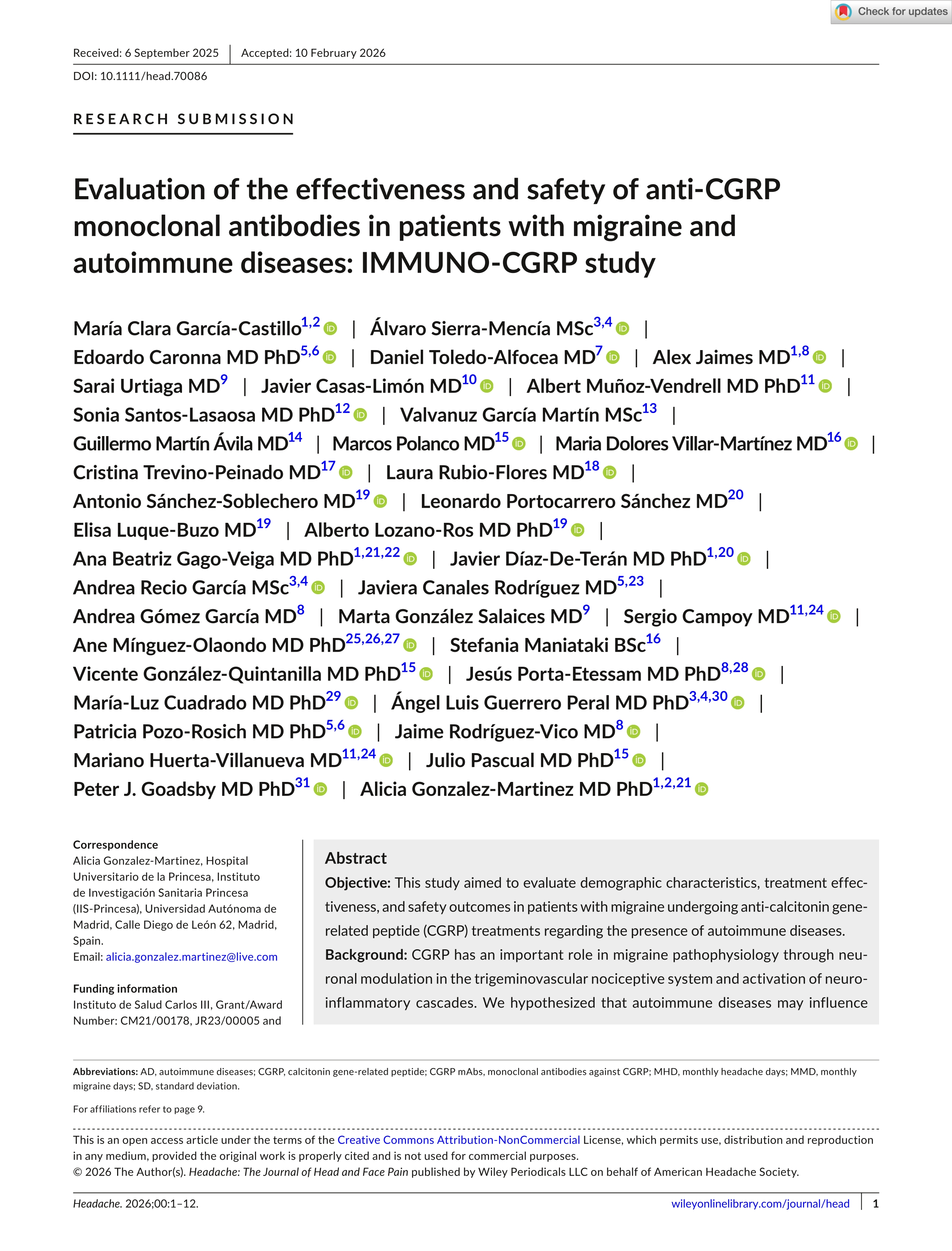
Resumen: Objective: This study aimed to evaluate demographic characteristics, treatment effectiveness, and safety outcomes in patients with migraine undergoing anti‐calcitonin gene‐related peptide (CGRP) treatments regarding the presence of autoimmune diseases. Background: CGRP has an important role in migraine pathophysiology through neuronal modulation in the trigeminovascular nociceptive system and activation of neuro‐inflammatory cascades. We hypothesized that autoimmune diseases may influence treatment response and safety profiles in patients with migraine treated with anti‐CGRP treatments. Methods: This was a retrospective multicenter, age‐ and sex‐matched cohort study in headache units/headache clinics in Spain and United Kingdom between May 2024 and May 2025 including patients treated with CGRP monoclonal antibodies from prospectively collected cohorts. Patients were assessed for demographics, migraine‐related characteristics, treatment effectiveness (monthly migraine days [MMD] and/or monthly headache days [MHD]), and safety outcomes. The main outcome was the effectiveness measured by ≥50% response rate in MMD between the two groups. Secondary outcomes included other effectiveness measurements regarding the number of MMD and MHD and treatment emerging adverse events. Results: A total of 388 patients with migraine under anti‐CGRP treatments (194 with autoimmune diseases and 194 age‐ and sex‐matched controls without autoimmune diseases) were included. The proportion of patients achieving a ≥50% response rate in MMD was higher in patients without autoimmune diseases at 6 (69% vs. 53%; p = 0.006) and 9 months (74% vs. 52%; p = 0.006). Treatment emerging adverse events were comparable between the two groups (35% vs. 38%; p = 0.575). Patients with autoimmune disease had a significantly lower likelihood of achieving a ≥50% response in MMD compared with those without autoimmune disease (adjusted odds ratio, 0.61; 95% confidence interval, 0.44–0.85; p = 0.006), independent of comorbid depression and medication overuse. Conclusions: Our study shows that anti‐CGRP treatments are effective and safe for patients with migraine regardless the presence of autoimmune diseases, although an increased treatment response in patient without autoimmune disorders compared to patients with autoimmune disorders was observed. These findings highlight the need for early intervention, tailored strategies, and vigilant monitoring in patients with migraine and autoimmune disorders. Further research should explore immunomodulatory approaches to enhance outcomes.
Idioma: Inglés
DOI: 10.1111/head.70086
Año: 2026
Publicado en: Headache (2026), [12 pp.]
ISSN: 0017-8748
Financiación: info:eu-repo/grantAgreement/ES/ISCIII/CM21-00178
Financiación: info:eu-repo/grantAgreement/ES/ISCIII/PI24-01085
Tipo y forma: Artículo (Versión definitiva)
Área (Departamento): Area Medicina (Dpto. Medicina, Psiqu. y Derm.)
 Debe reconocer adecuadamente la autoría, proporcionar un enlace a la licencia e indicar si se han realizado cambios. Puede hacerlo de cualquier manera razonable, pero no de una manera que sugiera que tiene el apoyo del licenciador o lo recibe por el uso que hace. No puede utilizar el material para una finalidad comercial.
Exportado de SIDERAL (2026-04-10-13:45:38)
Visitas y descargas
Idioma: Inglés
DOI: 10.1111/head.70086
Año: 2026
Publicado en: Headache (2026), [12 pp.]
ISSN: 0017-8748
Financiación: info:eu-repo/grantAgreement/ES/ISCIII/CM21-00178
Financiación: info:eu-repo/grantAgreement/ES/ISCIII/PI24-01085
Tipo y forma: Artículo (Versión definitiva)
Área (Departamento): Area Medicina (Dpto. Medicina, Psiqu. y Derm.)
Debe reconocer adecuadamente la autoría, proporcionar un enlace a la licencia e indicar si se han realizado cambios. Puede hacerlo de cualquier manera razonable, pero no de una manera que sugiera que tiene el apoyo del licenciador o lo recibe por el uso que hace. No puede utilizar el material para una finalidad comercial.Exportado de SIDERAL (2026-04-10-13:45:38)
Enlace permanente:
Visitas y descargas
Este artículo se encuentra en las siguientes colecciones:
Artículos > Artículos por área > Medicina
Registro creado el 2026-04-10, última modificación el 2026-04-10