Effectiveness of exercise and nutrition interventions for cognitive function in older adults: A systematic review and meta-analysis
Castillo-Bernad, Sergio (Universidad de Zaragoza) ; Moradell, Ana (Universidad de Zaragoza) ; Gómez-Bruton, Alejandro (Universidad de Zaragoza) ; Matute-Llorente, Ángel (Universidad de Zaragoza) ; González-Agüero, Alejandro ; Casajús, José A. (Universidad de Zaragoza) ; Gómez-Cabello, Alba ; Lozano-Berges, Gabriel (Universidad de Zaragoza) ; Vicente-Rodríguez, Germán (Universidad de Zaragoza)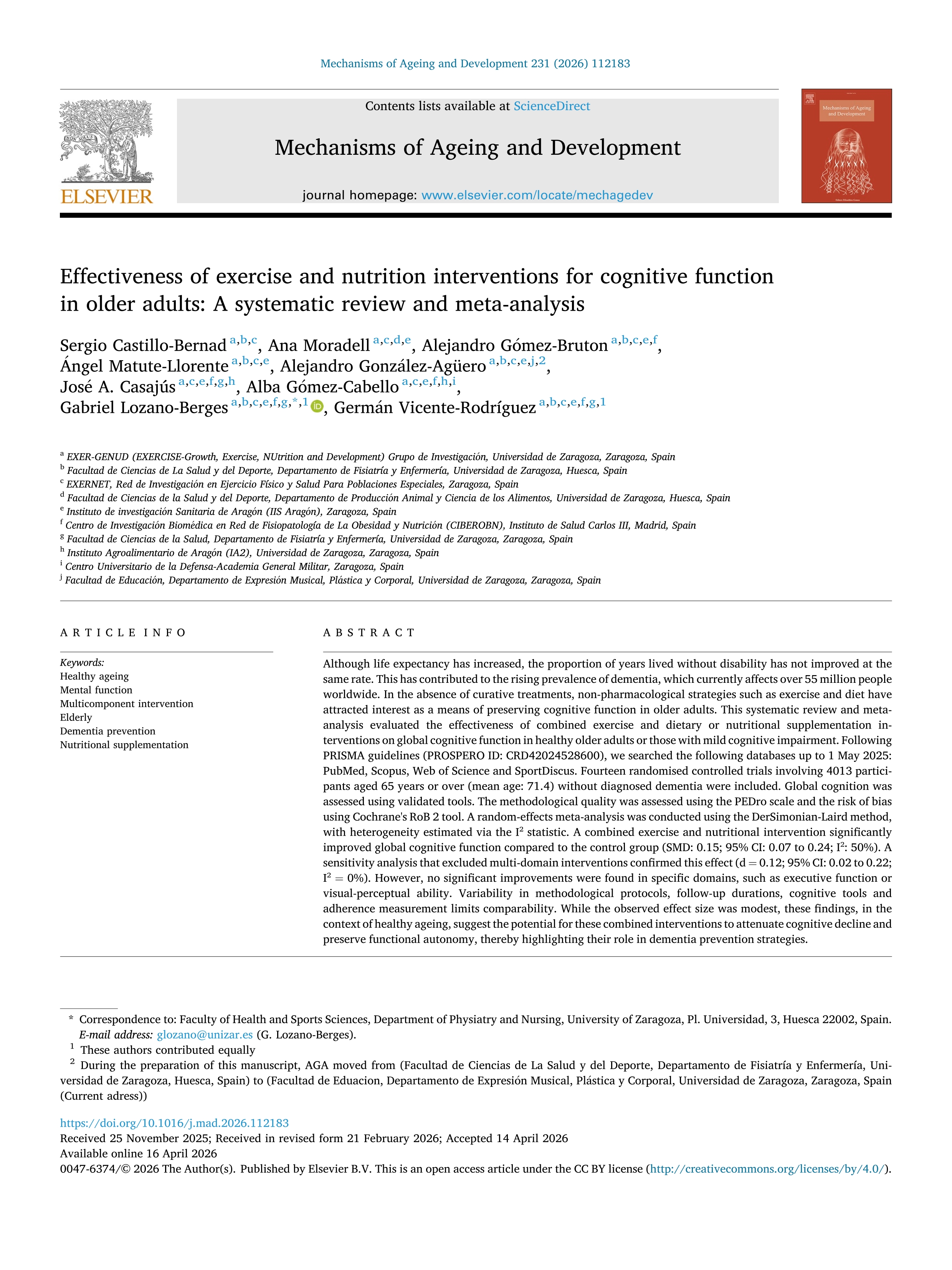
Resumen: Although life expectancy has increased, the proportion of years lived without disability has not improved at the same rate. This has contributed to the rising prevalence of dementia, which currently affects over 55 million people worldwide. In the absence of curative treatments, non-pharmacological strategies such as exercise and diet have attracted interest as a means of preserving cognitive function in older adults. This systematic review and metaanalysis evaluated the effectiveness of combined exercise and dietary or nutritional supplementation interventions on global cognitive function in healthy older adults or those with mild cognitive impairment. Following PRISMA guidelines (PROSPERO ID: CRD42024528600), we searched the following databases up to 1 May 2025: PubMed, Scopus, Web of Science and SportDiscus. Fourteen randomised controlled trials involving 4013 participants aged 65 years or over (mean age: 71.4) without diagnosed dementia were included. Global cognition was assessed using validated tools. The methodological quality was assessed using the PEDro scale and the risk of bias using Cochrane's RoB 2 tool. A random-effects meta-analysis was conducted using the DerSimonian-Laird method, with heterogeneity estimated via the I² statistic. A combined exercise and nutritional intervention significantly improved global cognitive function compared to the control group (SMD: 0.15; 95% CI: 0.07 to 0.24; I²: 50%). A sensitivity analysis that excluded multi-domain interventions confirmed this effect (d = 0.12; 95% CI: 0.02 to 0.22; I² = 0%). However, no significant improvements were found in specific domains, such as executive function or visual-perceptual ability. Variability in methodological protocols, follow-up durations, cognitive tools and adherence measurement limits comparability. While the observed effect size was modest, these findings, in the context of healthy ageing, suggest the potential for these combined interventions to attenuate cognitive decline and preserve functional autonomy, thereby highlighting their role in dementia prevention strategies.
Idioma: Inglés
DOI: 10.1016/j.mad.2026.112183
Año: 2026
Publicado en: MECHANISMS OF AGEING AND DEVELOPMENT 231 (2026), 112183 [17 pp.]
ISSN: 0047-6374
Financiación: info:eu-repo/grantAgreement/ES/AEI/RED2022-134800-T
Financiación: info:eu-repo/grantAgreement/ES/ISCIII/CB12-03-30038
Financiación: info:eu-repo/grantAgreement/ES/MCD/EXP 104961
Financiación: info:eu-repo/grantAgreement/ES/MCD/EXP 75079
Financiación: info:eu-repo/grantAgreement/ES/MINECO/DEP2016-78309-R
Financiación: info:eu-repo/grantAgreement/ES/MINECO-FEDER/ISCIII-CB16-10-00477
Financiación: info:eu-repo/grantAgreement/ES/UZ/UZCUD2017-BIO-01
Financiación: info:eu-repo/grantAgreement/ES/UZ/UZ2021-BIO-05
Tipo y forma: Article (Published version)
Área (Departamento): Área Nutrición Bromatología (Dpto. Produc.Animal Cienc.Ali.)
Área (Departamento): Área Educación Física y Depor. (Dpto. Fisiatría y Enfermería)
Exportado de SIDERAL (2026-04-30-13:57:20)
Visitas y descargas
Idioma: Inglés
DOI: 10.1016/j.mad.2026.112183
Año: 2026
Publicado en: MECHANISMS OF AGEING AND DEVELOPMENT 231 (2026), 112183 [17 pp.]
ISSN: 0047-6374
Financiación: info:eu-repo/grantAgreement/ES/AEI/RED2022-134800-T
Financiación: info:eu-repo/grantAgreement/ES/ISCIII/CB12-03-30038
Financiación: info:eu-repo/grantAgreement/ES/MCD/EXP 104961
Financiación: info:eu-repo/grantAgreement/ES/MCD/EXP 75079
Financiación: info:eu-repo/grantAgreement/ES/MINECO/DEP2016-78309-R
Financiación: info:eu-repo/grantAgreement/ES/MINECO-FEDER/ISCIII-CB16-10-00477
Financiación: info:eu-repo/grantAgreement/ES/UZ/UZCUD2017-BIO-01
Financiación: info:eu-repo/grantAgreement/ES/UZ/UZ2021-BIO-05
Tipo y forma: Article (Published version)
Área (Departamento): Área Nutrición Bromatología (Dpto. Produc.Animal Cienc.Ali.)
Área (Departamento): Área Educación Física y Depor. (Dpto. Fisiatría y Enfermería)
Exportado de SIDERAL (2026-04-30-13:57:20)
Permalink:
Visitas y descargas
Este artículo se encuentra en las siguientes colecciones:
articulos > articulos-por-area > educacion_fisica_y_deportiva
articulos > articulos-por-area > nutricion_y_bromatologia
Notice créée le 2026-04-30, modifiée le 2026-04-30