Health-Related Quality of Life in Menopausal Women with Cancer: Results from the CALCAN Study
Ruiz Peña, Ana Cristina (Universidad de Zaragoza) ; Baquedano Mainar, Laura (Universidad de Zaragoza) ; Coronado Martín, Pluvio J.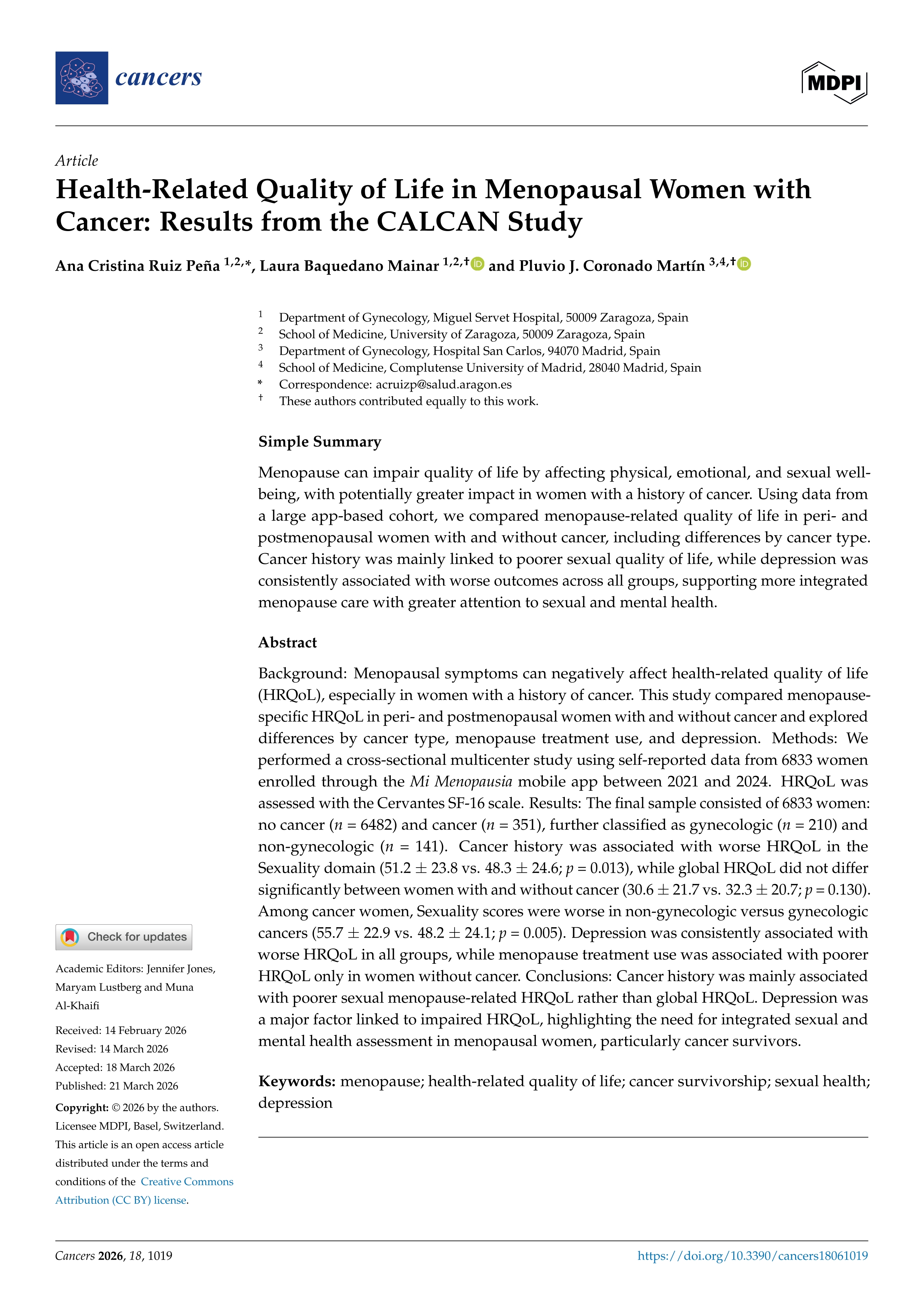
Resumen: Background: Menopausal symptoms can negatively affect health-related quality of life (HRQoL), especially in women with a history of cancer. This study compared menopause-specific HRQoL in peri- and postmenopausal women with and without cancer and explored differences by cancer type, menopause treatment use, and depression. Methods: We performed a cross-sectional multicenter study using self-reported data from 6833 women enrolled through the Mi Menopausia mobile app between 2021 and 2024. HRQoL was assessed with the Cervantes SF-16 scale. Results: The final sample consisted of 6833 women: no cancer (n = 6482) and cancer (n = 351), further classified as gynecologic (n = 210) and non-gynecologic (n = 141). Cancer history was associated with worse HRQoL in the Sexuality domain (51.2 ± 23.8 vs. 48.3 ± 24.6; p = 0.013), while global HRQoL did not differ significantly between women with and without cancer (30.6 ± 21.7 vs. 32.3 ± 20.7; p = 0.130). Among cancer women, Sexuality scores were worse in non-gynecologic versus gynecologic cancers (55.7 ± 22.9 vs. 48.2 ± 24.1; p = 0.005). Depression was consistently associated with worse HRQoL in all groups, while menopause treatment use was associated with poorer HRQoL only in women without cancer. Conclusions: Cancer history was mainly associated with poorer sexual menopause-related HRQoL rather than global HRQoL. Depression was a major factor linked to impaired HRQoL, highlighting the need for integrated sexual and mental health assessment in menopausal women, particularly cancer survivors.
Idioma: Inglés
DOI: 10.3390/cancers18061019
Año: 2026
Publicado en: Cancers 18, 6 (2026), 1019
ISSN: 2072-6694
Tipo y forma: Artículo (Versión definitiva)
Área (Departamento): Área Obstetricia y Ginecología (Dpto. Cirugía)
 Debe reconocer adecuadamente la autoría, proporcionar un enlace a la licencia e indicar si se han realizado cambios. Puede hacerlo de cualquier manera razonable, pero no de una manera que sugiera que tiene el apoyo del licenciador o lo recibe por el uso que hace.
Exportado de SIDERAL (2026-04-30-13:58:49)
Visitas y descargas
Idioma: Inglés
DOI: 10.3390/cancers18061019
Año: 2026
Publicado en: Cancers 18, 6 (2026), 1019
ISSN: 2072-6694
Tipo y forma: Artículo (Versión definitiva)
Área (Departamento): Área Obstetricia y Ginecología (Dpto. Cirugía)
Debe reconocer adecuadamente la autoría, proporcionar un enlace a la licencia e indicar si se han realizado cambios. Puede hacerlo de cualquier manera razonable, pero no de una manera que sugiera que tiene el apoyo del licenciador o lo recibe por el uso que hace. Exportado de SIDERAL (2026-04-30-13:58:49)
Enlace permanente:
Visitas y descargas
Este artículo se encuentra en las siguientes colecciones:
Artículos > Artículos por área > Obstetricia y Ginecología
Registro creado el 2026-04-30, última modificación el 2026-04-30