Multiplex Decomposition of Non-Markovian Dynamics and the Hidden Layer Reconstruction Problem
Lacasa, L. ; Mariño, I.P. ; Miguez, J. ; Nicosia, V. ; Roldán, É. ; Lisica, A. ; Grill, S.W. ; Gómez-Gardeñes, J. (Universidad de Zaragoza)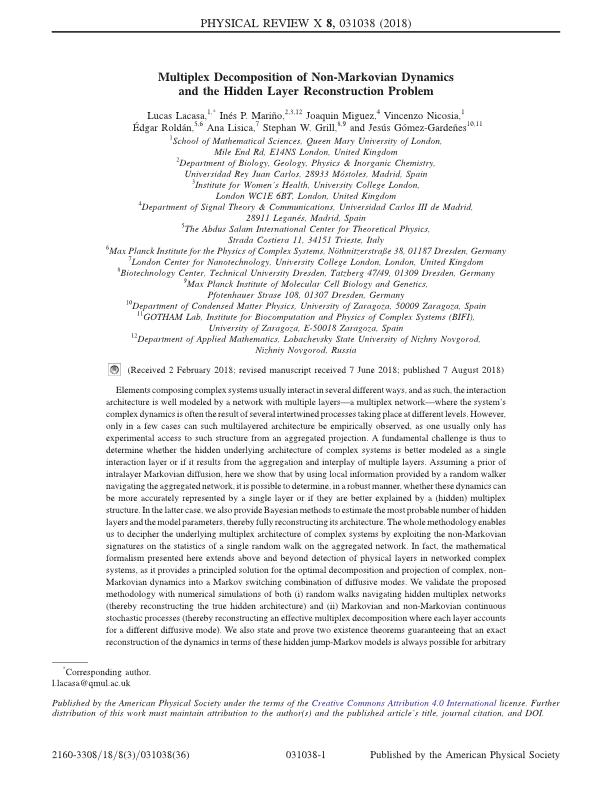
Resumen: Elements composing complex systems usually interact in several different ways, and as such, the interaction architecture is well modeled by a network with multiple layers - a multiplex network - where the system''s complex dynamics is often the result of several intertwined processes taking place at different levels. However, only in a few cases can such multilayered architecture be empirically observed, as one usually only has experimental access to such structure from an aggregated projection. A fundamental challenge is thus to determine whether the hidden underlying architecture of complex systems is better modeled as a single interaction layer or if it results from the aggregation and interplay of multiple layers. Assuming a prior of intralayer Markovian diffusion, here we show that by using local information provided by a random walker navigating the aggregated network, it is possible to determine, in a robust manner, whether these dynamics can be more accurately represented by a single layer or if they are better explained by a (hidden) multiplex structure. In the latter case, we also provide Bayesian methods to estimate the most probable number of hidden layers and the model parameters, thereby fully reconstructing its architecture. The whole methodology enables us to decipher the underlying multiplex architecture of complex systems by exploiting the non-Markovian signatures on the statistics of a single random walk on the aggregated network. In fact, the mathematical formalism presented here extends above and beyond detection of physical layers in networked complex systems, as it provides a principled solution for the optimal decomposition and projection of complex, non-Markovian dynamics into a Markov switching combination of diffusive modes. We validate the proposed methodology with numerical simulations of both (i) random walks navigating hidden multiplex networks (thereby reconstructing the true hidden architecture) and (ii) Markovian and non-Markovian continuous stochastic processes (thereby reconstructing an effective multiplex decomposition where each layer accounts for a different diffusive mode). We also state and prove two existence theorems guaranteeing that an exact reconstruction of the dynamics in terms of these hidden jump-Markov models is always possible for arbitrary finite-order Markovian and fully non-Markovian processes. Finally, we showcase the applicability of the method to experimental recordings from (i) the mobility dynamics of human players in an online multiplayer game and (ii) the dynamics of RNA polymerases at the single-molecule level.
Idioma: Inglés
DOI: 10.1103/PhysRevX.8.031038
Año: 2018
Publicado en: Physical review. X 8, 3 (2018), 031038 [36 pp]
ISSN: 2160-3308
Factor impacto JCR: 12.211 (2018)
Categ. JCR: PHYSICS, MULTIDISCIPLINARY rank: 5 / 81 = 0.062 (2018) - Q1 - T1
Factor impacto SCIMAGO: 6.497 - Physics and Astronomy (miscellaneous) (Q1)
Financiación: info:eu-repo/grantAgreement/ES/DGA/E36-17R
Financiación: info:eu-repo/grantAgreement/ES/MINECO/FIS2014-55867-P
Financiación: info:eu-repo/grantAgreement/ES/MINECO/FIS2017-87519-P
Financiación: info:eu-repo/grantAgreement/ES/MINECO/TEC2015-69868-C2-1-R
Financiación: info:eu-repo/grantAgreement/ES/MINECO/TEC2017-86921-C2-1-R CAIMAN
Tipo y forma: Artículo (Versión definitiva)
Área (Departamento): Área Física Materia Condensada (Dpto. Física Materia Condensa.)
 Debe reconocer adecuadamente la autoría, proporcionar un enlace a la licencia e indicar si se han realizado cambios. Puede hacerlo de cualquier manera razonable, pero no de una manera que sugiera que tiene el apoyo del licenciador o lo recibe por el uso que hace.
Exportado de SIDERAL (2025-06-19-08:41:25)
Visitas y descargas
Idioma: Inglés
DOI: 10.1103/PhysRevX.8.031038
Año: 2018
Publicado en: Physical review. X 8, 3 (2018), 031038 [36 pp]
ISSN: 2160-3308
Factor impacto JCR: 12.211 (2018)
Categ. JCR: PHYSICS, MULTIDISCIPLINARY rank: 5 / 81 = 0.062 (2018) - Q1 - T1
Factor impacto SCIMAGO: 6.497 - Physics and Astronomy (miscellaneous) (Q1)
Financiación: info:eu-repo/grantAgreement/ES/DGA/E36-17R
Financiación: info:eu-repo/grantAgreement/ES/MINECO/FIS2014-55867-P
Financiación: info:eu-repo/grantAgreement/ES/MINECO/FIS2017-87519-P
Financiación: info:eu-repo/grantAgreement/ES/MINECO/TEC2015-69868-C2-1-R
Financiación: info:eu-repo/grantAgreement/ES/MINECO/TEC2017-86921-C2-1-R CAIMAN
Tipo y forma: Artículo (Versión definitiva)
Área (Departamento): Área Física Materia Condensada (Dpto. Física Materia Condensa.)
Debe reconocer adecuadamente la autoría, proporcionar un enlace a la licencia e indicar si se han realizado cambios. Puede hacerlo de cualquier manera razonable, pero no de una manera que sugiera que tiene el apoyo del licenciador o lo recibe por el uso que hace. Exportado de SIDERAL (2025-06-19-08:41:25)
Enlace permanente:
Visitas y descargas
Este artículo se encuentra en las siguientes colecciones:
Artículos > Artículos por área > Física de la Materia Condensada
Registro creado el 2018-09-24, última modificación el 2025-06-19