¿Cómo se interrelacionan las variables de burnout, engagement y autoeficacia académica? Un estudio con adolescentes escolares
Usan Supervia, P. (Universidad de Zaragoza) ; Salavera Bordas, C. (Universidad de Zaragoza) ; Domper Buil, E.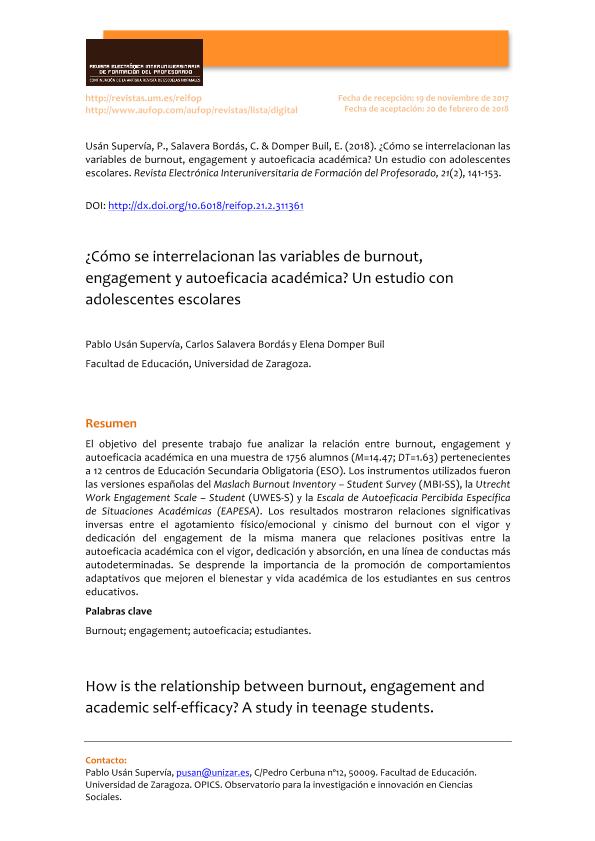
Resumen: El objetivo del presente trabajo fue analizar la relación entre burnout, engagement y autoeficacia académica en una muestra de 1756 alumnos (M=14, 47; DT=1, 63) pertenecientes a 12 centros de Educación Secundaria Obligatoria (ESO). Los instrumentos utilizados fueron las versiones españolas del Maslach Burnout Inventory – Student Survey (MBI-SS) (Schaufeli et al., 2002), la Utrecht Work Engagement Scale – Student (UWES-S) (Schaufeli et al., 2002) y la Escala de Autoeficacia Percibida Específica de Situaciones Académicas (EAPESA) (García et al., 2010). Los resultados mostraron relaciones significativas inversas entre el agotamiento físico/emocional y cinismo del burnout con el vigor y dedicación del engagement de la misma manera que relaciones positivas entre la autoeficacia académica con el vigor, dedicación y absorción, en una línea de conductas más autodeterminadas. Se desprende la importancia de la promoción de comportamientos adaptativos que mejoren el bienestar y vida académica de los estudiantes en sus centros educativos.
The aim of this research was to analyze the relationship between burnout, engagement and academic self-efficacy in a sample of 1756 students (M=14.47, SD=1.63) belonging to 12 secondary education highschools. The instruments used were the Spanish versions of the Maslach Burnout Inventory - Student Survey (MBI-SS), Utrecht Student Student Scale (UWES-S) and the Specific Perceived Self-Efficacy Scale of Academic Situations (EAPESA). The results showed inverse relationship between physical&emotional; effort and cynicism with vigor and dedication in the same way those positive relationships between academic self-efficacy with vigor, dedication and task absorption, in a more adaptive behaviors. The importance of the promotion of adaptive behaviors that improve the well-being and academic life of the students in their educational centers is revealed.
Idioma: Español
DOI: 10.6018/reifop.21.2.311361
Año: 2018
Publicado en: REVISTA ELECTRONICA INTERUNIVERSITARIA DE FORMACION DEL PROFESORADO 21, 2 (2018), 141-153
ISSN: 1575-0965
Tipo y forma: Article (Published version)
Área (Departamento): Área Psicolog.Evolut.Educac (Dpto. Psicología y Sociología)
 You must give appropriate credit, provide a link to the license, and indicate if changes were made. You may do so in any reasonable manner, but not in any way that suggests the licensor endorses you or your use. You may not use the material for commercial purposes. If you remix, transform, or build upon the material, you may not distribute the modified material.
Exportado de SIDERAL (2018-09-27-13:07:11)
Visitas y descargas
Idioma: Español
DOI: 10.6018/reifop.21.2.311361
Año: 2018
Publicado en: REVISTA ELECTRONICA INTERUNIVERSITARIA DE FORMACION DEL PROFESORADO 21, 2 (2018), 141-153
ISSN: 1575-0965
Tipo y forma: Article (Published version)
Área (Departamento): Área Psicolog.Evolut.Educac (Dpto. Psicología y Sociología)
You must give appropriate credit, provide a link to the license, and indicate if changes were made. You may do so in any reasonable manner, but not in any way that suggests the licensor endorses you or your use. You may not use the material for commercial purposes. If you remix, transform, or build upon the material, you may not distribute the modified material. Exportado de SIDERAL (2018-09-27-13:07:11)
Permalink:
Visitas y descargas
Este artículo se encuentra en las siguientes colecciones:
Articles > Artículos por área > Psicología Evolutiva y de la Educación
Record created 2018-09-27, last modified 2018-09-27