The relationship between cortisol and cognitive function in healthy older people: The moderating role of Apolipoprotein E polymorphism
Montoliu, T. ; Hidalgo, Vanesa (Universidad de Zaragoza) ; Pulopulos, Matias M. ; Ivorra, J.L. ; Martínez, M.J. ; Salvador, A.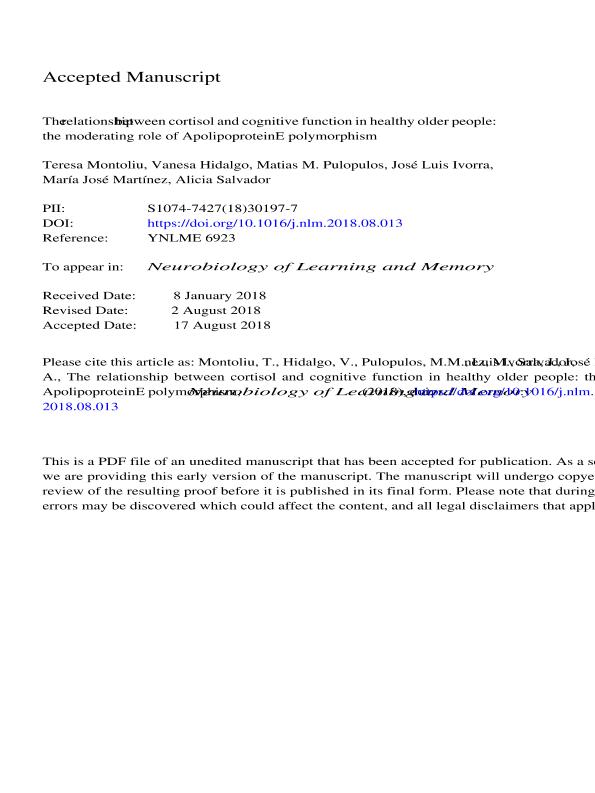
Resumen: The Apolipoprotein E4 (ApoE-e4) allele has been suggested as the main risk factor for late onset Alzheimer''s disease (AD), whereas the ApoE-e2 allele has been proposed as a protective factor. These proposals have increased the interest in the effect of the ApoE genotype in healthy people. Additionally, high cortisol levels have been related to negative effects on cognition. However, few studies have investigated the relationship between cognitive performance and cortisol, taking into account the different ApoE alleles. For this reason, the aim of this study was to evaluate different cognitive domains (declarative and working memory, attention, and executive function) and their relationship with cortisol, considering the ApoE-e2, ApoE-e3, and ApoE-e4 alleles in healthy older people (55–77 years old). Two saliva samples were collected during the neuropsychological session to obtain cortisol levels and the ApoE genotype. Results showed an association between the ApoE genotype and declarative memory, specifically learning ability, where ApoE-e2 group performed better than ApoE-e4 and ApoE-e3 groups. No differences in cortisol levels were obtained considering the ApoE genotype. In addition, higher mean cortisol levels were related to a worse performance on declarative memory, for the whole sample, and when considering the three allelic variation, for the ApoE-e4 group. On the contrary, an increase of cortisol levels during the neuropsychological session was associated to a better performance on declarative memory for the whole sample, and for the ApoE-e3 group when considering the three alleles. Besides, ApoE-e3 group also showed an association between higher mean cortisol levels and a better attention performance. Therefore, our results suggest that carrying the ApoE-e4 allele may be a vulnerability factor in the adverse effects of Hypothalamic-Pituitary-Adrenal (HPA) axis dysregulation on cognition during aging, while ApoE-e3 allele could be associated to a more adaptive HPA axis response.
Idioma: Inglés
DOI: 10.1016/j.nlm.2018.08.013
Año: 2018
Publicado en: NEUROBIOLOGY OF LEARNING AND MEMORY 155 (2018), 297-305
ISSN: 1074-7427
Factor impacto JCR: 3.01 (2018)
Categ. JCR: BEHAVIORAL SCIENCES rank: 11 / 53 = 0.208 (2018) - Q1 - T1
Categ. JCR: PSYCHOLOGY, MULTIDISCIPLINARY rank: 25 / 137 = 0.182 (2018) - Q1 - T1
Categ. JCR: PSYCHOLOGY rank: 19 / 77 = 0.247 (2018) - Q1 - T1
Categ. JCR: NEUROSCIENCES rank: 126 / 266 = 0.474 (2018) - Q2 - T2
Factor impacto SCIMAGO: 1.732 - Behavioral Neuroscience (Q1) - Experimental and Cognitive Psychology (Q1) - Cognitive Neuroscience (Q1)
Financiación: info:eu-repo/grantAgreement/ES/MEC/PSI2013-46889
Financiación: info:eu-repo/grantAgreement/ES/MEC/PSI2016-78763
Tipo y forma: Article (PostPrint)
Área (Departamento): Área Psicobiología (Dpto. Psicología y Sociología)
 All rights reserved by journal editor
Exportado de SIDERAL (2020-10-28-13:23:58)
Visitas y descargas
Idioma: Inglés
DOI: 10.1016/j.nlm.2018.08.013
Año: 2018
Publicado en: NEUROBIOLOGY OF LEARNING AND MEMORY 155 (2018), 297-305
ISSN: 1074-7427
Factor impacto JCR: 3.01 (2018)
Categ. JCR: BEHAVIORAL SCIENCES rank: 11 / 53 = 0.208 (2018) - Q1 - T1
Categ. JCR: PSYCHOLOGY, MULTIDISCIPLINARY rank: 25 / 137 = 0.182 (2018) - Q1 - T1
Categ. JCR: PSYCHOLOGY rank: 19 / 77 = 0.247 (2018) - Q1 - T1
Categ. JCR: NEUROSCIENCES rank: 126 / 266 = 0.474 (2018) - Q2 - T2
Factor impacto SCIMAGO: 1.732 - Behavioral Neuroscience (Q1) - Experimental and Cognitive Psychology (Q1) - Cognitive Neuroscience (Q1)
Financiación: info:eu-repo/grantAgreement/ES/MEC/PSI2013-46889
Financiación: info:eu-repo/grantAgreement/ES/MEC/PSI2016-78763
Tipo y forma: Article (PostPrint)
Área (Departamento): Área Psicobiología (Dpto. Psicología y Sociología)
All rights reserved by journal editorExportado de SIDERAL (2020-10-28-13:23:58)
Permalink:
Visitas y descargas
Este artículo se encuentra en las siguientes colecciones:
Articles > Artículos por área > Psicobiología
Record created 2019-08-19, last modified 2020-10-28