Evaluation of an immunochromatographic serologic test to detect the presence of anti-Toxoplasma gondii antibodies in cats
Villanueva-Saz, Sergio (Universidad de Zaragoza) ; Martínez, Mariví ; Giner, Jacobo ; Pérez, María Dolores (Universidad de Zaragoza) ; Tobajas, Ana Pilar (Universidad de Zaragoza) ; Yzuel, Andrés ; Verde, María Teresa (Universidad de Zaragoza) ; Lacasta, Delia (Universidad de Zaragoza) ; Fernández, Antonio (Universidad de Zaragoza) ; Marteles, Diana (Universidad de Zaragoza) ; Ruíz, Héctor (Universidad de Zaragoza)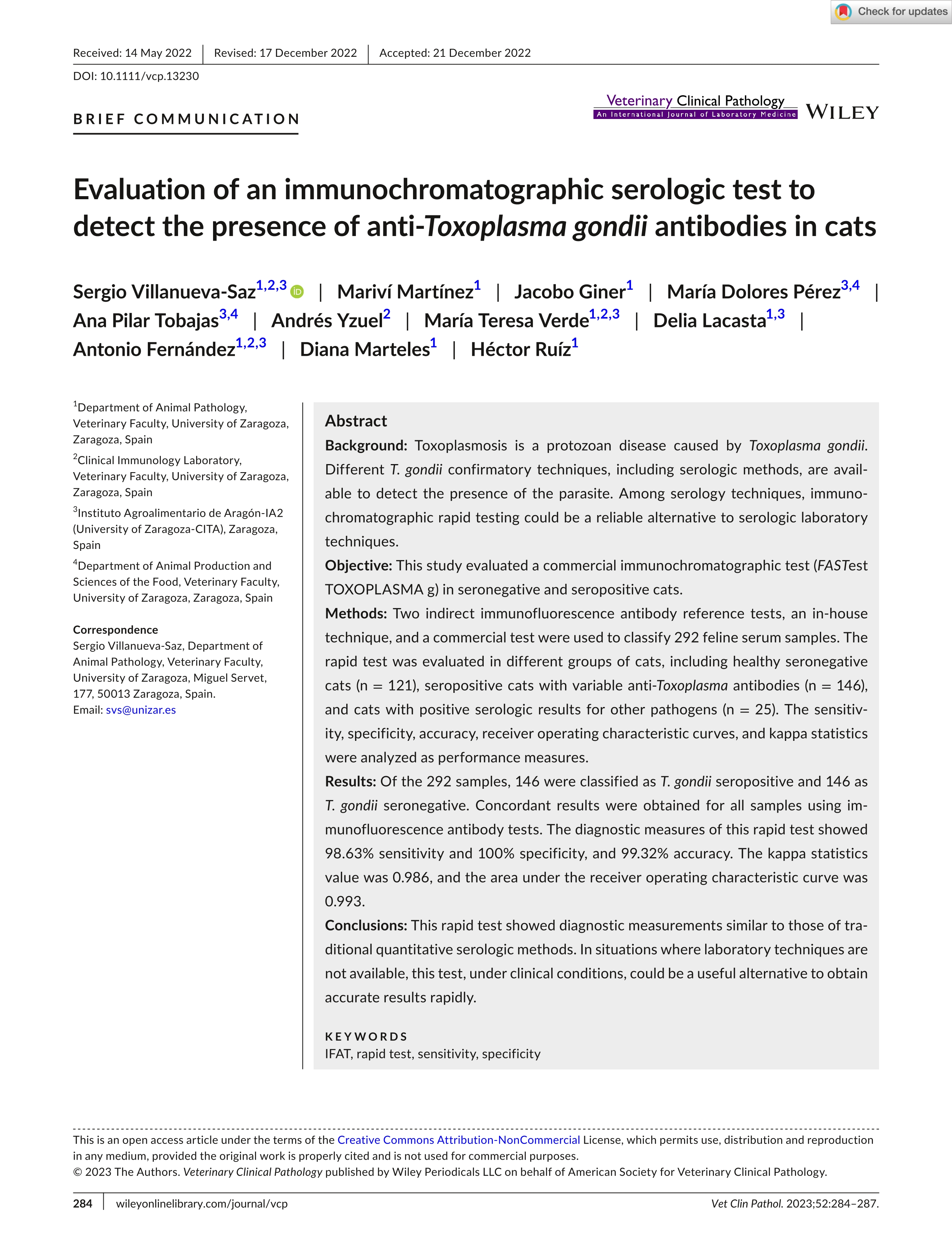
Resumen: Background: Toxoplasmosis is a protozoan disease caused by Toxoplasma gondii. Different T. gondii confirmatory techniques, including serologic methods, are available to detect the presence of the parasite. Among serology techniques, immunochromatographic rapid testing could be a reliable alternative to serologic laboratory techniques.
Objective: This study evaluated a commercial immunochromatographic test (FASTest TOXOPLASMA g) in seronegative and seropositive cats.
Methods: Two indirect immunofluorescence antibody reference tests, an in-house technique, and a commercial test were used to classify 292 feline serum samples. The rapid test was evaluated in different groups of cats, including healthy seronegative cats (n = 121), seropositive cats with variable anti-Toxoplasma antibodies (n = 146), and cats with positive serologic results for other pathogens (n = 25). The sensitivity, specificity, accuracy, receiver operating characteristic curves, and kappa statistics were analyzed as performance measures.
Results: Of the 292 samples, 146 were classified as T. gondii seropositive and 146 as T. gondii seronegative. Concordant results were obtained for all samples using immunofluorescence antibody tests. The diagnostic measures of this rapid test showed 98.63% sensitivity and 100% specificity, and 99.32% accuracy. The kappa statistics value was 0.986, and the area under the receiver operating characteristic curve was 0.993.
Conclusions: This rapid test showed diagnostic measurements similar to those of traditional quantitative serologic methods. In situations where laboratory techniques are not available, this test, under clinical conditions, could be a useful alternative to obtain accurate results rapidly.
Idioma: Inglés
DOI: 10.1111/vcp.13230
Año: 2023
Publicado en: VETERINARY CLINICAL PATHOLOGY 52, 2 (2023), 284-287
ISSN: 0275-6382
Factor impacto JCR: 1.2 (2023)
Categ. JCR: VETERINARY SCIENCES rank: 90 / 167 = 0.539 (2023) - Q3 - T2
Factor impacto CITESCORE: 1.7 - Veterinary (all) (Q2)
Factor impacto SCIMAGO: 0.421 - Veterinary (miscellaneous) (Q2) - Medicine (miscellaneous) (Q3)
Tipo y forma: Congress (Published version)
Área (Departamento): Área Bioquímica y Biolog.Mole. (Dpto. Bioq.Biolog.Mol. Celular)
Área (Departamento): Área Medicina y Cirugía Animal (Dpto. Patología Animal)
Área (Departamento): Área Tecnología de Alimentos (Dpto. Produc.Animal Cienc.Ali.)
 You must give appropriate credit, provide a link to the license, and indicate if changes were made. You may do so in any reasonable manner, but not in any way that suggests the licensor endorses you or your use. You may not use the material for commercial purposes.
Exportado de SIDERAL (2025-10-17-14:29:06)
Visitas y descargas
Objective: This study evaluated a commercial immunochromatographic test (FASTest TOXOPLASMA g) in seronegative and seropositive cats.
Methods: Two indirect immunofluorescence antibody reference tests, an in-house technique, and a commercial test were used to classify 292 feline serum samples. The rapid test was evaluated in different groups of cats, including healthy seronegative cats (n = 121), seropositive cats with variable anti-Toxoplasma antibodies (n = 146), and cats with positive serologic results for other pathogens (n = 25). The sensitivity, specificity, accuracy, receiver operating characteristic curves, and kappa statistics were analyzed as performance measures.
Results: Of the 292 samples, 146 were classified as T. gondii seropositive and 146 as T. gondii seronegative. Concordant results were obtained for all samples using immunofluorescence antibody tests. The diagnostic measures of this rapid test showed 98.63% sensitivity and 100% specificity, and 99.32% accuracy. The kappa statistics value was 0.986, and the area under the receiver operating characteristic curve was 0.993.
Conclusions: This rapid test showed diagnostic measurements similar to those of traditional quantitative serologic methods. In situations where laboratory techniques are not available, this test, under clinical conditions, could be a useful alternative to obtain accurate results rapidly.
Idioma: Inglés
DOI: 10.1111/vcp.13230
Año: 2023
Publicado en: VETERINARY CLINICAL PATHOLOGY 52, 2 (2023), 284-287
ISSN: 0275-6382
Factor impacto JCR: 1.2 (2023)
Categ. JCR: VETERINARY SCIENCES rank: 90 / 167 = 0.539 (2023) - Q3 - T2
Factor impacto CITESCORE: 1.7 - Veterinary (all) (Q2)
Factor impacto SCIMAGO: 0.421 - Veterinary (miscellaneous) (Q2) - Medicine (miscellaneous) (Q3)
Tipo y forma: Congress (Published version)
Área (Departamento): Área Bioquímica y Biolog.Mole. (Dpto. Bioq.Biolog.Mol. Celular)
Área (Departamento): Área Medicina y Cirugía Animal (Dpto. Patología Animal)
Área (Departamento): Área Tecnología de Alimentos (Dpto. Produc.Animal Cienc.Ali.)
You must give appropriate credit, provide a link to the license, and indicate if changes were made. You may do so in any reasonable manner, but not in any way that suggests the licensor endorses you or your use. You may not use the material for commercial purposes. Exportado de SIDERAL (2025-10-17-14:29:06)
Permalink:
Visitas y descargas
Este artículo se encuentra en las siguientes colecciones:
Articles > Artículos por área > Bioquímica y Biología Molecular
Articles > Artículos por área > Medicina y Cirugía Animal
Articles > Artículos por área > Tecnología de Alimentos
Record created 2025-07-22, last modified 2025-10-17