Knowledge levels and learning needs in dysphagia management: perspectives from professional and non-professional stakeholders in five european countries
Remón, Sara (Universidad de Zaragoza) ; Ferrer-Mairal, Ana (Universidad de Zaragoza) ; Bradauskiene, Vijole ; Cortés, Ana Cristina ; Sanclemente, Teresa (Universidad de Zaragoza)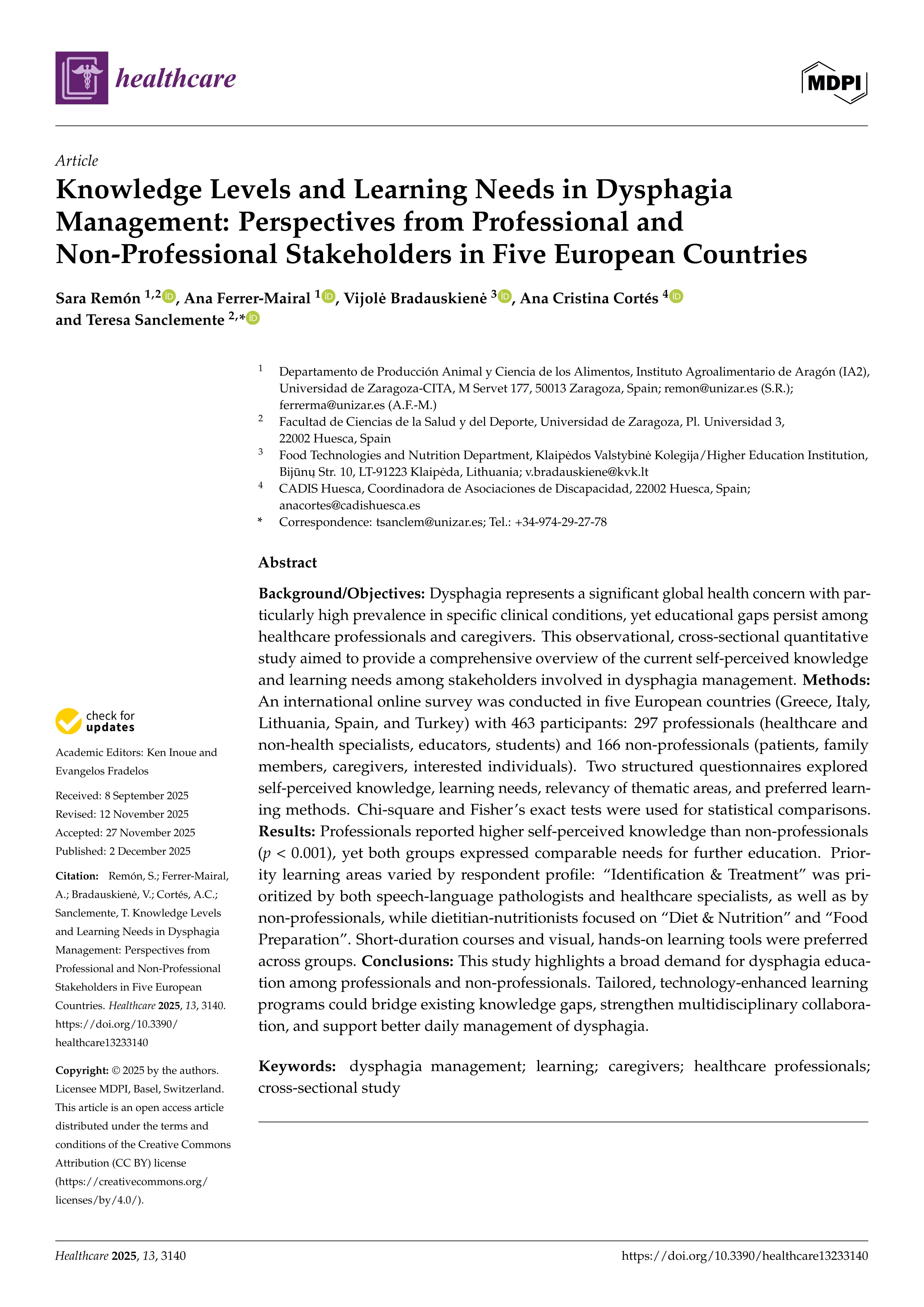
Resumen: Objectives: Dysphagia represents a significant global health concern with particularly high prevalence in specific clinical conditions, yet educational gaps persist among healthcare professionals and caregivers. This observational, cross-sectional quantitative study aimed to provide a comprehensive overview of the current self-perceived knowledge and learning needs among stakeholders involved in dysphagia management.
Methods: An international online survey was conducted in five European countries (Greece, Italy, Lithuania, Spain, and Turkey) with 463 participants: 297 professionals (healthcare and non-health specialists, educators, students) and 166 non-professionals (patients, family members, caregivers, interested individuals). Two structured questionnaires explored self-perceived knowledge, learning needs, relevancy of thematic areas, and preferred learning methods. Chi-square and Fisher’s exact tests were used for statistical comparisons.
Results: Professionals reported higher self-perceived knowledge than non-professionals (p < 0.001), yet both groups expressed comparable needs for further education. Priority learning areas varied by respondent profile: “Identification & Treatment” was prioritized by both speech-language pathologists and healthcare specialists, as well as by non-professionals, while dietitian-nutritionists focused on “Diet & Nutrition” and “Food Preparation”. Short-duration courses and visual, hands-on learning tools were preferred across groups.
Conclusions: This study highlights a broad demand for dysphagia education among professionals and non-professionals. Tailored, technology-enhanced learning programs could bridge existing knowledge gaps, strengthen multidisciplinary collaboration, and support better daily management of dysphagia.
Idioma: Inglés
DOI: 10.3390/healthcare13233140
Año: 2025
Publicado en: Healthcare (Switzerland) 13, 23 (2025), 3140 [18 pp.]
ISSN: 2227-9032
Tipo y forma: Artículo (Versión definitiva)
Área (Departamento): Área Nutrición Bromatología (Dpto. Produc.Animal Cienc.Ali.)
Área (Departamento): Área Tecnología de Alimentos (Dpto. Produc.Animal Cienc.Ali.)
 Debe reconocer adecuadamente la autoría, proporcionar un enlace a la licencia e indicar si se han realizado cambios. Puede hacerlo de cualquier manera razonable, pero no de una manera que sugiera que tiene el apoyo del licenciador o lo recibe por el uso que hace.
Exportado de SIDERAL (2025-12-12-14:43:00)
Visitas y descargas
Methods: An international online survey was conducted in five European countries (Greece, Italy, Lithuania, Spain, and Turkey) with 463 participants: 297 professionals (healthcare and non-health specialists, educators, students) and 166 non-professionals (patients, family members, caregivers, interested individuals). Two structured questionnaires explored self-perceived knowledge, learning needs, relevancy of thematic areas, and preferred learning methods. Chi-square and Fisher’s exact tests were used for statistical comparisons.
Results: Professionals reported higher self-perceived knowledge than non-professionals (p < 0.001), yet both groups expressed comparable needs for further education. Priority learning areas varied by respondent profile: “Identification & Treatment” was prioritized by both speech-language pathologists and healthcare specialists, as well as by non-professionals, while dietitian-nutritionists focused on “Diet & Nutrition” and “Food Preparation”. Short-duration courses and visual, hands-on learning tools were preferred across groups.
Conclusions: This study highlights a broad demand for dysphagia education among professionals and non-professionals. Tailored, technology-enhanced learning programs could bridge existing knowledge gaps, strengthen multidisciplinary collaboration, and support better daily management of dysphagia.
Idioma: Inglés
DOI: 10.3390/healthcare13233140
Año: 2025
Publicado en: Healthcare (Switzerland) 13, 23 (2025), 3140 [18 pp.]
ISSN: 2227-9032
Tipo y forma: Artículo (Versión definitiva)
Área (Departamento): Área Nutrición Bromatología (Dpto. Produc.Animal Cienc.Ali.)
Área (Departamento): Área Tecnología de Alimentos (Dpto. Produc.Animal Cienc.Ali.)
Debe reconocer adecuadamente la autoría, proporcionar un enlace a la licencia e indicar si se han realizado cambios. Puede hacerlo de cualquier manera razonable, pero no de una manera que sugiera que tiene el apoyo del licenciador o lo recibe por el uso que hace. Exportado de SIDERAL (2025-12-12-14:43:00)
Enlace permanente:
Visitas y descargas
Este artículo se encuentra en las siguientes colecciones:
Artículos > Artículos por área > Nutrición y Bromatología
Artículos > Artículos por área > Tecnología de Alimentos
Registro creado el 2025-12-12, última modificación el 2025-12-12