Differential effects of computerized cognitive stimulation versus stimulating leisure activities on mood and global cognition in adults with subjective and mild cognitive impairment: A randomized controlled trial
Gómez-Soria, I. (Universidad de Zaragoza) ; Cuenca-Zaldivar, J. N. ; Oliván-Blázquez, B. (Universidad de Zaragoza) ; Aguilar Latorre, A. (Universidad de Zaragoza) ; Magallón-Botaya, R. M., (Universidad de Zaragoza) ; Calatayud, E. (Universidad de Zaragoza)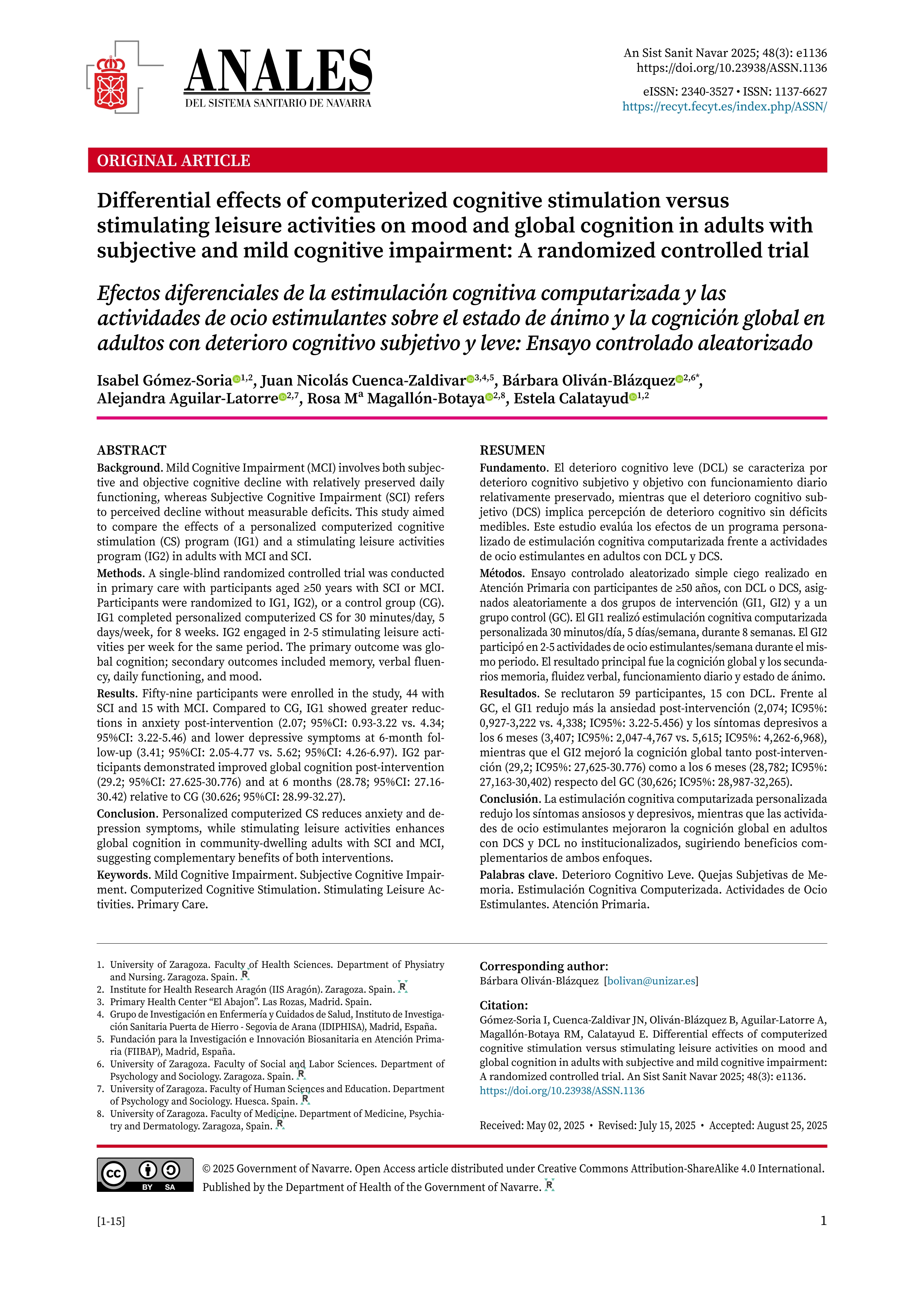
Resumen: Background. Mild Cognitive Impairment (MCI) involves both subjective and objective cognitive decline with relatively preserved daily functioning, whereas Subjective Cognitive Impairment (SCI) refers to perceived decline without measurable deficits. This study aimed to compare the effects of a personalized computerized cognitive stimulation (CS) program (IG1) and a stimulating leisure activities program (IG2) in adults with MCI and SCI. Methods. A single-blind randomized controlled trial was conducted in primary care with participants aged ≥50 years with SCI or MCI. Participants were randomized to IG1, IG2), or a control group (CG). IG1 completed personalized computerized CS for 30 minutes/day, 5 days/week, for 8 weeks. IG2 engaged in 2-5 stimulating leisure activities per week for the same period. The primary outcome was global cognition; secondary outcomes included memory, verbal fluency, daily functioning, and mood. Results. Fifty-nine participants were enrolled in the study, 44 with SCI and 15 with MCI. Compared to CG, IG1 showed greater reductions in anxiety post-intervention (2.07; 95%CI: 0.93-3.22 vs. 4.34; 95%CI: 3.22-5.46) and lower depressive symptoms at 6-month follow-up (3.41; 95%CI: 2.05-4.77 vs. 5.62; 95%CI: 4.26-6.97). IG2 participants demonstrated improved global cognition post-intervention (29.2; 95%CI: 27.625-30.776) and at 6 months (28.78; 95%CI: 27.16- 30.42) relative to CG (30.626; 95%CI: 28.99-32.27). Conclusion. Personalized computerized CS reduces anxiety and depression symptoms, while stimulating leisure activities enhances global cognition in community-dwelling adults with SCI and MCI, suggesting complementary benefits of both interventions. Keywords. Mild Cognitive Impairment. Subjective Cognitive Impairment. Computerized Cognitive Stimulation. Stimulating Leisure Activities. Primary Care
Idioma: Inglés
DOI: 10.23938/ASSN.1136
Año: 2025
Publicado en: Anales del Sistema Sanitario de Navarra 48, 3 (2025), e1136
ISSN: 1137-6627
Financiación: info:eu-repo/grantAgreement/ES/DGA/B21-23R-GAIAP
Tipo y forma: Artículo (Versión definitiva)
Área (Departamento): Área Psicología Social (Dpto. Psicología y Sociología)
Área (Departamento): Area Medicina (Dpto. Medicina, Psiqu. y Derm.)
Área (Departamento): Área Fisioterapia (Dpto. Fisiatría y Enfermería)
Área (Departamento): Área Psicolog.Evolut.Educac (Dpto. Psicología y Sociología)
Exportado de SIDERAL (2026-01-08-14:10:58)
Visitas y descargas
Idioma: Inglés
DOI: 10.23938/ASSN.1136
Año: 2025
Publicado en: Anales del Sistema Sanitario de Navarra 48, 3 (2025), e1136
ISSN: 1137-6627
Financiación: info:eu-repo/grantAgreement/ES/DGA/B21-23R-GAIAP
Tipo y forma: Artículo (Versión definitiva)
Área (Departamento): Área Psicología Social (Dpto. Psicología y Sociología)
Área (Departamento): Area Medicina (Dpto. Medicina, Psiqu. y Derm.)
Área (Departamento): Área Fisioterapia (Dpto. Fisiatría y Enfermería)
Área (Departamento): Área Psicolog.Evolut.Educac (Dpto. Psicología y Sociología)
Exportado de SIDERAL (2026-01-08-14:10:58)
Enlace permanente:
Visitas y descargas
Este artículo se encuentra en las siguientes colecciones:
Artículos > Artículos por área > Psicología Evolutiva y de la Educación
Artículos > Artículos por área > Psicología Social
Artículos > Artículos por área > Fisioterapia
Artículos > Artículos por área > Medicina
Registro creado el 2026-01-08, última modificación el 2026-01-08