Vegetarianism and veganism compared with mental health and cognitive outcomes: a systematic review and meta-analysis
Iguacel, Isabel (Universidad de Zaragoza) ; Huybrechts, Inge ; Moreno, Luis A (Universidad de Zaragoza) ; Michels, Nathalie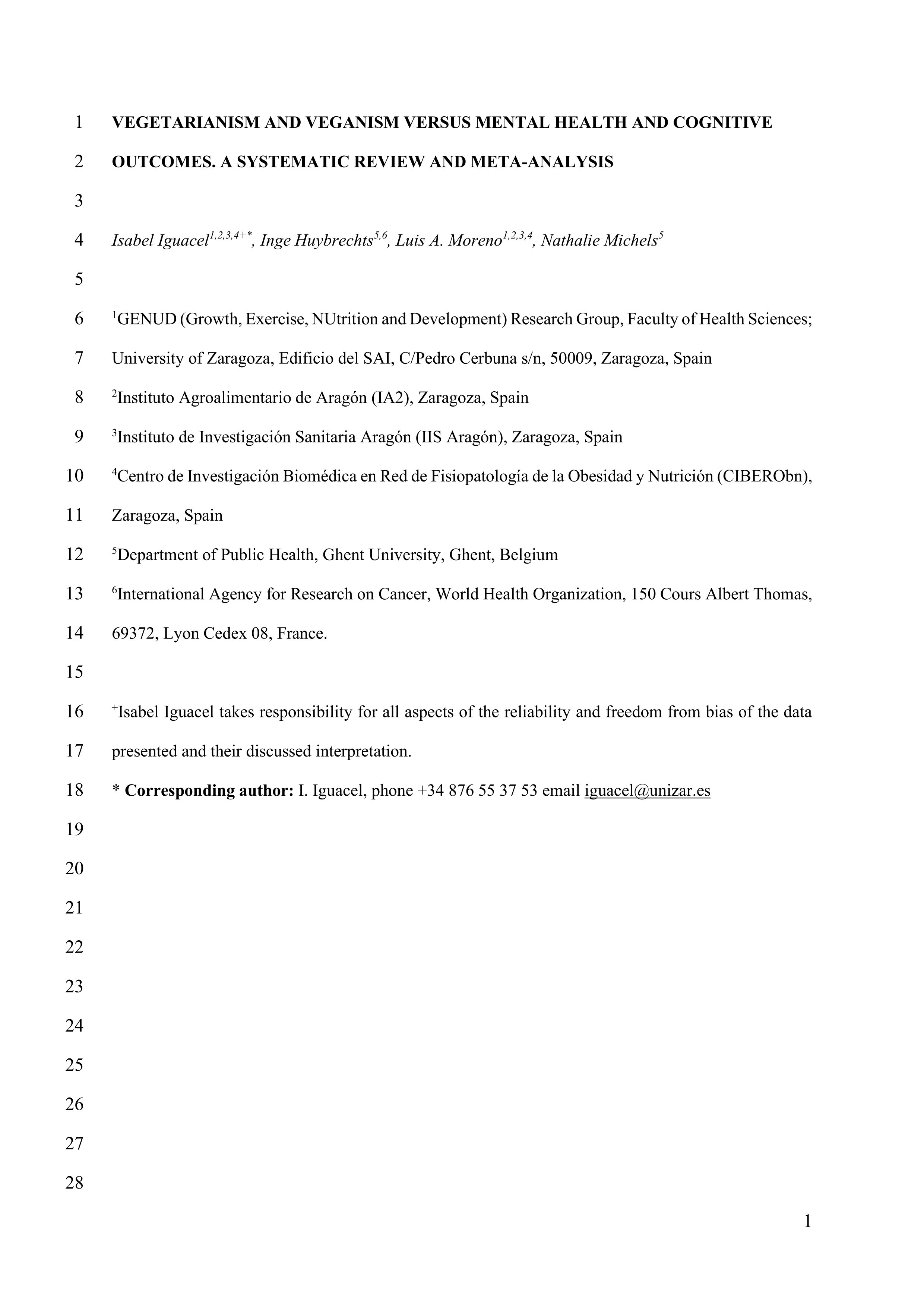
Resumen: Context: Vegetarian and vegan diets are increasing in popularity. Although they provide beneficial health effects, they may also lead to nutritional deficiencies. Cognitive impairment and mental health disorders have a high economic burden.
Objective: A meta-analysis was conducted to examine the relationship between vegan or vegetarian diets and cognitive and mental health.
Data Sources: PubMed, Scopus, ScienceDirect, and Proquest databases were examined from inception to July 2018.
Study Selection: Original observational or interventional human studies of vegan/vegetarian diets were selected independently by 2 authors.
Data Extraction: Raw means and standard deviations were used as continuous outcomes, while numbers of events were used as categorical outcomes.
Results: Of 1249 publications identified, 13 were included, with 17 809 individuals in total. No significant association was found between diet and the continuous depression score, stress, well-being, or cognitive impairment. Vegans/vegetarians were at increased risk for depression (odds ratio = 2.142; 95%CI, 1.105–4.148) and had lower anxiety scores (mean difference = -0.847; 95%CI, -1.677 to -0.018). Heterogeneity was large, and thus subgroup analyses showed numerous differences.
Conclusions: Vegan or vegetarian diets were related to a higher risk of depression and lower anxiety scores, but no differences for other outcomes were found. Subgroup analyses of anxiety showed a higher risk of anxiety, mainly in participants under 26¿years of age and in studies with a higher quality. More studies with better overall quality are needed to make clear positive or negative associations.
Idioma: Inglés
DOI: 10.1093/nutrit/nuaa030
Año: 2021
Publicado en: NUTRITION REVIEWS 79, 4 (2021), 361-381
ISSN: 0029-6643
Factor impacto JCR: 6.846 (2021)
Categ. JCR: NUTRITION & DIETETICS rank: 14 / 90 = 0.156 (2021) - Q1 - T1
Factor impacto CITESCORE: 10.3 - Nursing (Q1) - Medicine (Q1)
Factor impacto SCIMAGO: 1.351 - Nutrition and Dietetics (Q1) - Medicine (miscellaneous) (Q1)
Tipo y forma: Artículo (PostPrint)
Área (Departamento): Área Enfermería (Dpto. Fisiatría y Enfermería)
 Derechos reservados por el editor de la revista
Exportado de SIDERAL (2026-01-19-14:38:42)
Visitas y descargas
Objective: A meta-analysis was conducted to examine the relationship between vegan or vegetarian diets and cognitive and mental health.
Data Sources: PubMed, Scopus, ScienceDirect, and Proquest databases were examined from inception to July 2018.
Study Selection: Original observational or interventional human studies of vegan/vegetarian diets were selected independently by 2 authors.
Data Extraction: Raw means and standard deviations were used as continuous outcomes, while numbers of events were used as categorical outcomes.
Results: Of 1249 publications identified, 13 were included, with 17 809 individuals in total. No significant association was found between diet and the continuous depression score, stress, well-being, or cognitive impairment. Vegans/vegetarians were at increased risk for depression (odds ratio = 2.142; 95%CI, 1.105–4.148) and had lower anxiety scores (mean difference = -0.847; 95%CI, -1.677 to -0.018). Heterogeneity was large, and thus subgroup analyses showed numerous differences.
Conclusions: Vegan or vegetarian diets were related to a higher risk of depression and lower anxiety scores, but no differences for other outcomes were found. Subgroup analyses of anxiety showed a higher risk of anxiety, mainly in participants under 26¿years of age and in studies with a higher quality. More studies with better overall quality are needed to make clear positive or negative associations.
Idioma: Inglés
DOI: 10.1093/nutrit/nuaa030
Año: 2021
Publicado en: NUTRITION REVIEWS 79, 4 (2021), 361-381
ISSN: 0029-6643
Factor impacto JCR: 6.846 (2021)
Categ. JCR: NUTRITION & DIETETICS rank: 14 / 90 = 0.156 (2021) - Q1 - T1
Factor impacto CITESCORE: 10.3 - Nursing (Q1) - Medicine (Q1)
Factor impacto SCIMAGO: 1.351 - Nutrition and Dietetics (Q1) - Medicine (miscellaneous) (Q1)
Tipo y forma: Artículo (PostPrint)
Área (Departamento): Área Enfermería (Dpto. Fisiatría y Enfermería)
Derechos reservados por el editor de la revistaExportado de SIDERAL (2026-01-19-14:38:42)
Enlace permanente:
Visitas y descargas
Este artículo se encuentra en las siguientes colecciones:
Artículos > Artículos por área > Enfermería
Registro creado el 2026-01-19, última modificación el 2026-01-19